Monday, April 9, 2012

Finished? Finished? Finished!

"Is it finished?"

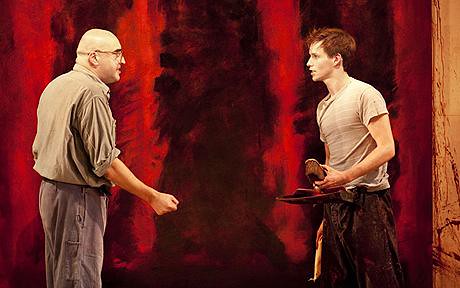
That is one of the hardest questions an artist often has to answer, not only to a random bystander, by to himself as well.  This happen can happen to great masters, as shown in the play "Red", when Mark Rothko struggled to understand where his paintings stand and if they were not completed, what went missing.  Admittedly, it was a fictional account of Rothko's life, but it rang absolutely true.

As for me, it had happened many times.  Sometimes, the dissatisfaction could take place several years after  the "completion", or just few hours after the apparent completion.

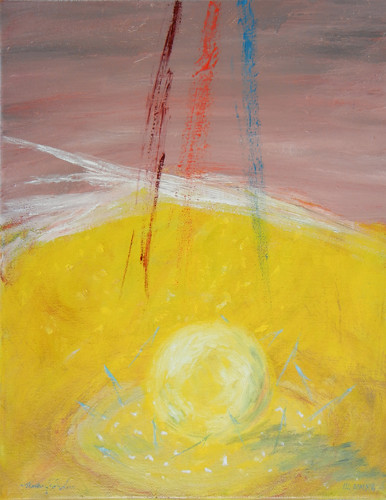
Recently, I completed an oil painting - Orestes, which was another abstract rendering on the theme of a well-known Greek tragedy.

I saw Orestes as a bunch of white lights, emerging from dark elements, the purple and black paints, which signify the unrelenting furies.  On the top right of the canvas, I used some lightly applied yellow stokes to indicate the purity and light Orestes tried to achieve, or the wisdom of the god and goddess.  Happily, I signed my name on the canvas.  Fin!
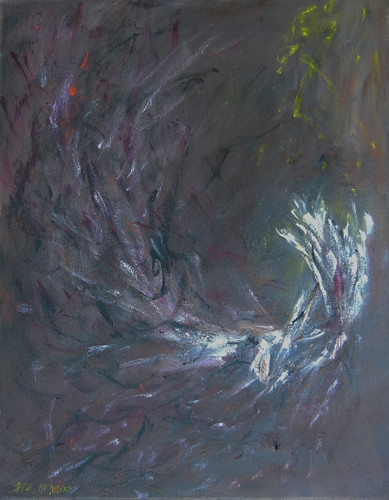
Orestes _ Final Stage 1 _ 8250 500

When I photograph this piece, I became less happy with those yellow stokes and decided to balance them with some light blue paints, and incidentally, I could use them to differentiate Apollo and Athena.  Once more, I believed that the painting was finished.
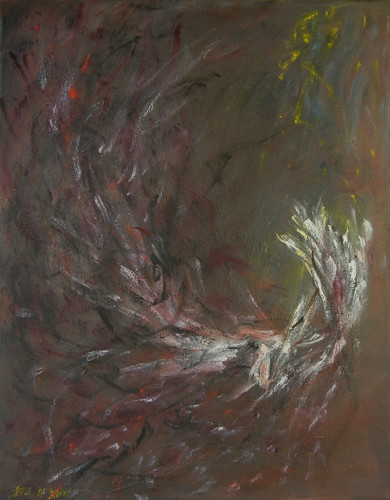
Orestes _ Final Stage 2 _  8262 500

A few hours later, I felt dissatisfied again.  This time, it was those white paints annoyed me.  The trajectory was wrong. I bent them over a little bit, towards the right, meeting the yellow and blue streaks head on.  I also added scattered white drips, to indicate more sense of motion and struggle.  Finally, it was really finished.

Orestes
Orestes 
Oil on Canvas
14" x 11" 


Matthew Felix Sun's Paintings Completed in 2012 by Matthew Felix Sun photoset

Saturday, April 7, 2012

My Favorite Works at Palazzo Medici Riccardi, Firenze, Italia

The High Renaissance palace in Florence, Palazzo Medici Riccardi, near the Duomo, was another landmark in this bejeweled city.  It was a residence for Medice then Riccardi clans.  I remember that I walked by it everyday during my stay in Florence, since my hotel was just a few doors down.

The palace had many treasures, itself included, befitting to the exalted status of the ruling Medici family.  The most unforgettable paintings in the palace was the fresco cycle in the Cappella dei Magi, (the Magi Chapel) by the Renaissance master Benozzo Gozzoli, painted in 1459-1461.  They were colorful and vibrant, and the figures were much idealized and stylized.  The impressive retinue of the Magi were like toy soldiers yet they were not ridiculous but endearing.  This was a chapel for the people who still have treasured memory of a wonderful childhood.


Cappella dei Magi, vedute generali


Eastern Wall, the procession of the Magi

The procession of the Magi on the eastern wall, easily commanded my attention, which was led by Caspar, the youngest Magus on a magnificent white horse.  Caspar, young and ethereal beautiful, gazed upon viewers unflinchingly and once one looked into his eyes, it was hard to shift from that thoughtful gaze. This figure was alleged to be a portrait of Lorenzo il Magnifico.


East Wall, Caspar, the youngest Magus - alleged portrait of Lorenzo il Magnifico

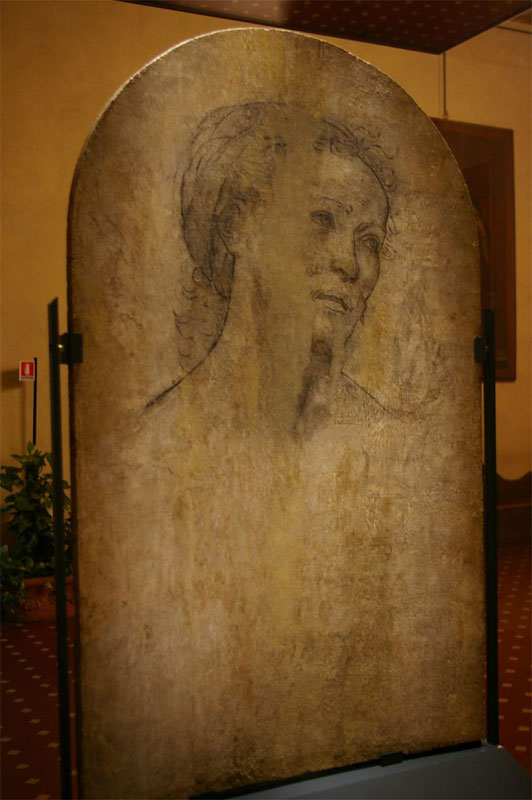
After such sumptuous visual feast, I was glad to encounter something very plain and austere - a drawing by Fra Filippo Lippi - on the reverse side of his painting: Madonna and Child.  That painting was accomplished and with his usual beauty yet it was this monochromatic drawing commanded attention.  This drawing, for some reason, had been referred to as a woman with a moustache.  With or without a moustache, she was full of grace.  His three-quarter profile revealed her to be a woman full of feelings and emotions.  Her eyes, gazing upwards, were almost in tears.  The line drawing was delicate and precise.  The modeling of the head full.  With a few economic and assured strokes, Lippi gave us a great compassionate interceder. 


My Favorite Museum Collection Series

>> My Favorite Museum Collection Series 25: My Favorite Artworks at Cappelle Medicee, San Lorenzo, Firenze
<< My Favorite Museum Collection Series 23: My Favorite Frescoes at Santa Croce, Firenze


List of My Favorite Artworks in the Museums I've Visited

Thursday, April 5, 2012

Mark Rothko and "Red" at Berkeley Repertory Theatre


Last week, I saw the wonderful production of John Logan's award winning play, "Red", at Berkeley Repertory Theatre's, and was deeply impressed and moved by the presentation of the struggle of the great Latvian-American (sometimes referred to as Russian-American) abstract painter Mark Rothko, born Marcus Rothkowitz (Latvia (Dvinsk, [now Daugavpils], Latvia, September 25, 1903 - February 25, 1970, New York City, New York), while interacting, scolding, tutoring his young assistant.  Berkeley Rep's website described the play as such:
At the height of his fame, Mark Rothko struggles in his studio to finish a major series of murals. The brilliant master wrestles with his new apprentice in a battle of wits over a bucket of paint.
The play  was very intense and witty and there were many things to savor.

First, I was most impressed by the philosophy behind Rothko's approach to art.  He insisted on that a person had to be civilized to become an artist.  That mantra was definitely a rebuke to our era when every trivial object, every thoughtless person could style himself as an artist.  His disdain for the pop art scene, though too severe, was not without merit.  Capturing zeitgeist was not unimportant, but true art needs to build beyond the mere reflection.

The depiction of Rothko's struggle - a great man's tussling with mundane life and to secure and preserve his posterity, his relevancy - was also well managed though a bit conveniently constructed.

Another main theme of the play - invented by the playwright - respect but bury the fathers, gave the play an air of a Greek tragedy.  Speaking of tragedy, I was not very convince by the device in the form of the assistant's family tragedy; however, it didn't bother me and both actors, being so immersed in their challenging roles, ensured that even as a device, it was integral facade of the play.

There was a very physical scene, when Rothko and his assistant primed a huge canvas, to the beats of the energetic symphonic music.  Paints spattered everywhere and I felt that at that moment, I was feeling the pulse of a great artist.  It was very gratifying to see his painting process, even though it was only the initial step.  If his energetic action here could be seen as joyous, when he faced more advanced canvas, at times, he was obviously struggling and that was precisely why his works were moving.  He wanted to present some ideas, some visions, instead of doing it for his own pleasure and meditation.

Though the actors were very physically active, the supremacy of the play was the words, which made this play an oasis after a spate of over-produced, hyper-kinetic productions.  It was through words, uttered with great intensity and clarity, that we peeped into the innermost of Rothko.

Living in the San Francisco Bay Area, I have been able to see Rothko's works many times, in Oakland Museum of California, Berkeley Art Museum, and San Francisco Museum of Modern Art (SFMOMA).

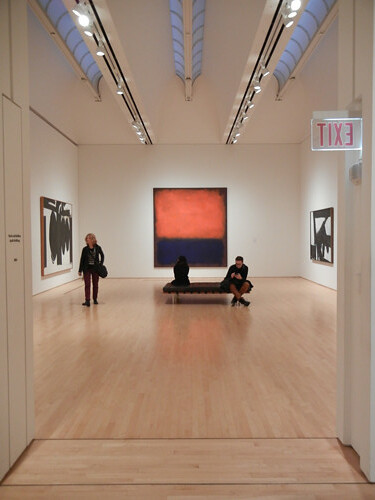
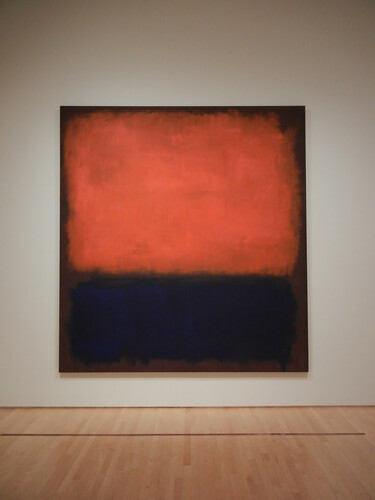
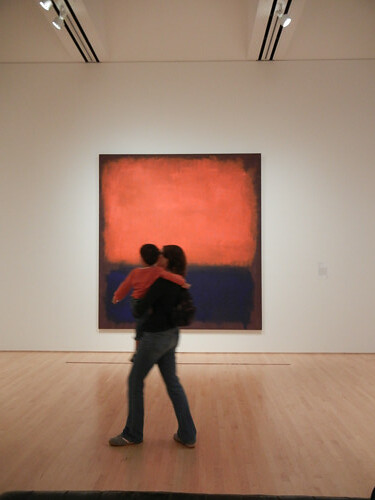
Below are a series of pictures I took at SFMOMA, in front of Rothko's "No. 14, 1960", 1960, Oil on Canvas, 114 1/2 in. x 105 5/8 in. (290.83 cm x 268.29 cm).  It is deceptively simply yet rich with sub-contents.  Its palette is delightful.  It's both monumental huge and invitingly intimate, even a child loved it:

No. 14, Mark Rothko, 1960, Oil on Canvas, SFMOMA _ 9637

No. 14, Mark Rothko, 1960, Oil on Canvas, SFMOMA _ 9642

No. 14, Mark Rothko, 1960, Oil on Canvas, SFMOMA _ 9640

Below are a couple of images from this play's Tony-winning New York City run:

Alfred Molina and Eddie Redmayne in Red at the Donmar Warehouse

Mark Rothko in Red

Tuesday, April 3, 2012

Oil Painting "Oedipus" Completed

Continuing my abstraction of well-known Greek tragedies, I completed an oil painting "Oedipus".  For this most wrenching story, I incorporated several important elements of his life into this rather subdued rendering of this very dramatic and intense story.

The colors I used were mostly subdued and pale, in order to counterbalance the overwrought and sensational story I was trying to present.  The footprints, the thorns, snow-capped mountain, the crossroads, and the scarfs, framed the round and sad face of Oedipus, whose bleeding eyes and screaming mouth further repeated the round shape of his rather blank face.

I came to the final composition fairly easily, except for the details around the crossroads which at the beginning was too much detailed and was in conflict with the overall style and only after obscuring the definitions of some objects, I managed to a better balance.

Oedipus / 俄狄浦斯 / Ödipus


Matthew Felix Sun's Paintings Completed in 2012 by Matthew Felix Sun photoset

Sunday, April 1, 2012

My Favorite Frescoes at Santa Croce, Firenze

Basilica of Santa Croce in Florence, built in the 13th century, boasted of many early frescoes by Agnolo Gaddi, Taddeo Gaddi and Giotto (Giotto di Bondone).

Giotto, who emerged from the medieval tradition and ushered in the Renaissance spirit in Italy with his increasingly naturalistic approaches, had a large presence in Santa Croce.  Amongst the many frescoes by him and other masters, it was difficult to pick favorites, yet choose I must.

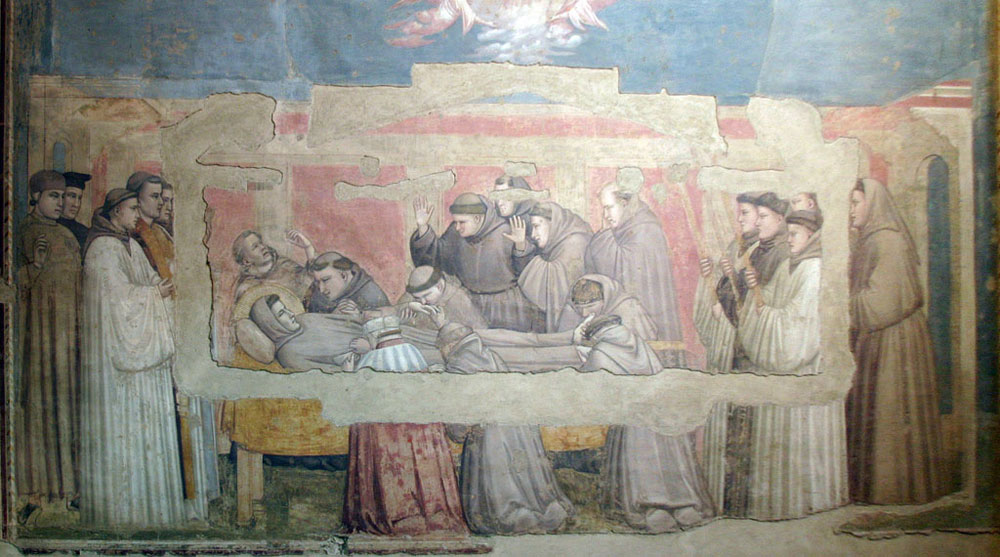
For the top choice, I'll choose "The Death of St. Francis" in Bardi Chapel, as part of the cycle on "The Life of St. Francis". 

This death scene, appropriately somber, was intense yet restrained, with amazingly beautiful hues on the sky, the background, the bed and the robe of a high prelate or a prince. The facial expressions on the mourning people vivid but dignified.  The harmony of these pale yet vibrant colors was like the Renaissance polyphony, soaring, comforting and otherworldly.  This picture was almost too beautiful for a death scene.


The Death of St. Francis
Giotto
Bardi Chapel, Basilica of Santa Croce

The second pick of mine went to another piece of this cycle - "Apparition at Arles". The story was that one day, when St. Anthony of Padua was preaching in the chapter house at Arles, St. Francis miraculously appeared.

Here, Giotto presented us a group portrait in a composition quite similar to the later, more renown masterpiece - the Last Supper by Leonardo da Vinci in Milan - the crowd sat in a horizontal file, while in the middle of the row, larger than life, St. Francis floated in the mid air and caused amazement amongst the people, except for one brother who perhaps had dozed off.  St. Anthony, calmly faced St. Francis, anchoring the left side of the picture, together with the sitting people below, they formed a rough pyramid, adding more of the classic air to the picture.  The figures here were more in the line drawing form, with delicately outlined faces, particularly that of St. Francis, quite like the later works by Fra Angelico and Botticelli.  The earth-colored robes echoed the rusty hued roof tiles, and the marble tile on the foreground.  Subtly, pale wash of green and blue accented the painting and created a subtle yet rich fabric for this scene, frozen in time.


Scenes from the Life of Saint Francis: 3. Apparition at Arles 1325
Giotto
Bardi Chapel, Basilica of Santa Croce


My Favorite Museum Collection Series

>> My Favorite Museum Collection Series 24: My Favorite Works at Palazzo Medici Riccardi, Firenze, Italia
<< My Favorite Museum Collection Series 22:  My Favorite Sculptures at Loggia dei Lanzi (Loggia della Signoria), Firenze


List of My Favorite Artworks in the Museums I've Visited

Friday, March 30, 2012

"Paris and Three Goddesses" in Oil

A couple weeks ago, I posted my pastel drawing of Paris and Three Goddesses, together with the oil painting of "Helen of Troy", my small series of presenting familiar Greek tragedies in semi-abstract fashion.

Now, my oil version of this Paris is completed, which though has the same composition and color palette, but has definitely somewhat different finish - brighter, richer and more sensual, perhaps if I have done more of pastel, I could accomplish more with that medium:

Paris and Three Goddesses / 帕里斯和三位女神 / Paris und drei Göttinnen
Paris and Three Goddesses
Oil on Canvas
14" x 11"

Below is the Pastel version:

Paris and Three Goddesses / 帕里斯和三位女神 / Paris und drei Göttinnen
Paris and Three Goddesses
Pastel on Paper


Matthew Felix Sun's Paintings Completed in 2012 by Matthew Felix Sun photoset