Sunday, November 27, 2016

My Favorite Paintings at Yale University Art Gallery

Yale University Art Gallery's art collection had an amazing depth, whose collections dated back to the antiquities, but the paintings impressed me most were modern works.

My favorite was an Edward Hopper, Rooms by the Sea (1951), which, in contrast to his usual gloomy and enclosed settings, was surprisingly sunny and airy, though not without some uncertainty and vulnerability. The beautiful shaded green and yellow floor contrasted wonderfully with brilliant blue sky and lapping waves see through huge openings of the house, which cast bright geometrical shapes on the walls and floor, and those window sand sunshine created many focal points and they echoed one another through the canvas. A dash of red sofa and brown dresser, seen at the edge of the painting, anchored the sharp angled composition, and balanced the large sun spot and the open sea at the right edge of the canvas.
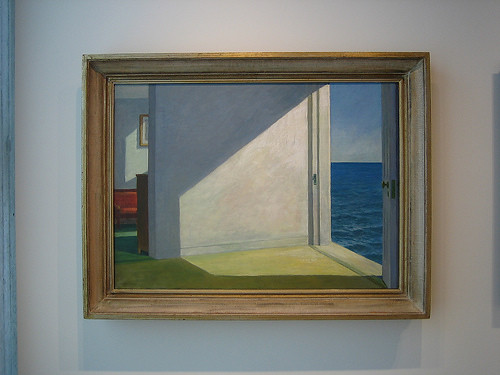
Rooms by the Sea, 1951, Edward Hopper _7742
Rooms by the Sea, 1951, Edward Hopper

My second favorite was Die Ungeborenen (The Unborn) (2001) by Anselm Kiefer, in his usual monochromatic fashion, and the media were again, consisted of paint, plants, and perhaps metal cutout dresses, all his usual media and motifs. Over the dark, though not overwhelmingly gloomy background, a delicate, broken plant floated in the center, with several very small dresses hung on its extended branches at varying heights. The message was not very clear, even aided with the title; perhaps, those dresses symbolized some tragically unborn children, and that made this dark, yet very delicate painting very touching and poignant.
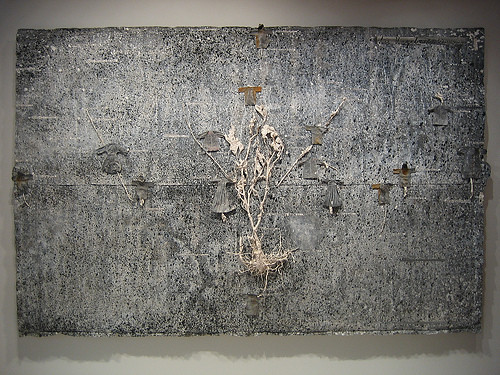
Die Ungeborenen (The Unborn), 2001, Anselm Kiefer _7747
Die Ungeborenen (The Unborn), 2001, Anselm Kiefer


My Favorite Museum Collection Series
>> My Favorite Museum Collection Series 152: My Favorite Paintings at J. Paul Getty Museum - Getty Center, Los Angeles
<< My Favorite Museum Collection Series 150: My Favorite Paintings at Oakland Museum of California

List of My Favorite Artworks in the Museums I've Visited

Other Related posts on Art · 文化 · Kunst:
- Museum of Modern Art (MOMA), New York City 
- "The Steins Collect" Exhibit in San Francisco Museum of Modern Art (SFMOMA)
- Art in Subway Station, New York City
- Neue Galerie New York - Austrian and German Art Gallery
- Barry McGee Mural, Soho, New York 2010
- Arslan: In the Midst of a Single Breath - Dillon Gallery, New York

Thursday, November 24, 2016

Featured Installation - Wilting Flowers


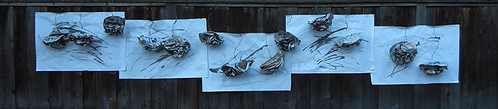
Recently I created an installation Wilting Flowers and fully documented the creation and installation processes.


This new effort was spurred by my continued fascination with paper material – delicate, malleable, and transitory, characteristics well suited for hinting at, versus representing, a world full of fragility and vulnerability, constantly under the threat of total destruction.

My local newspaper, “The San Francisco Chronicle”, served as the foundation: a segment of our time, distilled and encapsulated. Inky strokes and splashes were added to the newspaper sheets, which were folded and tied up to form large flowers, with aluminum wires wrapped with dyed twine as stems.
For the background, I chose five sheets of plain white paper, streaked with similar black strokes of ink diluted with various amount of water.

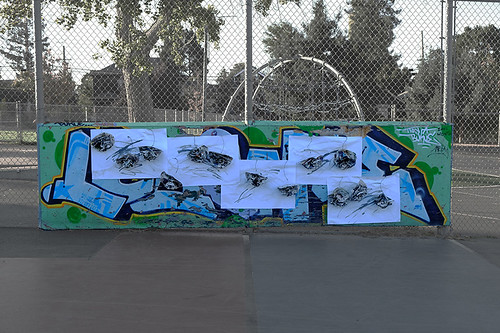
To install, I attached these background paper to a wall in an uneven row, then affixed those flowers, 13 total, to those sheets. There were no strict rules about how to lay out the background sheets and flowers, as long as the finished installation looked balanced, and the flowers largely faced outwards.

I have installed these sheets and flowers on different surfaces – a colorful graffitied plywood wall, or somber looking wooden fences, at different times of the day. The differences between the surfaces, the different light cast on the wall or fence, background sheets and paper flowers, all contributed to a murmuring polyphony.

 Wilted Lowers Installation _ DSCN4040 - modified - 800px
Wilting Flowers

Ink on paper and newspaper, aluminum wire, cotton string
40" x 140" x 5"
Completed in 2016

Wilting Flowers / 凋萎的花卉 / Wilting Blumen


Originally posted on matthewfelixsun.com

Other Related posts on Art · 文化 · Kunst:
- Featured Painting – “Forest Within” – When Reality Met Illusion
- Featured Painting: The March of Time
- My Featured Painting "Minotaur"
- Featured Painting "Progression"
- A New Installation - Chairs Installation, November 2012
- Stringed White Dresses - The Process of a New Installation
- "Intrude", Wonderful Rabbits Installation in San Francisco

Monday, November 21, 2016

My Favorite Paintings at Oakland Museum of California

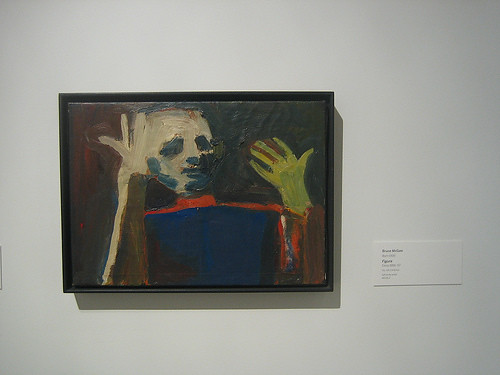
Oakland Museum of California has many wonderful oil paintings created by Californian artists in the middle of 20th century. The best example was Bruce McGaw's Figure (c. 1956-57), a portrait of a strangely lit bust, whose held up and inward facing hands were both awkward and eloquent, and it was quite a challenge to determine the spatial relationship between those arms and his eerie looking face. The pale tan face and right hand, interrupted by dark shadow of his featured, and framed by dark background, gave him a ghostly look, which was reinforced by the greenish tone on his left hand. A small patch of red on his left sleeve, and a thin stripe of red on his collar and shoulder over the navy blue uniform, added exciting notes to this muted monologue.

Figure, c. 1956-57, Oil on Canvas, Bruce McGaw, Oakland Museum of California _ 9486
Figure, c. 1956-57, Oil on Canvas, Bruce McGaw

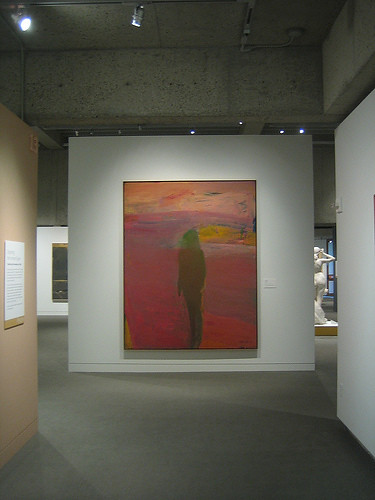
My second favorite was Spring Nude (1962) by Nathan Oliveira. This painting had layers upon layers of paints, and the effect of the interplay of visible paints from various layers were thrilling. In the middle of the canvas, superimposed amidst these layers of red, pink, purple, blue, yellow and green hues, was a dark silhouette of a figure, which could be either a man or a woman, either frontal or rear view, and this addition completely changed the outlook of this otherwise abstract work, and the patterns of the background became a fantastically colored beach, and the painting became an evocative figure study in an unusual, almost mythic setting.

Spring Nude, 1962, Oil on Canvas, Nathan Oliveira, Oakland Museum of California _ 9491
Spring Nude, 1962, Oil on Canvas, Nathan Oliveira

My Favorite Museum Collection Series
>> My Favorite Museum Collection Series 151: My Favorite Paintings at Yale University Art Gallery
<< My Favorite Museum Collection Series 149: My Favorite Paintings at Anderson Collection at Stanford University

List of My Favorite Artworks in the Museums I've Visited

Other Related posts on Art · 文化 · Kunst:
- Pixar Exhibit and Newly Renovated Oakland Museum of California
- Opening of "Free Art" at Pro Arts Gallery, Oakland
- Free Art at Pro Arts Gallery, Oakland
- Architectural Wonder - the Cathedral of Christ the Light in Oakland
- Driving on the New East Span of San Francisco Bay Bridge

Friday, November 18, 2016

My Favorite Paintings at Anderson Collection at Stanford University

Anderson Collection at Stanford University was built to showcase an Anderson family's modern art collection.

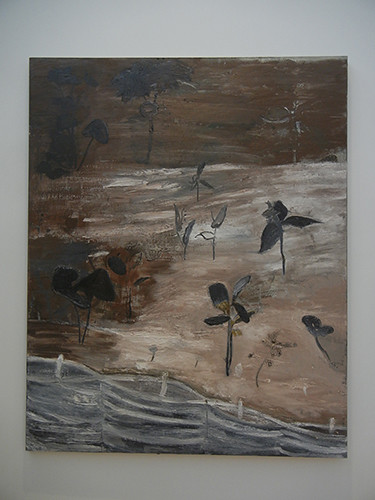
I found Theophrastus' Garden (1982) by Terry Winters very enchanting. This ethereal garden, in pleasing shades of burnt umber and blended and mingled with white tint, was at the same time earthy, solid, airy, and unreal. The strange, insect-looking flora, in shades of steely blue, scattered around into the depth, like the dispersing dandelion seeds, animated this fenced in paradise.

DSCN9139 _ Theophrastus' Garden, 1982, Terry Winters, Anderson Collection
Theophrastus' Garden, 1982, Terry Winters

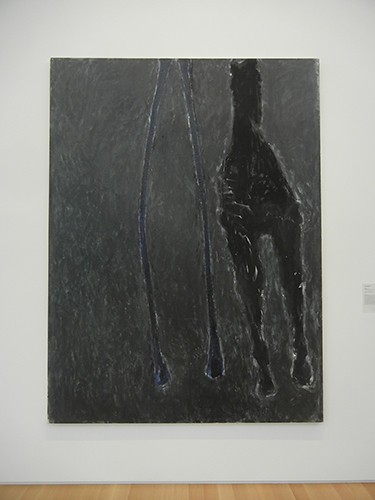
Another favorite of mine was a monochromatic, semi-abstract parting by Susan Rothenberg, Wishbone (1979). In the center of the motley black canvas, "stood" an elongated blue black wishbone, a forked bone (the furcula) between the neck and breast of a bird, often chicken from our tables. To its right, a lean horse, in charcoal black shade, occupied the right one-third of the canvas. The shape of the horse, viewed absolutely frontal, seen only it's head, triangle-shaped torso, and two legs, echoed that of the wishbone, or could be its filled-out shadow. The meaning of this painting was quite opaque. Perhaps, the swift horse, might be the agent to accomplish one's wish? Though employed almost only one color, Rothenberg managed to created a world full of shifting changes of shades and moods, and charged with vigor and emotion.

DSCN9146 _ Wishbone, 1979, Susan Rothenberg, Anderson Collection
Wishbone, 1979, Susan Rothenberg

My Favorite Museum Collection Series
>> My Favorite Museum Collection Series 150: My Favorite Paintings at Oakland Museum of California
<< My Favorite Museum Collection Series 148: My Favorite Paintings at Iris & B. Gerald Cantor Center for Visual Arts at Stanford University

List of My Favorite Artworks in the Museums I've Visited

Other Related posts on Art · 文化 · Kunst:
- Anderson Collection at Stanford University
- Paintings at Cantor Arts Center, Stanford University
- Rodin and Richard Serra in Cantor Arts Center, Stanford University
- Inside Richard Serra's Sculpture "Sequence" at Cantor Arts Center, Stanford University
- Auguste Rodin at Cantor Arts Center, Stanford University
- Andy Goldsworthy's Stone River in a Lush Setting
- Four Chinese Masters's Works at Cantor Arts Center, Stanford University
- Second Thoughts on the Sculpture "The Blind" by Lorado Taft
- Richard Serra Drawing and 2010 SECA Art Award at SFMOMA
- My Favorite Sculptures at Institut für Klassische Archäologie, Karl-Franzens-Universität Graz

Tuesday, November 15, 2016

My Favorite Paintings at Iris & B. Gerald Cantor Center for Visual Arts at Stanford University

Iris & B. Gerald Cantor Center for Visual Arts at Stanford University was known for its amazing Rodin sculpture collections, but its painting collections were also remarkable.

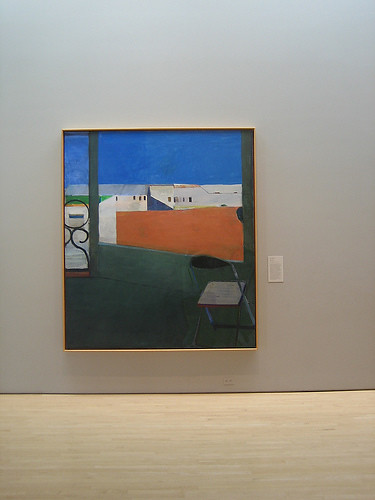
My favorite was a semi-abstract by Richard Diebenkorn, titled Window. This painting was striking in its bold division of the canvas into several flat areas of brilliantly contrasting colors - bright blue, neutral orange and muted green, plus a narrow stretch of varying gray. Some details of depicted objects, large or small, helped to break otherwise monotonousness of each area, and artfully joined them together. The painting also drew viewers in with its many shapes and forms, and enigmatic relationships of planes, and trickery of view points. Those objects, seemingly readily identifiable, but upon closer examination, tended to shift away from the initial impressions. This painting's evocative atmosphere, intriguing composition, and strategic placement of objects, reminded me of mature Matisse in similar interior/exterior setting. This painting was exemplary in both representational and abstract worlds.

Window, Richard Diebenkorn _ 1887
Window, Richard Diebenkorn

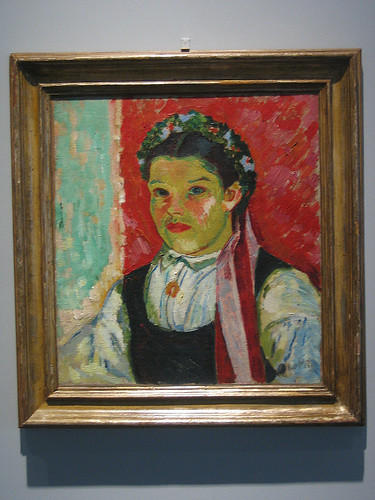
My second favorite was a portrait by Max Pechstein, Kurish Bride, I.  This was a boldly outlined and modeled portrait of a lovely young woman, in a simple black and white dress or blouse, adorned with wildflower garland and red and pink scarf, high-cheeked and wide eyed, solid yet sensual, sedated yet hopeful, and almost joyous. One particularly striking aspect was that her face was painted in unnatural and even sickly green, but it complimented well of her dark eyes, ruddy cheeks and scarlet lips. Furthermore, against deep red backdrop, and offset by pale green over light brown, the colors clashed dramatically and excitingly, and made her face commend all the attention. The large area of red background echoed and contrasted her ruddy cheeks and scarlet lips, and the scarf, thus firmly connected to the central figure. A riotously outburst of colors and emotions.

Kurish Bride, I, Max Pechstein _ 1909
Kurish Bride, I, Max Pechstein


My Favorite Museum Collection Series
>> My Favorite Museum Collection Series 149: My Favorite Paintings at Anderson Collection at Stanford University
<< My Favorite Museum Collection Series 147: My Favorite Engravings at Seattle Art Museum

List of My Favorite Artworks in the Museums I've Visited

Other Related posts on Art · 文化 · Kunst:
- Anderson Collection at Stanford University
- Paintings at Cantor Arts Center, Stanford University
- Rodin and Richard Serra in Cantor Arts Center, Stanford University
- Inside Richard Serra's Sculpture "Sequence" at Cantor Arts Center, Stanford University
- Auguste Rodin at Cantor Arts Center, Stanford University
- Andy Goldsworthy's Stone River in a Lush Setting
- Four Chinese Masters's Works at Cantor Arts Center, Stanford University
- Second Thoughts on the Sculpture "The Blind" by Lorado Taft
- Richard Serra Drawing and 2010 SECA Art Award at SFMOMA
- My Favorite Sculptures at Institut für Klassische Archäologie, Karl-Franzens-Universität Graz

Friday, November 11, 2016

My Favorite Engravings at Seattle Art Museum

What impressed me most in Seattle Art Museum were two amazing engravings, both by the great German artist Albrecht Dürer (1471-1528).

The first was titled Ritter, Tod und Teufel (Knight, Death and Devil) (1513). This allegorical piece zoomed in on a weary-looking knight amounting a sturdy steed, accompanied by two goat-like strange creatures, one on an exhausted horse to the knight's right — Death, identifiable by the hourglass in his hand reminding the knight of the shortness of life, and the other one following behind on foot, even more hideous looking than Death — the Devil, joining in hearty taunting. Underneath the knight's horse, a hound resolutely ran along on that narrow range of a waste land, as steadfast as the master, who maintained his proud posture and stony countenance in the company of danger, could be seen either as symbol of courage, or foolhardiness.

Dürer's technical virtuosity was astounding, not only in the tense subject and well-planned composition, but particularly also in many fine details, such as the majestic muscles and shining pelt of the horse, the menacing cliffs pressing on the travelers, and the castles seen through barren branches atop the jagged ridge, all through flowing lines, endlessly varied types of fine hatching, the subtle modulations of light and shadow, and the absolute confidence in rendering of minutiae details.

Knight, Death and the Devil
Albrecht Dürer [Public domain], via Wikimedia Commons
Ritter, Tod und Teufel (Knight, Death and Devil), 1513, Albrecht Dürer, 1471-1528

The second Dürer was Das Meerwunder (The Sea Monster, or The Sea Wonder), ca. 1498. This engraving depicted a naked maiden, lying on the back of a scaled creature with human head and fish body, being led or dragged away from shore into broad water body, though it was curiously narrow, more an estuary than an open sea. The background featured a steep hill and a castle on top, and a grander castle at the foot of the hill, just above the shore, onto which maidens clambered several naked in great haste, ostensibly fleeing from danger, the sea monster, and nearby, an old man gesticulating his alarm, next to a collapsed woman lamenting on the ground.

Despite all the drama on the distant shore, the central figures, both the sea creature and the abducted maiden, were rather curiously calm and almost nonchalant save for a few traces of sadness, resignation, and slight distress on the maiden's face, which was in turn betrayed by her body's eloquent pose in a reclined pose often associated with voluptuous and seductive Venus. This contradiction created a fascinating though somewhat sad enigma.

Comparing to the dark tone of Knight piece, this one was much brighter, almost ironically sunny, dominated by more white space due to far less hatching, and result was airy and quite suitable to the sea setting, though no necessarily the obviously disturbing story. These main figures and landscape though were no less three-dimensional, due to energetic and graceful lines, and subtle suggestions of shades and volumes, as in a very fine line drawing. 

Albrecht Dürer - Sea Monster (Das Meerwunder) (NGA 1943.3.3483)
Das Meerwunder (The Sea Monster, or The Sea Wonder), ca. 1498, Albrecht Dürer
Albrecht Dürer [Public domain], via Wikimedia Commons


My Favorite Museum Collection Series
>> My Favorite Museum Collection Series 148: My Favorite Paintings at Iris & B. Gerald Cantor Center for Visual Arts at Stanford University
<< My Favorite Museum Collection Series 146: My Favorite Artifacts in Phoebe A. Hearst Anthropology Museum, UC Berkeley

List of My Favorite Artworks in the Museums I've Visited

Other Related posts on Art · 文化 · Kunst:
- Crescat Graffiti, Vita Excolatur by Quinn Dombrowski
- My Favorite Paintings at Musée Marmottan Monet
- Museum of Modern Art (MOMA), New York City
- Max Beckmann's Paintings in MOMA and MET
- Gustav Klimt and Egon Schiele in Wien (Vienna)