Showing posts with label Poetry. Show all posts

Wednesday, November 1, 2017

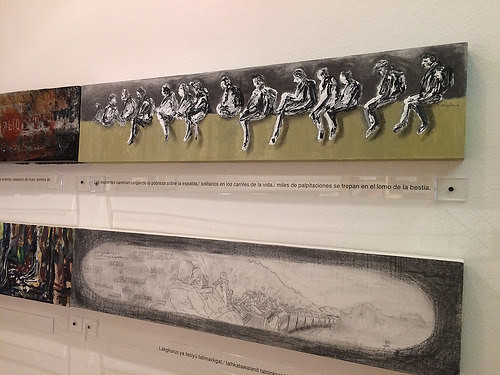
MONTARlaBestia (Riding the Beast) Exhibition, Center for Latin American Studies, UC Berkeley


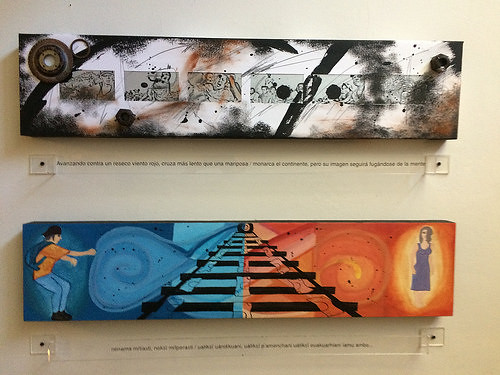
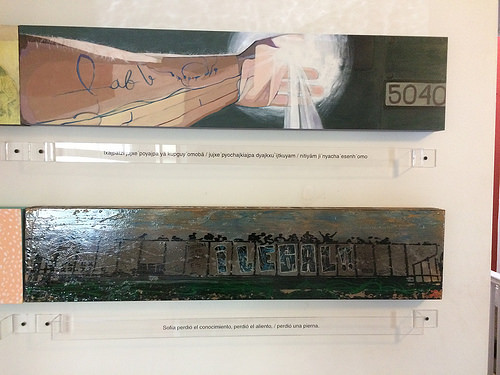
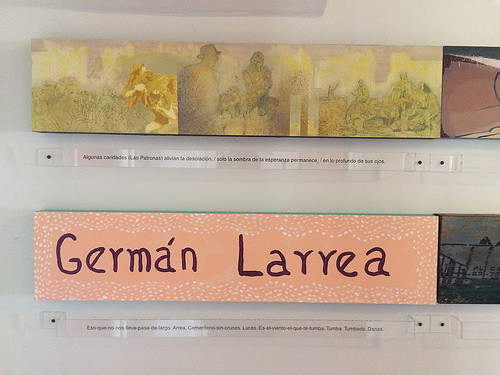
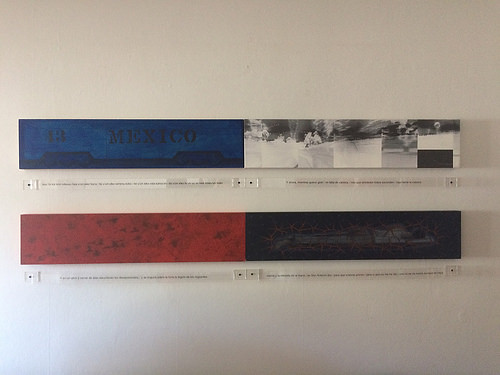
IMG_4855 - MONTARlaBestia (Riding the Beast), Center for Latin American Studies, UC Berkeley

IMG_4854 - MONTARlaBestia (Riding the Beast), Center for Latin American Studies, UC Berkeley

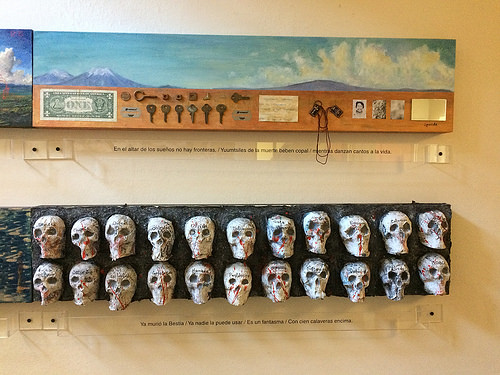
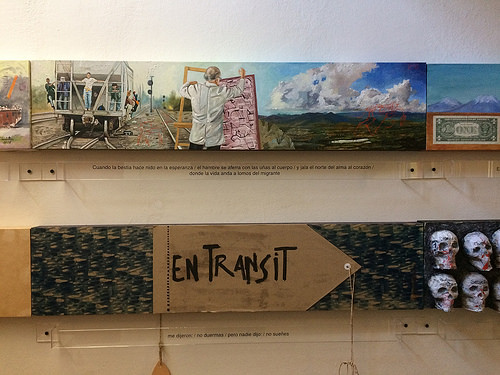
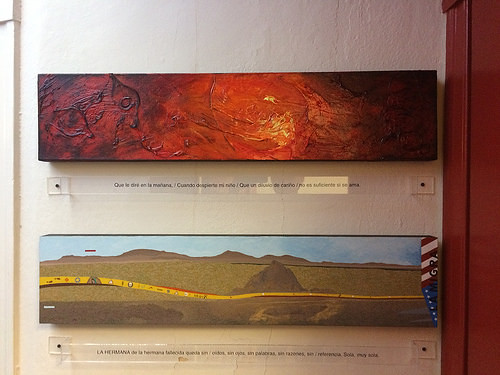
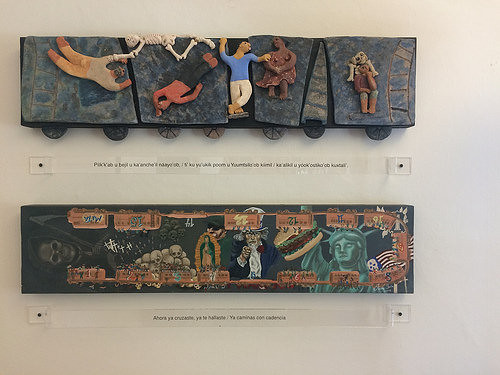
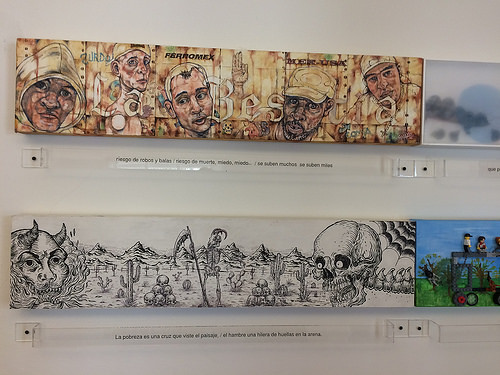
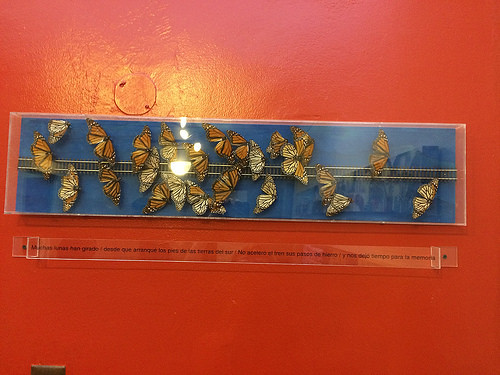
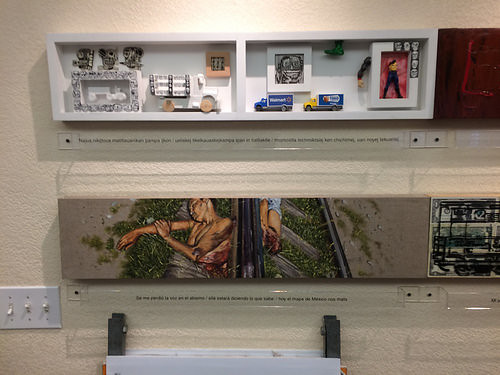
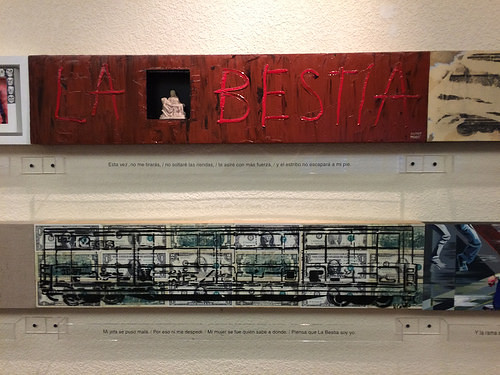
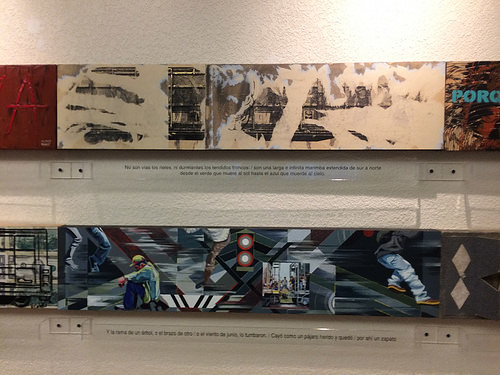
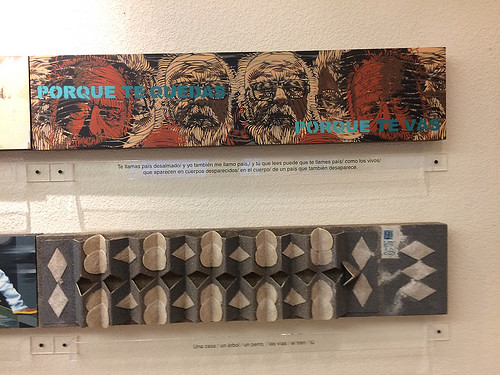
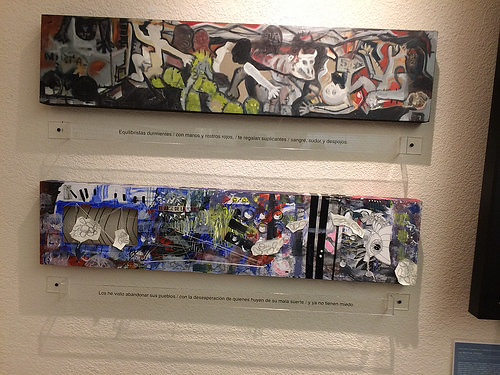
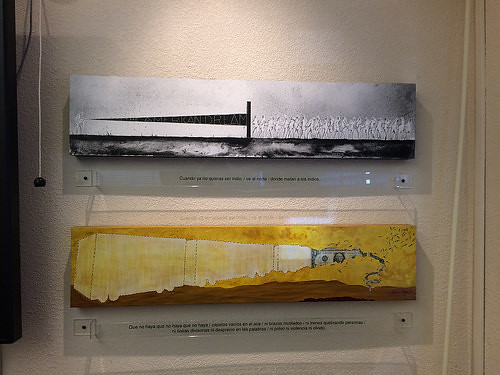
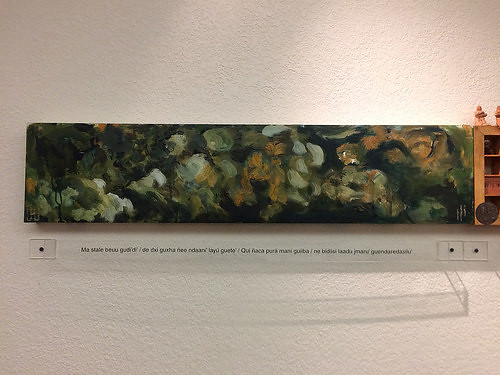
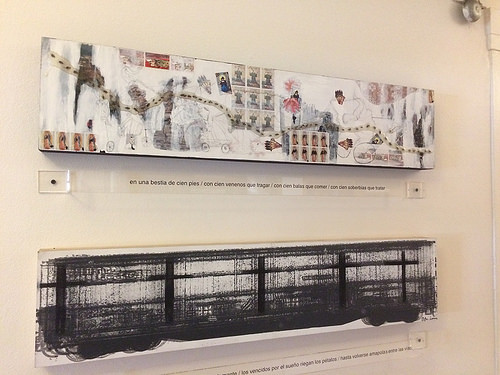
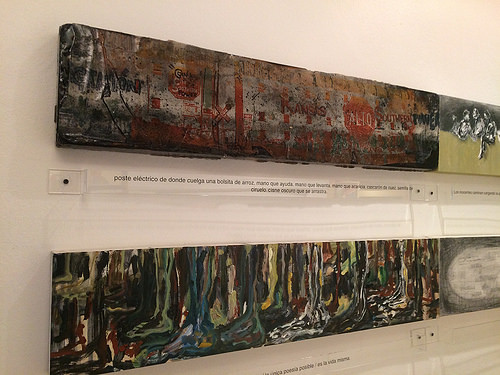
Recently, I saw a deeply moving and technically impressive exhibition at Center for Latin American Studies, UC Berkeley, titled "MONTARlaBestia (Riding the Beast)".

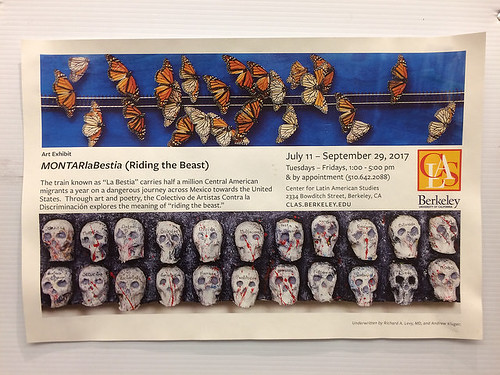
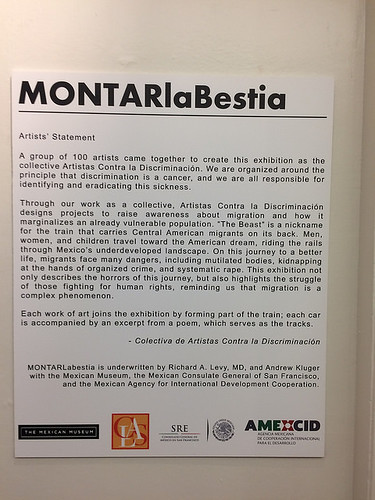
According to the poster, "the train known as 'La Bestia' carries half a million Central American migrants a year on a dangerous journey across Mexico towards the United States. Through art and poetry, the Colectivo de Artistas Contra la Discriminación explores the meaning of 'riding the best'."

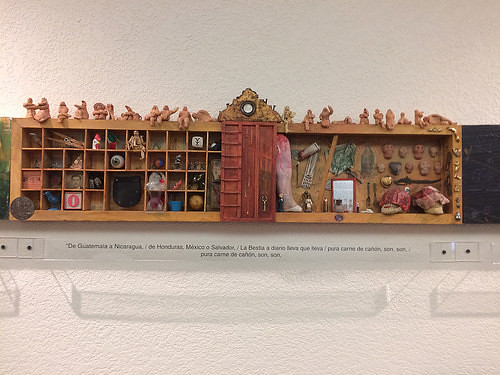
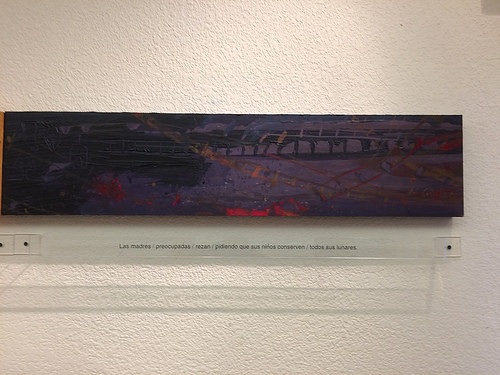
Below are several of those touching images, together with the accompanying poetry, documenting the struggles and suffering of those desperate people, and some of them will haunt me for a long time.

IMG_4852 - MONTARlaBestia (Riding the Beast), Center for Latin American Studies, UC Berkeley

IMG_4853 - MONTARlaBestia (Riding the Beast), Center for Latin American Studies, UC Berkeley

IMG_4857 - MONTARlaBestia (Riding the Beast), Center for Latin American Studies, UC Berkeley

IMG_4858 - MONTARlaBestia (Riding the Beast), Center for Latin American Studies, UC Berkeley

IMG_4859 - MONTARlaBestia (Riding the Beast), Center for Latin American Studies, UC Berkeley

IMG_4860 - MONTARlaBestia (Riding the Beast), Center for Latin American Studies, UC Berkeley
 
IMG_4861 - MONTARlaBestia (Riding the Beast), Center for Latin American Studies, UC Berkeley

IMG_4862 - MONTARlaBestia (Riding the Beast), Center for Latin American Studies, UC Berkeley

IMG_4863 - MONTARlaBestia (Riding the Beast), Center for Latin American Studies, UC Berkeley

IMG_4866 - MONTARlaBestia (Riding the Beast), Center for Latin American Studies, UC Berkeley

IMG_4867 - MONTARlaBestia (Riding the Beast), Center for Latin American Studies, UC Berkeley

IMG_4868 - MONTARlaBestia (Riding the Beast), Center for Latin American Studies, UC Berkeley

IMG_4870 - MONTARlaBestia (Riding the Beast), Center for Latin American Studies, UC Berkeley

IMG_4871 - MONTARlaBestia (Riding the Beast), Center for Latin American Studies, UC Berkeley

IMG_4872 - MONTARlaBestia (Riding the Beast), Center for Latin American Studies, UC Berkeley

IMG_4873 - MONTARlaBestia (Riding the Beast), Center for Latin American Studies, UC Berkeley

IMG_4874 - MONTARlaBestia (Riding the Beast), Center for Latin American Studies, UC Berkeley

IMG_4875 - MONTARlaBestia (Riding the Beast), Center for Latin American Studies, UC Berkeley

IMG_4876 - MONTARlaBestia (Riding the Beast), Center for Latin American Studies, UC Berkeley

IMG_4877 - MONTARlaBestia (Riding the Beast), Center for Latin American Studies, UC Berkeley

IMG_4880 - MONTARlaBestia (Riding the Beast), Center for Latin American Studies, UC Berkeley

IMG_4881 - MONTARlaBestia (Riding the Beast), Center for Latin American Studies, UC Berkeley

IMG_4882 - MONTARlaBestia (Riding the 
Beast), Center for Latin American Studies, UC 
Berkeley


Other Related posts on Art · 文化 · Kunst:
- "Fresh Works VII" Juried Exhibition in Pleasanton
- Changes Exhibition Opened at Expressions Gallery, Berkeley
- Group Exhibitions in Seattle, Berkeley and San Diego & a Publication
- "Scapes: Land, Sea and Urban" Juried Exhibition at Pacific Art League, Palo Alto, California
- Oil Painting "Upstream" Goes to Seattle
- Opening of "Free Art" at Pro Arts Gallery, Oakland
- City Art Gallery Holiday Show Opening Reception
- "Golden Ages" Opening at Expressions Gallery, Berkeley

Thursday, February 9, 2012

Onegin, Werther and Other Seminal (Yet Obscure) Works in World Literature


Roxana Constantinescu as
Charlotte and James Valenti as
Werther at the MN Opera.
Photo by Michal Daniel.
Source: Aisle Say Magazine
Recently, I came across an opera review on Aisle Say Twin Cities, the Minneapolis/St. Paul branch of Aisle Say Magazine, which hosts theater reviews across the country.  It summarized the synopsis of the opera as such:
Werther (pronounced ver-TAIR) was such a hit in Goethe's day that Massenet's 1892 operatic adaptation could be likened to the movie version of Harry Potter or Lord of the Rings. The original publication of the book inspired devoted readers to dress up as Werther, and a rash of copycat suicides led authorities to worry about "Werther Fever." The story, so deeply resonant in the minds of 18th- and 19th-century European readers and viewers, tells of young love kept apart by duty and tradition. In a nutshell: Werther – a brooding young man who modern audiences would call "emo" – sees Charlotte at a ball and falls madly and instantly in love with her. Charlotte, however, has promised her dying mother that she would marry Albert. Unable to cope with his heartbreak – sorry for the spoiler – Werther shoots himself.
This is rather surprising that a caution of spoiler.  Don't we all know of the basic storyline of Die Leiden des jungen Werthers (The Sorrow of the Young Werther) by Goethe?  Don't we all know that Werther shot and killed himself in the seminar novel of the world literature?  Is the spoiler alert really needed?

This reminded me a ballet performance of "Onegin" by Eifman Ballet I attended a few years ago, at Cal Performances in Berkeley, California.  During a pivotal scene, the heroine Tatiana wrote love letter to the protagonist, Eugene Onegin.  The innovative choreographer Boris Eifman kept the ballerina accompanied by the reading of the letter, in Alexandr Pushkin's original Russian poetry.  The old gentleman sat next to me kindly whispered to me the English translations, unaware of the fact that I had been very familiar with the story and though I couldn't understand the reading verbally, I knew every nuances of the letter and the movement of the dancer.


Even when I was a child, in Mao's China, I knew of the stories of Eugene Onegin and the young Werther.  I remember vividly the cover of the copy of Die Leiden des jungen Werthers (in Chinese translation, in traditional characters) my father kept on his bookshelf.  Years later, I read both books in English translations and have seen various reincarnations of them - films, dances, operas, etc.  They were so familiar to me that I often forget that despite the supremely importance of these two literature works, many people in the U.S. still have no idea what they are and what they are about.

Cover of the first edition, 1925
Source: wikipedia
To me, the comparative American literature is The Great Gatsby by F. Scott Fitzgerald.  I truly hope that most Americans know of the book and know of the story plot and need to spoiler alert for this the most American literature.  Would this be as obscure as other seminal works of world literature?


Sunday, November 22, 2009

Sonette an Orpheus

I just finished re-reading Sonette an Orpheus (Sonnets to Orpheus) by Rainer Maria Rilke and am in a trance. I have just started a painting on the subject of Orpheus - I cannot tell if reading Rilke triggered the project or the project propelled my reading.

Out of the fifty-five poems, the one really impressed into my mind is the last one (No. 26) of Part I:

Du aber, Göttlicher, du, bis zuletzt noch Ertöner,
da ihn der Schwarm der verschmähten Mänaden befiel,
hast ihr Geschrei übertönt mit Ordnung, du Schöner,
aus den Zerstörenden stieg dein erbauendes Spiel.

Keine war da, daß sie Haupt dir und Leier zerstör.
Wie sie auch rangen und rasten, und alle die scharfen
Steine, die sie nach deinem Herzen warfen,
wurden zu Sanftem an dir und begabt mit Gehör.

Schließlich zerschlugen sie dich, von der Rache gehetzt,
während dein Klang noch in Löwen und Felsen verweilte
und in den Bäumen und Vögeln. Dort singst du noch jetzt.

O du verlorener Gott! Du unendliche Spur!
Nur weil dich reißend zuletzt die Feindschaft verteilte,
sind wir die Hörenden jetzt und ein Mund der Natur.

An online English translation is available:
But you, divine, to the last resonating
when swarms of scorned maenads were bent on your murder,
you drowned out their shouting with beautiful order,
from out the destroyers rose uplifting playing.

No one there damaged your head or your lyre,
however they rushed you or rested apart;
and all the sharp rocks they threw at your heart
grew soft when they touched you and able to hear.

In the end they dismembered you, driven by vengeance,
but your sound yet lingered in cliffs and lions,
in forests and birds. Even now, you still sing there.

Oh desolate god! You unending trail out!
Only since blind hatred strew you about
are we now hearers and a mouth for nature.

This project will be the continuation of my Mythology Series.

Below is a quick sketch I made in Cafe Milano, Berkeley and the painting in the very beginning stage.

Sunday, November 8, 2009

Jane Campion's Movie "Bright Star" and John Keats

I just saw Jane Campion's movie Bright Star about "the three-year romance between 19th century poet John Keats and Fanny Brawne, which was cut short by Keats' untimely death at age 25" (quoted from IMDB.com). The movie was romantic yet devoid of sentimentality. The performances were hard to forget.

I must confess that I don't know much about John Keats and his work. I browsed a little bit his poetry and like this one very much:

On Seeing the Elgin Marbles

My Spirit is too weak — mortality
Weighs heavily on me like unwilling sleep,
And each imagined pinnacle and steep
Of godlike hardship tells me I must die
Like a sick eagle looking at the sky.
Yet 'tis a gentle luxury to weep
That I have not the cloudy winds to keep
Fresh for the opening of the morning's eye.
Such dim-conceived glories of the brain
Bring round the heart an undescribable feud;
So do these wonders a most dizzy pain,
That mingles Grecian grandeur with the rude
Wasting of old time — with a billowy main —
A sun — a shadow of a magnitude.

"Like a sick eagle looking at the sky." Perhaps, a painting or a drawing will come out of this?

Sunday, July 26, 2009

Majestic "Phèdre" from National Theatre of London

Two days after viewing the telecast of Phèdre from National Theatre of London, I am still in a dazed state by the incredible play and its pitch-perfect performance, except for a less than noble and tragic Theseus, and the occasionally too nimble camera works. Many details replayed in my mind vividly – a meaningful gesture, a well-executed body movement, a most poetic line and its precise and spontaneous delivery, a delightful lighting and new angle of scenery. It was the theater art in the highest order. This play, seen in cinema, was the best movie theater experience of mine in many years. The performance and production was also one of my best theater going experiences, along with an exulted list including King Lear, Savage Land, Desire Under the Elm in Shenyang, China, Hecuba in London, Oresteia (last 10-15 minutes excluded), The Miser, Figaro, Finn in the Underworld, The Secret In The Wings, Argonautika (Berkeley Repertory Theater), Saint Joan (Aurora Theater), Medea, The Tea House, and The Servant to Two Masters (Cal Performances) in Berkeley, California.

The play was not over produced therefore the audience could savor the poetry of Racine, instead of being distracted by extraneous efforts, which often than were unnecessary. As Phèdre, Helen Mirren was simply majestic, in this guilt-ridden, death-seeking pitiable woman/monster. When Phèdre perished, a new goddess was born. I cannot express my gratitude enough to National Theatre for bringing this performance to me, since traveling to London for a seat might not be available is just too cost prohibitive. Many thanks to Peter Gelb, the general manager of Metropolitan Opera, who ushered in these theater-cinema alliances all over the world. Bravo!

There are three more plays from National Theatre for simulcasting in cinemas in this pioneer season. The $25.50 per seat was really paltry offering we can provide to the highest pursuit of human kind – art.

For a cost of $0, there will be a free simulcast performance in the upcoming season – San Francisco Opera is bringing Giuseppe Verdi’s Il Trovatore, in a much-praised new production, to AT&T Park, Saturday, September 19, 2009. The cast includes a quartet of most sought-after singers and will be led by SF Opera’s new music director Nicola Luisotti. If you want to sample a new art form, Il Trovatore is a very good introduction. Do give yourself a treat and sign-up for a seat early.
Saturday, March 14, 2009

Gary Snyder at Morrison Library - 5 March 2009

San Francisco-born Gary Snyder is a world-renowned poet, essayist, and environmentalist. According to a UC Berkeley website, he "has published sixteen books of poetry and prose, and received the Pulitzer Prize in 1974 for Turtle Island. Snyder has traveled widely and lived for extended periods of time in Japan, where he studied and practiced Rinzai Zen. He is currently a professor at University of California, Davis." On March 5, 2009, he read in the Morrison Library in Doe Library from 12:10 pm to 1:00 pm.

I had a meeting from 10:30-noon. As soon as I left the meeting, I rushed to the library but the entrance was totally blocked by a few dozen disappointed listeners who could not get in. Robert Hass introduced Gary Snyder. However I tried, I could not make out the words. Then Gary Snyder stepped upon the podium. Again, I couldn't hear him. Hugely disappointed, I decided to leave. The consolation was that I did hear him a few years ago in Oakland.

I was also very glad that there were so many young people who still admired such "archaic" form and practitioner.

UC Berkeley promised a webcast but so far the audio or video files are not available on their website yet - http://lunchpoems.berkeley.edu/#snyder

Stay tuned.

PS:

In the comment, a kind reader forwarded me the information below:

Here's the URL for the page that has UCB's webcast: http://webcast.berkeley.edu/event_details.php?seriesid=55a026e9-b748-4d48-9d78-56f1177a334f ... also on YouTube at http://www.youtube.com/watch?v=WxVZxJIYj6o