Showing posts with label Opera. Show all posts

Friday, August 7, 2015

Modernism Not Welcomed at David Gockley's San Francisco Opera

On August 1, SFOpera presented Jennifer Higdon's "Cold Mountain" to acclaims. Even though juries are still out regarding this work, it has won most hearts of audience and critics. Here is an online review of "Cold Mountain":
Higdon’s is tonal music, with appropriate, occasional incorporations of Appalachian folk tunes. But it is a thoroughly modern score: Though often elegiac, the music is punctuated with violence and dissonance is almost an orchestral character itself, paralleling the opera’s unsettled, anxious mood. 
The opera company in question, SFO, alas, was not San Francisco Opera, which under the general director David Gockley, has commissioned impressive numbers of new operas but most of them were miserable affairs.  Rather, the glory belongs to Santa Fe Opera. Curiously, San Francisco Opera had announced this in an archived article:
SAN FRANCISCO, January 26, 2009—San Francisco Opera General Director David Gockley, joined by Music Director Designate Nicola Luisotti and Chairman of the Board of Directors John Gunn, today announced artistic details for the upcoming 2009–10 repertory season; plans to commission three operas by American composers Christopher Theofanidis, Mark Adamo and Jennifer Higdon.
While Higdon project apparently didn't pan out, Theofanidis's "Heart of a Soldier" and Adamo's "The Gospel of Mary Magdalene" did come into fruition, but both suffered severely from weak dramatic structures and insubstantial and turgid music.

This past June, instead of the healthy mixture of melodic and modern music by Higdon, San Francisco Opera presented a new opera, "La Ciociara" ("Two Women") by Marco Tutino, of an overly-melodramatic libretto coupling a maudlin score, which Gockley viewed as a strike back against the advance of modern development of classical music.

Here is what San Francisco Chronicle's review of the premiere:
... Tutino — along with General Director David Gockley, who commissioned the work from him on the recommendation of Music Director Nicola Luisotti — has also taken this opportunity to mount a rather forceful esthetic argument. In its strongest form, the claim is that the history of 20th century music has been a nightmare that we need to wake up from, and that the path to redemption lies in a wholesale return to the ancient traditions.

Committed to archaism
One doesn’t have to be a diehard modernist, or even much of a modernist at all, to appreciate the weakness of that position. Things have changed since 1900 — if nothing else, there have been two world wars — and plenty of musical ideas have been hatched in the interim. What possible purpose is served by turning one’s back on all of it?
 In a press announcement of "La Ciociara" before its premiere, David Gockley explained his philosophy behind pale aping of Puccini, claiming that "the failure of modernism has given opera a new start and a new potential." [see the embedded video below: 55'48']


In addition, Gockley stated in the video: 
I have a style to pursue, that is neo-verismo, and … one of the things both Nicola and I … we wanted an opera that will immediately speak to the audience, that they would take to heart immediately and walk out of the theater and would make a big impact on them. It’s a cliché you know walking out whistling the melodies and it’s not what you know we are supposed to do you know through out the 20th century with musical modernism being so chic. So we’ve decided we would turn our back on that, and forget that it existed. And we said to Marco: “You know, your fathers are Puccini, Leoncavallo and Mascagni and let them rip.”

We have a co-commissioner and co-producer in the Teatro Regio Torino … of course they thought twice about this you know, "are people going to say this is too retro?" And I said: “Come on, you know, be … be heroic, you know, go against the grain and maybe we’ll re-ignite a tradition.

[13'10'-15'35]
It was distressing to hear such sweeping denunciation of modernism from an impresario overseeing such an important theater. Gockley had expressed more than once that he wanted his composers to forget that modernism ever existed.  Could this be the reason that Higdon balked or dumped, despite the fact that her music was not even that edgy.


San Francisco Opera has also announced another commission - the seminal 18th Century Chinese novel by Xueqin CAO, "Dream of the Red Chamber", to be composed by Bright Sheng.
San Francisco Opera today announced two key artistic personnel for the Company’s world premiere commission, Dream of the Red Chamber by renowned Chinese-American composer Bright Sheng (Madame Mao, The Silver River). Premiering Fall 2016 at the War Memorial Opera House, Dream of the Red Chamber will be conducted by American maestro George Manahan and staged by celebrated Taiwanese director Stan Lai in his Company debut.
Initially, I was very excited by the idea but my excitement turned to suspicion when I learned that this might be a vanity project, as it was pushed forward by Chinese Heritage Foundation of Minnesota, which engaged San Francisco Opera to commission this opera.

Granted, that alone was not enough an alarm, then I encountered this report online, Opera on A Dream of Red Mansions:
When the project took off last year, Gockley asked Sheng for two things. First, the music - both vocal and instrumental - should relate to Chinese music, so use Chinese instruments. Second, it must be "beautiful" and avoid traces of European modernism in the score.  
Really, avoiding any trace of modern development in music history, in an opera set in English, commissioned for an English-speaking audience?

Haven't we heard something like that before. What was it called?

Degenerate Art!* Of course!

When artistic straightjacket becomes shackles, the stipulation degenerates from foolhardy to heinous.  Such regression is anything but heroic. If the artistic approach behind the "Dream of the Red Chamber" won't change, that project is doom as well, I am afraid.

* On Wikipedia: Degenerate art (German: Entartete Kunst) was a term adopted by the Nazi regime in Germany to describe virtually all modern art.


Related posts on Art · 文化 · Kunst: 
- Not Enough Drama, Love to Rescue - on San Francisco Opera's Commissions "Heart of A Soldier"
- San Francisco City Hall Celebrating 10th Anniversary of Same-Sex Marriage
- Rainy Days in San Francisco Bay Area
- Part 4, Götterdämmerung - Premiere of Wagner's Ring Cycle at San Francisco Opera
- You'd Think We Living in a Prosperous Time - Two Observations On San Francisco Opera's 2011-12 Season
- "Something Strikingly Original, If Not Completely New"
- Festive San Francisco City Hall and Opera House
- Lunar New Year Time in Shenyang, China
- San Francisco Opera's New "Werther"

Tuesday, March 26, 2013

Two Takes of "A Streetcar Named Desire"

Last month, a friend invited me to see her teenager son starring as Stanley Kowalski in the seminal American play, A Streetcar Named Desire, in his Oakland School for the Arts production.  Since I've seen this amazing young actor and his school mates' performance before, I did not have much trepidation on their behalves.  Even so, it was still quite ambitious for high school actors and their teacher to tackle this overtly emotional operatic piece.

Yet, I was gladly satisfied and quite moved by their performance - a performance was quite vivid, natural, honest and moving.  If here or there one wished for a bit more display of emotion or chemistry, it was not the fault of their young age - those "shortcomings" could be as easily encountered in a full-fledged professional troupe.  It was simply the challenge to portray the incredibly emotional and unstable characters, the challenge many adult and more experienced actors had often than not failed to wrestle to the ground.  I also truly appreciated the rather understated, less melodramatic portrayals, a relief from common fault often seen  in a Tennessee Williams' play.  Most impressive was that those actors matched each other well, particularly amongst the well-balanced central quartet, with the appropriate focus on Blanche.

The young actors had pledged not to watch the famous film so as not to ape the inimitable Marlo Brando and Vivian Leigh, et al., therefore, breathed their and their teacher's own readings into these roles.  I was particularly startled and impressed, positively, by the young actress' reading of that famous line of Blanche: "I don't want realism. I want magic!"

This line could be read many ways and here, her exclamation was a desperate attempt to stay afloat and a protestation against her foreseen doom.  That contrasted greatly with another "A Streetcar Named Desire" I saw on stage in 1998, an operatic adaptation by San Francisco Opera, composed by André Previn, to the libretto (a condensation of the play) by Philip Littell, starring the American star soprano, Renée Fleming.

Previn's music for this operatic Streetcar was a meandering train wreck and I was terribly bored by the obvious musical and dramatic gestures provided by the composer and his diva.  Previn constructed "I want magic" as a concert diva showpiece and when golden-voiced but always dramatically noncommittal Fleming sang it, it sounded like a willful five-year-old girl telling her mommy that she didn't want to know that Santa Claus is not real, that fairies do not exist.  Rather, she "wants magic".  It had neither fragility, tragedy, grandeur, doubt or delusion, therefore, a dramatic dead spot, and emotionally false, became a parody of a self-conscious diva prancing, however gracefully, in front of a gilded mirror.

Below is a segment of Fleming performing "I want magic!" in a concert and however lovely she sounded, it was dramatically false and even coy, from this lovely singer:


Related posts on Art · 文化 · Kunst:
- Theater Experiences in Wien (Vienna)
- Mark Rothko and "Red" at Berkeley Repertory Theatre
- Funny Theater, Not Textbook - David Henry Hwang's Chinglish at Berkeley Repertory Theatre
- Princess Turandot
- High Romanticism - German Tenor Jonas Kaufmann's Recital in Berkeley
- Angelic Voice - Philippe Jaroussky at Hertz Hall, UC Berkele

Wednesday, November 28, 2012

Theater Experiences in Wien (Vienna)

DSCN0643 _ Star of Schubert in front of Musikverein, Wien
Franz Schubert star near Musikverein, Wien
Wien (Vienna) means music and style.  In Vienna, the stars are given to composers and musicians - Schubert, Bach, Brahms, Berg, von Einem and von Karajan, etc., instead of film stars and starlets in Hollywood.

When I visited Vienna last month, my second trip to Vienna, I attended three different theatrical performances, all in renown venues, within a brief span of six nights.

DSCN9467 _ Volksoper, Wien, 2 October
Volksoper Wien
The first performance we attended was a night of three modern ballets at Volksoper.  The options then included Viennese operettas, such as Die lustige Witwe (The Merry Widow), a quintessential Viennese confection, but it was vetoed by my partner and we chose the ballet night instead, for its modernity and daring (see the preview video below).  It turned out to be a wonderful night of theater.  The three modern ballets were, in the order of performance and ascending scale of the pieces, Claude Debussy's "Nachmittag eines Fauns", Maurice Ravel's "Bolero" and Carl Orff's "Carmina Burana", performed by Wiener Staatsballett.

The first piece was intimate and small, with only two dancers, and the last was ambitious, set to a full orchestra, several choruses and multiple couples and corps, while the middle one was, in the middle of everything.  The first piece was lovely but just a tad underwhelming and the last one, hour long, had some muddy moments and sagging energy amongst generally very satisfying presentation and poignant choreographed dances; it was the middle piece made the strongest impact through its glorious choreography by Boris Nebyla, incredibly beautiful costume, and unflagging energy of the music.  It was one of the most satisfying theatrical pieces I have ever enjoyed.

DSCN9465 _ Volksoper, Wien, 2 October

DSCN9499 _ Volksoper, Wien, 2 October

DSCN9491 _ Volksoper, Wien, 2 October

DSCN9497 _ Volksoper, Wien, 2 October


Volksoper is the "second" or "third" opera house in Vienna.  The top one was the most exulted Wiener Staatsoper, and the other one might be "Theater an der Wien", where Beethoven's Fidelio premiered.  There were only Puccinis in those houses in the week I was in Vienna so I had to pass them over.  In 2002, I did enjoy a performance of Bellini's La Sonnambula at Wiener Staatsoper.  Standing section.  Cost 3 euros.  At that time, a guided tour of that house was 5 euros.  The house was much more grandiose and glamorous.  Formal too.  In the cafe inside the house, a server wore a name tag identifying her as Frau XXX.  Volksoper, in contrast, was a little smaller, more intimate and more down to earth.  After all, it was called "Folks' Opera".  Yet, it was in that "people's house" that my partner was made to check his quite nice-looking and almost formal black windbreaker, where in Staatsoper, a similar but more casual windbreaker cost no concern, and was also in the presence of Present Havel in Prague.  At Volksoper, My blazer was sanctioned by the usher.

For comparison, below are a group picture of Wiener Staatsoper I took during this trip:

DSCN1654 _ Wiener Staatsoper, Wien, 6 October

DSCN9026 _ Wiener Staatsoper, 2 October - 500

DSCN1793 _ Winer Staatsoper, Wien, 7 October

DSCN1779 _ near Staatsoper and Albertina Museum, Wien, 7 October

The second performance we attended was a play in one of the most prestigious theaters in German speaking world - Burgtheater in Vienna.

DSCN9424 _ Burgtheater, Wien, 2 October

DSCN9433 _ Burgtheater, Wien, 2 October

DSCN9436 _ Burgtheater, Wien, 2 October

The play we chose to see was Prinz Priedrich von Homburg by Heinrich von Kleist.  It was a seminal play on discipline, militarism and reason. It was a co-production with Salzburg Festival and in the title role, starred the wonderful young German actor August Diehl.  There were many young people in audience, perhaps high school students - the tickets were as low as 2.5 euros.  I didn't know if the high percentage of young people was the norm or not, or they were particularly lured by the heartthrob Diehl.

DSCN9224 _ Burgtheater Poster, Wien, 2 October- 500


It was a sparse, modern and fiercely intelligent production, yet emotional raw and wrenching - two and half hours without intermission breezed through.  I did my homework by reading both original German texts and English translation in advance, plus listening to a radio play produced in 1950s.   

DSCN9790 _ Burgtheater, Wien, 3 October

DSCN9796 _ August Diehl as Prince von Homburg, Burgtheater, Wien, 3 October

DSCN9794 _ Burgtheater, Wien, 3 October

The most venerated musical venue in Vienna for symphonic performances was the Großer Saal (Great Hall), sometimes called Golden Hall, of Musikverein (Music Association).  It was the venue for annual Vienna New Year's Concert, televised all over the world.  The building was an ornate classical structure, with elaborate decorations inside the hall, centering around Apollo and nine muses gracing the golden-trimmed ceiling.

DSCN0640 _ Musikverein, Wien, 5 October

DSCN1617 _ Musikverein, Wien, 6 October

DSCN1562 _ Musikverein, Wien, 6 October

Wikipedia described the Großer Saal thus:
The Großer Musikvereinssaal, or Goldener Saal (Golden Hall), is about 49 m (161 ft) long, 19 m (62 ft) wide, and 18 m (59 ft) high. It has 1,744 seats and standing room for 300. The annual Vienna New Year's Concert is held here. Its lively acoustics are primarily based on Hansen's intuition as he could not rely on any studies on architectural acoustics. The room's rectangular shape and proportions, its boxes and sculptures allow early and numerous sound reflections. The original equipment comprised a historic pipe organ built by Friedrich Ladegast, the first organ recital was held by Anton Bruckner in 1872. The present–day organ was originally installed by the Austrian firm Rieger Orgelbau in 1907, highly esteemed by musicians such as Franz Schmidt or Marcel Dupré, and rebuilt in 2011.
DSCN1548 _ Musikverein, Wien, 6 October

DSCN1555 _ Musikverein, Wien, 6 October

DSCN1541 _ Musikverein, Wien, 6 October

The program we enjoyed was performed by Wiener Symphoniker, conducted by Vladimir Fedosejev, Dirigent, with Edgar Krapp as organ soloist.  The pieces they performed were:
  • Werner Egk: Französische Suite nach Rameau für großes Orchester
  • Alexandre Guilmant: Symphonie für Orgel und Orchester Nr. 1 d - Moll, op. 42
    -------- Pause ----------
  • Modest Petrowitsch Mussorgskij: "Bilder einer Ausstellung" für Orchester bearbeitet von Maurice Ravel
    Encore:
  • Johann Sebastian Bach: Ouverture Nr. 3 D - Dur, BWV 1068 - 2. Satz (Air)
DSCN1588 _ Großer Saal, Musikverein, Wien, 6 October

DSCN1556 _ Großer Saal, Musikverein, Wien, 6 October

DSCN1585 _ Großer Saal, Musikverein, Wien, 6 October

It was glorious performance in a glorious hall.  I enjoyed the Egk and Mussorgky pieces very much.  Guilmant's organ symphony was not very engaging but it did allow the organ to go full blast and it was very impressive indeed.  For that experience's sake, I was glad for its inclusion.

The Wiener Symphoniker was a great symphonic orchestra, though overshadowed by the higher-profiled Wiener Philharmoniker.  Unfortunately, Wiener Philharmoniker was not performing both time I was in Vienna.  Therefore, a return to Vienna is a must.

We enjoyed the concert with our hosting friends, who were inspired and attempted to subscribe to the Wiener Philharmoniker's concerts but was told that they ought to wait for 13 years.  

Indeed, Vienna does mean music.

Related posts on Art · 文化 · Kunst: 
- Gondolas in Venice, Italy
- Teatro La Fenice di Venezia (La Fenice Theatre in Venice)
- Boy With Frog Sculpture and Punta della Dogana, Venice
- Bus Ride From Graz, Austria to Venice, Italy
- Magnificent Churches in Vienna
- Christopher Wheeldon's Brilliant Cinderella at San Francisco Ballet
- Theater Experiences in Wien (Vienna)

Label: Austria, Austria and Italy Trip 2012

Saturday, June 16, 2012

Operas in Concert Hall

I just booked ticket to see a semi-staged concert performance of Béla Bartók's Duke Bluebeard’s Castle at San Francisco Symphony (SFS), and Liszt's Piano Concerto No. 1, and am anticipating an exciting night in the symphony hall.  Below is a video clip featured on SFS's website, documenting the preparation for this production.


Opera, as an art genre, often boasts being the form has it all - music, drama, costume, scenery, and dance, etc.  However, an over-produced, stuffy production can suffocate drama and music, the essence of operas. 

Sometimes, symphonic orchestras would stage operas with reduced scenery, costume and staging, due to the constraint nature of the symphonic halls and often, such particular constraints could force the singers to rely on their body languages, facial expressions, and above all, their voices to convey meanings, and force the viewer/listener to concentrate on music instead of scenery.  I had the good fortune of attended several semi-staged opera productions and one concert performance (without any scenery, prop or costume appropriate to the characters) - Wagner's Der fliegende Holländer (The Flying Dutchman), Stravinsky's Oedipus Rex, The Nightingale, Beethoven's Fidelio, and Zemlinsky's Eine florentinische Tragödie (A Florentine Tragedy), presented by the SFS and nearly all of them left an indelible impressions on me. 

All of them except for Zemlinsky opera (in concert form), were staged with great economy and intensity and the confinement of the smaller stage often heightened the drama.  It helped to have great conductors on podium - all those performances were conducted by SFS's music director Michael Tilson Thomas, with the exception of the Florentine Tragodie, which was conducted by another wonderful conductor James Conlon, current music director at Los Angeles Opera.  It also helped that the orchestra was first rate one.  I was equally grateful for the concert performance of Eine florentinische Tragödie, simply because it is so rarely performed and a chance to hear it alive was something to be happy about.  Without the proper costume, the singers still were able to interact and created credible human drama and dramatic situations.  The tiny unsatisfactory memory was from Fidelio, where awkward narratives replaced the original spoken dialogues, and this marred the otherwise excellent music performance.

All said, I do enjoy marvelous productions which fully take advantage of opera house stage machinery, when done for dramatic purposes, and do not compete with or overwhelm music and drama.  I have enjoyed many wonderful productions at San Francisco Opera (SFO), where the stage is more equipped to present technically challenging productions, such as The Cunning Little Vixen, Eugene Onegin, Billy Budd, Così fan tutte, Werther, Tannhäuser, Il Barbiere di Siviglia (The Barber of Serville), and Věc Makropulos (The Makropulos Case).

Of course, the operas themselves had to be good.  Sometimes, an hyper-produced production was really a desperate attempt to salvage a hopelessly inert and lackluster work, or even a musically satisfying but dramatically static ones.

Speaking of operas with some dramatically weakness, I realized that I have forgotten that I did see one more concert opera at SFS, A Flowering Tree by John Adams, conducted by the composer himself.  The opera had gorgeous music but the story was narrated by a storyteller, told instead of shown, which somewhat took the wind out of the dramatic sail. 

Therefore, an excellent all-around work must be the foundation of a great night at theater, and Duke Bluebeard’s Castle is a true 20th century masterpiece and I must thank SFS for its adventurous operative effort.

San Francisco Opera Ring Cycle  2011 Götterdämmerung _  3715
San Francisco Opera House and the Symphony Hall

Thursday, February 9, 2012

Onegin, Werther and Other Seminal (Yet Obscure) Works in World Literature


Roxana Constantinescu as
Charlotte and James Valenti as
Werther at the MN Opera.
Photo by Michal Daniel.
Source: Aisle Say Magazine
Recently, I came across an opera review on Aisle Say Twin Cities, the Minneapolis/St. Paul branch of Aisle Say Magazine, which hosts theater reviews across the country.  It summarized the synopsis of the opera as such:
Werther (pronounced ver-TAIR) was such a hit in Goethe's day that Massenet's 1892 operatic adaptation could be likened to the movie version of Harry Potter or Lord of the Rings. The original publication of the book inspired devoted readers to dress up as Werther, and a rash of copycat suicides led authorities to worry about "Werther Fever." The story, so deeply resonant in the minds of 18th- and 19th-century European readers and viewers, tells of young love kept apart by duty and tradition. In a nutshell: Werther – a brooding young man who modern audiences would call "emo" – sees Charlotte at a ball and falls madly and instantly in love with her. Charlotte, however, has promised her dying mother that she would marry Albert. Unable to cope with his heartbreak – sorry for the spoiler – Werther shoots himself.
This is rather surprising that a caution of spoiler.  Don't we all know of the basic storyline of Die Leiden des jungen Werthers (The Sorrow of the Young Werther) by Goethe?  Don't we all know that Werther shot and killed himself in the seminar novel of the world literature?  Is the spoiler alert really needed?

This reminded me a ballet performance of "Onegin" by Eifman Ballet I attended a few years ago, at Cal Performances in Berkeley, California.  During a pivotal scene, the heroine Tatiana wrote love letter to the protagonist, Eugene Onegin.  The innovative choreographer Boris Eifman kept the ballerina accompanied by the reading of the letter, in Alexandr Pushkin's original Russian poetry.  The old gentleman sat next to me kindly whispered to me the English translations, unaware of the fact that I had been very familiar with the story and though I couldn't understand the reading verbally, I knew every nuances of the letter and the movement of the dancer.


Even when I was a child, in Mao's China, I knew of the stories of Eugene Onegin and the young Werther.  I remember vividly the cover of the copy of Die Leiden des jungen Werthers (in Chinese translation, in traditional characters) my father kept on his bookshelf.  Years later, I read both books in English translations and have seen various reincarnations of them - films, dances, operas, etc.  They were so familiar to me that I often forget that despite the supremely importance of these two literature works, many people in the U.S. still have no idea what they are and what they are about.

Cover of the first edition, 1925
Source: wikipedia
To me, the comparative American literature is The Great Gatsby by F. Scott Fitzgerald.  I truly hope that most Americans know of the book and know of the story plot and need to spoiler alert for this the most American literature.  Would this be as obscure as other seminal works of world literature?


Friday, October 21, 2011

Those Nasty Princesses - Turandot and Salome

Early this month, I saw my second Turandot by Giacomo Puccini.  Unlike the first time I saw it in the same production by British artist David Hockney on the same San Francisco Opera stage years ago with the truncated ending by Franco Alfano, this time, San Francisco Opera opted for Alfano's complete ending - Puccini died before he could complete his score for Turandot.  The longer ending made the transition of Turandot from an icy monster to a succumbed lover a bit more convincing, without reducing the bombastically glorious outpouring of the melody based on the "hit number" Nessun Dorma.


Luciano Pavarotti sings "Nessun Dorma"

Even so, the story of Turandot as presented by Puccini and his librettist was still a very hard to stomach and accept.  The story was simple: Chinese Princess Turandot, traumatized by a female ancestor's ravishment in the hands of invading male conquer, vowed not to surrender.  She posed three riddles for suitors - whoever solved them won her, otherwise, lost his head.  A tartar prince in exhile, Calaf won the battle and won her heart with a manly kiss.

Ridiculous stuff for sure.  However, beneath the ridiculousness and operative monstrosity, there were deeper meanings which eluded Puccini, whose specialty was small scaled daily emotion, detached from the social fabric.  His Madama Butterfly, his La bohème could be transport into any similar situation in any social and temporal setting, gaining universality but losing depth of social commentary as in Verdi or psychological insight as in Wagner. 

If it were Verdi, he would not have failed to pick out the elements of cultural clash between the female dominant, docile court of China, though hiding behind a bloody curtain, and that of the intrusive militant, male outsiders.  If it were Wagner, what a drama of battle of sexes we would have gain?  In Puccini's hand, we got a gloriously melodic opera celebrating two most insensitive protagonists on stage.  A lost opportunity, perhaps.  However, we do need our bonbons.

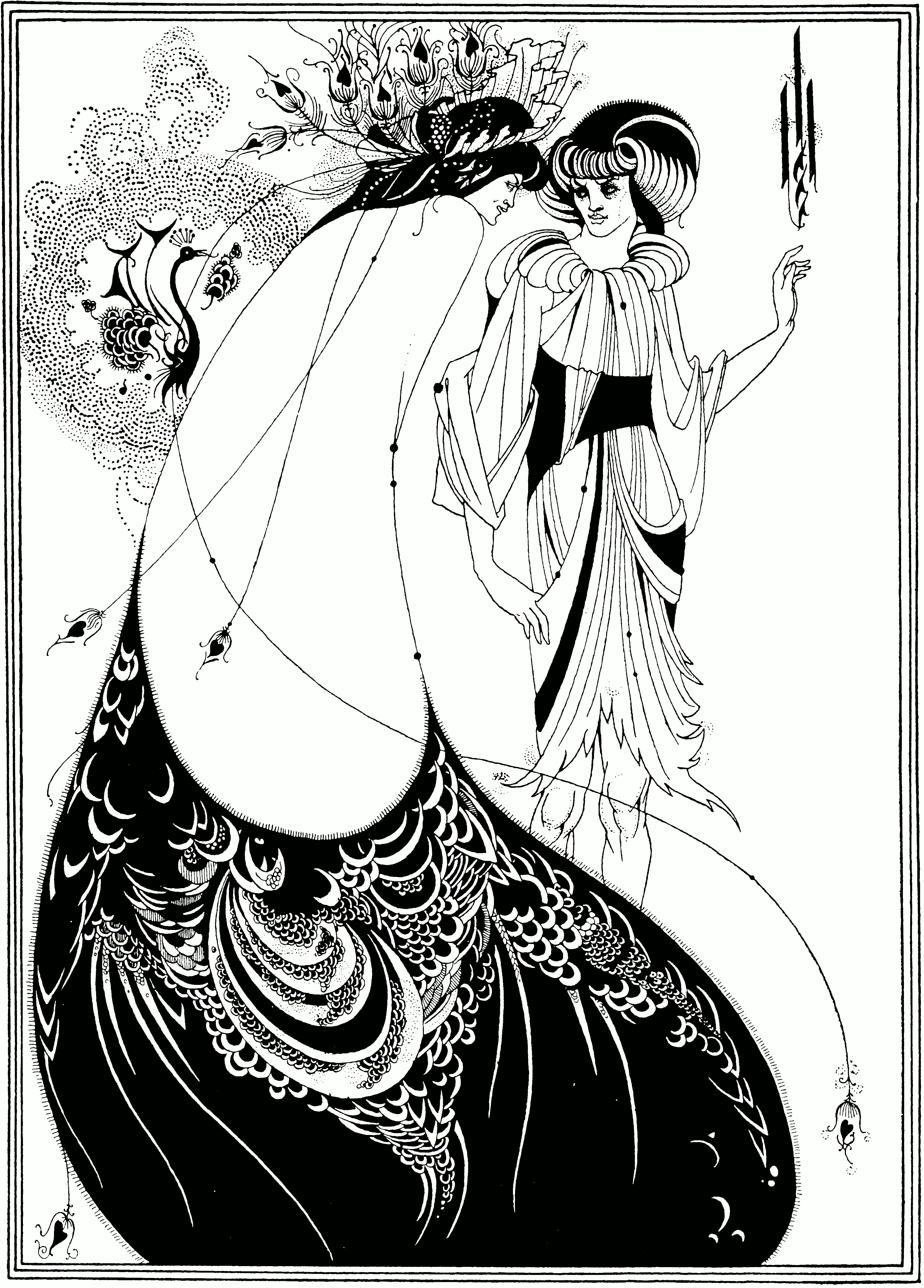
One of the illustrations Aubrey Beardsley
produced for the first English
edition of Wilde's play Salome (1894)
Watching the severed head of a losing suitor, I remembered another princess who liked to lob off head, this time, to gratify her own sexual desire - Princess Salome, courtesy of Oscar Wilde and Richard Strauss.

Awakening sexually on stage, and intrigued by the beauty of John the Baptist, who repulsed her advances, Salome demanded the head of Saint John on a silver platter and kissed the mouth of the severed head and tasted the blood.  In less than two hours time, Strauss presented us a spoiled child growing into a monstrous woman in a highly corrupted court and innocence lost.  His music was much more disturbing, way less heart tugging than Puccini's, but ultimately much, much more satisfying.

San Francisco Opera will present Turandot three more times this November - don't miss the rousing music, despite the gaudy and silly sets and costumes.


Wednesday, August 31, 2011

Not Enough Drama, Love to Rescue - on San Francisco Opera's Commissions "Heart of A Soldier"

"Not Enough Drama, Love to Rescue" was widely used in late 1980s in China to ridicule unwarranted love plot twist.  The relaxed political atmosphere just allowed love to be depicted in movies and consequently there was rampant overdose, particularly when drama became tepid, a love scene was duly inserted to keep the audience engaged, often to the detriment of the overall dramatic arc.

What made me think of this phrase was the San Francisco Opera's new commission, "Heart of a Soldier", to be presented on the eve of the 10th anniversary of the September 11 attack on the World Trade Center.

The opera was set to music by Christopher Theofanidis to Donna di Novelli's libretto, which was in turn based on James Stewart's book of the true story of Rick Rescorla.

SFOpera's website summarized the opera thus:
What makes a hero? The question was never an academic one for Rick Rescorla, a British-born adventurer who fought in Vietnam before settling in New York as head of security for a brokerage firm based in the World Trade Center. On September 11, 2001, his extraordinary courage and calmness in a crisis paid off: Rescorla led all of the 2,700 people under his care to safety—literally singing them down the stairs—before heading back into the burning building for one last check. He never emerged.
The opera covered vast ground - not only Rick Rescorla's heroic deeds on that fateful day, but also his long friendship with Dan Hill who served with him in Vietnam and helped to devise an evacuation plan for Rescorla's company in World Trade Center, and Rescorla's late found love with Susan.

The creative team argued that this is not just a hero's story, but intense love story.  I sincerely believe that all three strands - hero's growth and deeds, friendship and love are interesting in their own rights, but however I examine the story and the synopsis on SFOpera's website, I see them as separate strands.  They hardly mingle.  They refuse to merge.

Not once the friendship endangered or strengthened the love, or vice versa.  The love between Rick and Susan did not interfere with his duty, nor facilitated it.  The only connection was the joint effort of Dan and Rick's effort to create an evacuation plan but then Dan had largely remained in the background on the final day of Rick.

Therefore, I became suspicious of the over-reaching of the librettist.

San Francisco Chronicle reported this:
Stewart, an amateur pianist himself, heard about the opera project from director Francesca Zambello.

"I'm not an opera fanatic, but I have a subscription to the Metropolitan Opera and I do love music. And I started thinking, 'If this was "La Bohème," what would the acts be?' Suddenly it didn't seem so far-fetched."

When he saw DiNovelli's libretto, Stewart says, he was surprised and impressed at how much it included. "In my 'Bohème' version I'd had to cut a lot of the story out. I'd given up the whole Africa section, and Rick's childhood experiences on D-Day. But she got all that in there."
It seemed to me that the inclusion of so many events only made the opera episodic without much focus.  The love story here seems to me just as (ir)relevant to that in John Adams' Doctor Atomic, another San Francisco Opera commission, which was meandering, tedious and lacked confrontation, struggle and drama, a fault should be squarely put on the librettist's shoulders.  In that opera, there was long love scene between Dr. Oppenheimer and his wife, touching but entirely dispensable. There was no competing, conflicting motivations.

If love is to be included, it ought to have purpose.  People sneered at the improbability of the plot in Verdi's Il Trovatore, but it presented easy-to-grasp emotional motivations and competing love, and the love interest caused calamity, therefore, we had a riveting theater.  His Don Carlos had many love interests, often competing, and each of these propelled the march of the drama.  Not so in the cases of Doctor Atomic or Heart of a Soldier.

My biggest misgiving regarding Heart of a Soldier is that there is no clear dramatic arc and no coherent dramatic situation.  Take the friendship between Rick and Dan, which the opera's instigator and director Francesca Zambello had compared to the Greek tragedy-Orestes and Pylades.  However, Pylades and Orestes were vying to be sacrificed so their friend could live, while there was no such conflict existed in this new opera.  The comparison doesn't stand.

Ultimately, all those three strands compete with one another and the sum would come out less than parts.  Such was the case with Doctor Atomic - despite its masterful orchestral music and one powerful aria, it was a very boring night at theater.

For a ruminating opera, only Wagner managed to succeed with his hypnotically chromatic writing.  As for the music we are to have, we can get a glimpse from what Opera News reported that San Francisco Opera's general director David Gockley wanted "a legitimate composer, one with 'a big emotional sweep, who's not afraid to write a popular melody but still can deal with a big arc and complexity and breadth.'"

I hope that Mr. Theofanidis will succeed.  But if the opera does falter due to lacking of a coherent dramatic curve, it can at best offer colorful music episodes, some blinding color bursts, which were not enough.  Ever pessimistic, I'm dreading this cinematic stirring sweep already.

Gockley had a strong record of presenting new operas.  But most of them are non-threatening, sleek but without a strong dramatic or aural profile.  Gockley, Zambello and Theofanidis had all worked at Houston before.  I'm afraid some less inbreeding might have brought much more fresh ideas and intellect into any new enterprises.  Sometimes, it is much more rewarding to work with someone who's not always readily to agree with you.  Beside, Gockley cannot keep giving us Gershwins, Barbers or Menotis; we need some Bergs, Schoenbergs or Bartóks!


Related articles:
--> A Wasted Opportunity - on San Francisco Opera's New Commission "Heart of A Soldier"
--> World Premiere Opera "Heart of A Soldier" and What Is a Tragedy
--> San Francisco Opera's New Commission - Heart of a Soldier 

Sunday, August 28, 2011

Princess Turandot

San Francisco Opera is to open its new season with Puccini's Turandot, which was based on the great Italian dramatist Carlo Gozzi's play, which also had source from Persian.  Wikipedia stated that "Turandot is a Persian word and name meaning "the daughter of Turan", Turan being a region of Central Asia which used to be part of the Persian Empire."  The location of the story moved from Central Asian to Mongol (a 1710 fable by French scholar François Pétis de La Croix) and finally China (Gozzi, 1762).  Turandot was used as the name of the princess in Puccini's opera.

The story in Puccini's version was a deposed blind Tartar King Timur and slaved Liù came to China.  Unknown to them, his son Calaf arrived in Peking as well.  Princess Turandot, in the dark shadow of her female ancestor was brutally slain by a conquering prince, was determined not to be conquered by any male.  She posed three riddles for prince suitors.  Whoever could solve the riddles would win her and the throne, or lose his head if failed.  Calaf entered the race and solved the riddles.  In a moment of bravado, he gave Turandot another chance - if she could guess his name, he would be at her disposal.  Turandot tortured Liù for answer.  Liù, in love with Calaf killed herself and Turandot learned what love was through her sacrifice and Turandot and Calaf sang a love-duet over Liù's neglected body.

Fairy tale stuff.

I saw it once, several years ago, in the same David Hockney production, which was as fantastic as it was gaudy.  The costumes and makeups, particularly that of Turandot, was heavily influenced by the stylized Beijing Opera, and made a very poor princess - she looked definitely more like a Beijing Opera singer than a ethereal princess of China.  During imperial time, folk opera singers were no better than street beggars, social standing wise, therefore, it was quite ridiculous a sight of her to me.  No self-respecting princess in China would allow herself to dress up as a Beijing Opera Singer.  It just would not fly.


The male conquering a half-willing female with a great kiss was quite silly as well.  I also had trouble to sympathize with another little woman of Puccini, Liù, who sacrificed herself for an obvious cad.

I didn't believe that I'd see it again in the same production.  However, I had a new understanding of the opera and that made me eager to see it again.

Very recently, I realized that this is an allegory or prophecy about the history of China, written by foreigners.

Turandot can be seen as the embodiment of the Chinese people, who was keenly aware of the history of being invaded by barbaric - the Huns, the Mongols, the Manchus and the Japaneses and was determined to fend them off by all means, however cruel.

Seeing through lens of modern history, Calaf, the foreign prince suitor, can be seen as the seductive Communist ideas, personified by a Lenin, or better still a Stalin figure, who, not without struggle, conquered the half-reluctant, half-willing nation.

Or, seen through even more contemporary history, Calaf can be seen as a capitalist, say like Micheal Jackson, armed with Coca Cola, won the heart of the people of China and the feeble, aging emperor is the omnipresent portrait or bust of Mao Zedong.  For people who enjoy anachronism, a Steve Jobs armed with an iPad to tame the daughter of China is not out of line at all.

I never knew that western prophet could have such keen insight of China, and its history and people.  But I might only be dreaming.  When the opera is presented on the stage of War Memorial Opera House, it would be again, that gaudy and bombastic chinoiserie.

Wednesday, August 17, 2011

World Premiere Opera "Heart of A Soldier" and What Is a Tragedy

San Francisco Opera (SFOpera) is to present the World Premiere Production of Heart of a Soldier, with libretto by Donna di Novelli and music by Christopher Theofanidis, and was based on James Stewart's book of the true story of Rick Rescorla.  The opera is scheduled to be premiered on the eve of the 10th anniversary of the September 11th attacks on the World Trade Center, New York City, in 2001.  It is to be staged by Francesca Zambello, who just triumphantly staged Wagner's Ring Cycle for SFOpera.

SFOpera's website summarized the opera thus:
What makes a hero? The question was never an academic one for Rick Rescorla, a British-born adventurer who fought in Vietnam before settling in New York as head of security for a brokerage firm based in the World Trade Center. On September 11, 2001, his extraordinary courage and calmness in a crisis paid off: Rescorla led all of the 2,700 people under his care to safety—literally singing them down the stairs—before heading back into the burning building for one last check. He never emerged.
This paragraph is a quiet philosophical musing.  I remembered that it was called a tragedy before but I cannot find the word on their website any more.  Online search led me to their cached earlier press release, which did describe the story as a tragedy:
A story of war, love, friendship and heroism, Heart of a Soldier reflects on the extraordinary true story of Rick Rescorla, a man trained to be a consummate warrior who gave up his own life saving thousands in the attacks on September 11, 2001. Inspired by the American soldiers he saw as a boy in Cornwall, England preparing to launch the Normandy invasion on what became D-Day, and his adult friendship with American fighting man Dan Hill, whom he meets in war-torn Rhodesia, Rescorla emigrates to the United States in the early 1960s to become a soldier and a “Yank,” ultimately becoming a decorated platoon leader during the Vietnam War.

On September 11, 2001, as head of security for Morgan Stanley at Two World Trade Center, Rescorla is thrown to the floor when United Airlines Flight 175 crashes into the South Tower.  Amidst the unimaginable chaos that ensues, Rescorla uses his commanding presence and booming voice to literally sing his colleagues down smoke-filled stairs and out of the building. While he successfully evacuates all of his company’s 2,700 employees from the South Tower before it collapses, Rescorla makes the ultimate sacrifice when he goes back into the building to search for stragglers. Heart of a Soldier is an opera about a hero who disdains that very term, and about his deep friendship with an American soldier, so unlike him in approach and yet so similar in dedication and bravery.

“For nearly a decade I have been hoping to commission an opera from the brilliantly talented Christopher Theofanidis,” stated David Gockley. “When there finally was a window of opportunity at Houston Grand Opera, I changed jobs and preliminary plans for Heart of a Soldier had to be put on hold.  Once in San Francisco, I felt the opportunity to commission this work in observation of the tenth anniversary of the tragic events of 9/11—and the commitment of Tom Hampson to create the lead role—gave the project critical mass.  On the surface the piece is about what it takes to be a true hero, but what will drive the music is the passion, the suspense and the ultimate tragedy.” [I changed the font to bold and italic so my reader can find it.]

Perhaps, it was with good reason that SFOpera stopped to describe the opera as a tragedy.  To me, Mr. Rescorla's story is moving, sad and with a heartbreaking and unhappy ending.  But is it tragedy and what is a tragedy?

Typically, in a loose sense, we call all sad stories tragedy.  But I prefer to limit the use to a narrower sense.

There are many definitions of tragedy but I think the first definition used by Dictionary.com is the most pertinent:  

  1. a dramatic composition, often in verse, dealing with a serious or somber theme, typically that of a great person destined through a flaw of character or conflict with some overpowering force, as fate or society, to downfall or destruction.
  2. the branch of the drama that is concerned with this form of composition.
  3. the art and theory of writing and producing tragedies.
  4. any literary composition, as a novel, dealing with a somber theme carried to a tragic conclusion.
  5. the tragic element of drama, of literature generally, or of life.
To me, tragedy is the destruction of something good, noble and/or beautiful, something people recognize as good, and ought to through the flaw(s) in character(s), otherwise, the stories can be sad and touching but hardly tragic.
Wagner's Ring Cycle is the tragic story of the gods, because due to their greediness, they brought disaster onto themselves and the world. 

Shakespeare wrote many tragedies.  Take his most famous ones such as Hamlet, Othello, Macbeth, or Romeo and Juliet for example. The first three plays arrived their sad endings through the fatal flaws of the main characters, who were basically good and noble, but Hamlet was hesitate and indecisive, Othello was insecure and jealous, Macbeth was ambitious and easily manipulated.  Romeo and Juliet themselves perhaps had no such overt flaws, but taking their clans as a whole, we can see clearly that this is rather a conventional tragedy due to their inflexible hatred and thirst for revenge, they destroyed these two children they love, therefore the play was a tragedy for them collectively.

Back to the opera "Hear of A Soldier".  The more I read about it, the more I am convinced that it is a story of reassurance in humanity, and celebration of friendship, love and heroism, rather than the bemoaning a sad fate and event.

That is quite appropriate and it is how we should observe the event and honor the people who perished due to no fault of their own as individuals.

It we insist on treating 9/11 as a tragic event, then we have to examine ourselves collectively.  The event was the result of some religious zealot who bore obvious hatred of the U.S. for certain.  But, had we, the American people and the American government done something in the past contributing to the poverty, economic and environmental disasters, political corruptions and other humiliations to other parts of the world?  Couldn't we see something of ourselves in Wagner's chief god Wotan?  The answer can be nothing but yes.  Therefore, in a certain sense, the September 11 event in New York City could be partially, however significantly or insignificantly, be attributed to the flaws of our collected characters or behaviors, and that made the loss of so many lives on that fateful day tragic.


Related articles:
--> A Wasted Opportunity - on San Francisco Opera's New Commission "Heart of A Soldier"
--> Not Enough Drama, Love to Rescue - on San Francisco Opera's Commissions "Heart of A Soldier"
--> San Francisco Opera's New Commission - Heart of a Soldier

Monday, June 20, 2011

Part 4, Götterdämmerung - Premiere of Wagner's Ring Cycle at San Francisco Opera

The last installment of the new Francesca Zambello production of Richard Wagner's Ring Cycle was staged as part of the cycle took place on 19 June 2011, Sunday. This particular production was unveiled for the first time in San Francisco Opera just several days ago on 5 June 2011, with the cast of:

Brünnhilde Nina Stemme
Siegfried Ian Storey
Gunther Gerd Grochowski
Hagen Andrea Silvestrelli
Waltraute & Second Norn Daveda Karanas
Gutrune Melissa Citro
Alberich Gordon Hawkins
First Norn Ronnita Miller
Third Norn Heidi Melton
Woglinde Stacey Tappan
Wellgunde Lauren McNeese
Flosshilde Renée Tatum

San Francisco Opera Ring Cycle  2011 Götterdämmerung _  3702
Ashby BART Station

Sunday, I went to San Francisco by BART from Ashby station, which looked rather menacing enough for the set of this masculine Ring Cycle.

San Francisco Opera Ring Cycle  2011 Götterdämmerung _  3711
Before the Armageddon

San Francisco Opera Ring Cycle  2011 Götterdämmerung _  3715
Patrons Arriving

San Francisco Opera Ring Cycle  2011 Götterdämmerung _  3721
Poster


This opera is the longest one with a prologue and three acts.  It started at 1 pm and ended at 5:30 pm, when the curtain calls were over.

San Francisco Opera Ring Cycle  2011 Götterdämmerung _  3732
Inside the House

San Francisco Opera Ring Cycle  2011 Götterdämmerung _  3744
Before Curtain

San Francisco Opera Ring Cycle  2011 Götterdämmerung _  3751
Musicians in the Pit Getting Ready for the Show

The prologue was a scene of three Norns, fate daughters of earth goddess Erda, who spin the fates of everyone, seeing the past, present and future. Here, the set was a integrated circuit board, and the Norns wear bright green coats and dark sunglasses. Instead of spinning, they attached and detached cables to the IC board, to collect or provide knowledge. An interesting idea of integrating digital age. But the idea was not fully exploited and the green coats were plainly garish. This scene should be timeless, mysterious and sad. With three overgrown frogs working out with their arm-thick cables, they were anything but timeless, mysterious or sad. They were actually farcical and the scene was played for laughter. Dramatic situation and lustrous voices wasted. All three Nors sang lustily. Miller's contralto was as formidable as Erda and I really wished I had the stamina to see Cycle 3, which would feature Melton's Sieglinde which surely would be amazing.

Act I started with another awakening scene - this time, both Siegfried and Brünnhilde, from their love-making. Another extended love-duet. Tenor Ian Storey, had very similar physical and facial structure to Jay Hunter Morris, therefore the continuity of the character of Siegfried was ensured, even though their sounds were more different than their appearances, which also made sense, because in Siegfried, he was an absolutely innocent youth, and more tenor sounding Morris provided just that. Here, after having tasted love, more expansive and baritonal Storey demonstrated his increased feelings. He sounded more heroic but less free on top. A trade off. Stemme again, sang gloriously and her statue grew immensely with every single note.

Next scene we found Siegfried's adventure took him to Gibichung Hall, where he was ensnared by Albrech's son Hagen's black magic, fell in love with Hagen's half-sister Guntrune and would capture Brünnhilde for Hagen's half-brother Gunther.  This scene was set in a sleek modern living room, without much characters.  Some large pipes looming in the background hinted at their wealth perhaps related to fossil fuel.

Hagen, sung by Italian bass Andrea Silverstrelli, was the embodiment of blackness.  His music was gloriously dark and scary.  Gerd Grochowski and Melissa Citro both sang and acted the flawed but also decent ruling brother and sister well.

Next scene, Brünnhilde was visited by her sister Waltraute (Daveda Karanas), who begged her to give the ring to the Rheinmaidens so as to save Wotan's skin.  Brünnhilde, now valued Siegfried's love more than anything and would not let go of the ring, the symbol of the love.  Valhalla, which cast her out, meant nothing for her now.  Let them perish.  They both sang magnificently but some of the physical interactions were ill-timed.  For example, Brünnhilde started to push her dear sister away, roughly, even before Waltraute asked her to give up the ring.

Then, Siegfried, disguised as Gunther, came through fire and conquered Brünnhilde and robbed her ring.  Putting his sword, Notung, in between, he would spend the night with Brünnhilde, before carry her away next day for Gunther.  Strangely, instead of laying down the sword between them and lying down, he dragged Brünnhilde off stage.  Rather unnecessary confusion.

When the Act 1 was over, it was past 3 p.m.

San Francisco Opera Ring Cycle  2011 Götterdämmerung _  3764
First Intermission

San Francisco Opera Ring Cycle  2011 Götterdämmerung _  3771
Intermission (Grand Tier)

Act two started with Hagen and Gutrune watching television together, in his bed.  Quite ambiguously.  It was an interesting twist.  Albrech came after Gutrune repulsed Hagen's advances and left the room, and urged Hagen to gain the Ring and its power.  Hagen asked Albrech "Der Ewigen Macht, wer erbte sie" ("Who inherits the might of the immortals?").  It was an interesting question and this question stayed with me long after the opera.

Hagen assembled his vassals - here they looked more like underlings of mafia - in act 2 to welcome Gunther's bride.  The male chorus sang lustily on and around a platform, which put many soloist on the disadvantage upstage, particularly Siegfried, and during this act, I had to stain to hear him sometimes.  Brünnhilde was dragged onto stage, in an ill-fitting gray evening gown.  Inexplicably, she was in a pair of ungainly black combat shoes, not even boots.  Perhaps, this meant to emphasis her discomfort.  Barefoot would have worked better.

The confrontation between Brünnhilde and the supposedly traitor Siegfried was epic and the revenge trio (Brünnhilde, Hagen and Gunther) was the darkest moment of the cycle and the most delicious one.  I always enjoyed this stretch the most.  However, the physical interaction was not good enough here.  They were ill-timed, tentative and brief.  Brünnhilde and Gunther barely toughed Hagen's spear before they withdrew their hands, therefore left little impact which should have been tremendous here.

San Francisco Opera Ring Cycle  2011 Götterdämmerung _  3791
Second Intermission

Before Act 3, General Director David Gockley came up the stage.  He was met a round of gratifying applauds.  However, he was here to deliver bad news - tenor Ian Storey was vocally indisposed during Act 2, but he would sing for the rest of the performance.

Interestingly, the announcement seemed have lifted his worry, and his vocal productions were freer, clearer and more audible.

The first scene, we found Rheinmaidens, in muddied garbs, collecting garbage littered along the river.  Siegfried came during the hunt organized by Hagen, and just about to give up his ring, the Rheinmaidens made a poorly-judged threat and that put the fearless hero off and who decided to keep the supposedly cursed Ring after all.  After this scene, I started to doubt, just a bit, my earlier assertive that this production being musical.  When Rheinmaidens collected garbage, they made loud noises with their cans, plastic bottles and bags, and sabotaged their lovely singing.  To me, any uncalled for extraneous sound was an offense and should be avoided at all costs.

Hagen, Gunther and their vassals joined Siegfried.  Hagen cunningly asked Siegfried to tell his past, aided by his potion which restored Siegfried's memory of his love for Brünnhilde.  Seizing the opportunity, pushing away the interfering Gunther, Hagen stabbed Siegfried's back, the soft spot betrayed by Brünnhilde, whose love for Siegfried turned to hatred.

Back home, Gutrune longed for Siegfried's horn.  When people returned without hearing it, she panicked and Hagen sadistically presented her Siegfried's body.  She accused Hagen and Gunther of murder.  Hagen then  fought Gunther over the ring and broke Gunther's neck and lunged for the ring but Siegfried raised his hand.  Here, Zambello misfired badly.  Instead of raising his hand either threateningly, defiantly, or in refusal, when confronted by Hagen, here, Siegfried raised hand way before Hagen arrived at his side, and his hand raised at the level perfect for Hagen to reach out.  It looked at a complete surrendering.

At this crucial moment, Brünnhilde strode in, followed by Rheinmaidens.  All manfolks left the stage.  She had learned and understood everything.  She and Gutrune reconciled and their sisterhood was quite touching.  Another nice touch was the surprise and shock when Rheinmaidens learned that they were to reclaim the gold from Brünnhilde's ashes.  Here, the nihilism triumphed.  Like father, like daughter.

Following order, Guturne, Rheinmaidens and other women threw logs towards the hidden river bank at the far back of the stage, very noisily, and dumped Siegfried's body there too and dosed with gasoline.  Brünnhilde, a torch in hand, walked into the pit behind the stage, and small fire come up there.  Scrim fell down, and more flames could be seen, then the square pictures of fallen heroes collected at Valhalla, spiced up by some parts of building blocks, serenely floated down, like over-sized beautiful snowflakes, signify the destruction of Valhalla.  It was very anticlimactic.

By now, without a spectacular final denouement, it hardly mattered.  However, after seventeen hours, it would be nice to have something to be shocked or marveled at.  The pictures of those heroes were all in frontal view, unblemished. Nothing was rotated, twisted, charred, in flame or in smoke.

Then, all cleared up.  Hagen was dispatched by a garbage bag on head by the Rheinmaidens - nice touch.  They dug out that piece of golden cloth and twirled it about to symbolize the gold and an innocent child brought a young branch and planted it on stage.  Rather gratuitously.

Curtain.

The cast were met with thunderous applause.  However, Ian Storey met a little bit booing.  He came up stage gritted his teeth.  I felt it was uncalled for - he did a decent job - not on the level of Nina Stemme but a worthy partner, indisposed or not.

Conductor Runnicles was greeted with enthusiastic applauds.  We were truly blessed to have Stemme and Runnicles in this Ring Cycle.  They were standing before the second curtain, which now was lifted and revealed the entire orchestra behind it and the theater went nuts.

Nina Stemme then walked to the wing and greeted Francesca Zambello and other creative team members, who were met with applauds and quite loud booing. 

San Francisco Opera Ring Cycle  2011 Götterdämmerung _  3809
Curtain Call


Curtain Call

The booing was quite baffling.  I thought this Ring cycle, conceived by Zambello, was eloquent and interest, totally valid.   Her modernistic twist, not always coherent, was always interesting and showed respect to music and texts.

The scenery was largely not very inspired and the costumes were just passable.  The video projections between scenes were either irrelevant or too literal and I prefer a blank curtain and imagining drama in my own head.  However, it was the interaction amongst the characters and the ability to present the inner conflict, Zambello triumphed.  We should be grateful for this, in our age of Spider-Man and Cirque du Soleil.

Was this a perfect Ring?  No.  Were there rooms for improvement?  Many.  Was this a Ring for the ages?  Probably not.  Was it successful?  A resounding yes.

San Francisco Opera Ring Cycle  2011 Götterdämmerung _  3724
Horned Helmets Off Stage

I suspect that the people who booed Zambello et. al. either felt the production was not bold enough, and or not traditional enough - they wanted their winged helmets and breastplates.  I do wish she had pushed the envelop further.  The dubbed "American Ring", after these 17 hours, were quite inappropriate, for better for worse.  I do felt a deep relief that no "September 11" reference was made.  That would trivialize both the event and the operas.  It is essentially a universal drama, belonged to human kind.

The ending with the innocent child, didn't work for me.  Because it signified a hope which did not exist. 

Here, the question regarding who was to inherit the splendor of gods.  We?  Homo sapiens?  Considering the rapidly deterioration of the earth, I'm afraid that we were just as doomed as the occupants of Valhalla.

6:30 p.m., curtain calls ended and we filed out the theater.  Exhausted but in exciting mood.  I overhead that there was an old lady in her nineties, was in town by herself for all three cycles.  Another anecdote I heard was this would be either the 58th or 59th Ring Cycle for another audience member who was also in her or his nineties.  Perhaps they were talking about the same person.  But I wouldn't be surprised if not.


San Francisco Opera Ring Cycle  2011 Götterdämmerung _  3810
End of the Show


End of the Cycle

7:30 p.m., eight hours after I left home for the opera, I went back home.

My advice for anyone thinking about attending a Ring Cycle:  do it at least once.  Experiencing them in installments were good enough compromise but the experience of seeing these four operas in close secession was an experience with much greater impact.

San Francisco Opera Ring Cycle  2011 Götterdämmerung _  3718
Ring Cycle Poster

San Francisco Opera's website also provided some interesting statistics regarding the Ring Cycle.  Such as:

Total number of people involved on stage / in the pit = 415
( 1 conductor + 1 director + 5 designers + 1 choreographer + 30 singers + 94 orchestra + 76 chorus + 52 supers + 115 crew + 30 music and production staff + 10 studio teachers and wranglers (not counting administrative staff, volunteers, ushers, box office staff, etc.)

Total number of animals = 12 (2 dogs, 1 bear, 1 “bird”, 1 frog, 1 serpent, 6 dead animals)
Total time to complete the Ring = 17 hours.


Related articles:
Part 3, Siegfried - Premiere of Wagner's Ring Cycle at San Francisco Opera
Part 2, Die Walküre - Premiere of Wagner's Ring Cycle at San Francisco Opera
Part 1, Das Rheingold - Premiere of Wagner's Ring Cycle at San Francisco Opera
My Experiences with Wagner's Operas
Saturday, June 18, 2011

Part 3, Siegfried - Premiere of Wagner's Ring Cycle at San Francisco Opera

The third installment of the new Francesca Zambello production of Richard Wagner's Ring Cycle was staged as part of the cycle took place on 17 June 2011, Friday. This particular production was premiered in San Francisco Opera just several days ago on 29 May 2011, with the cast of:

Siegfried Jay Hunter Morris
The Wanderer (Wotan) Mark Delavan
Brünnhilde Nina Stemme
Mime David Cangelosi
Alberich Gordon Hawkins
Fafner Daniel Sumegi
Erda Ronnita Miller
Forest Bird Stacey Tappan

Siegfried, though conceived first and was the central part of Wagner's plan, has always been just like the title character, the orphan, of the cycle - it lacks the colorfulness of Das Rheingold, lacks the thrill and familiarity of Die Walküre and doesn't have the dramatic one of the bleakest showdowns of Götterdämmerung.  Only three females characters in a long evening, and all roles were relatively speaking, brief.  Even Brünnhilde had only about 45 minutes on stage.  The main character Siegfried can also be problematic, not only for singers who is valiant enough to take it on and for directors as well.  The waking up of Brünnhilde in the final scene was really a semi-rape.

However, from the first few bars of the orchestral playing, I suspected that my opinion on this opera might change.  I always found the forging music cheesy, when I listen to recordings, no matter how exalted the performances were.  But, last night, I found that music was threatening, urgent and mystic, without an iota of cheesiness.  Kudos to the heroic effort from conductor Donald Runnicles.

In Act one, we found Siegfried, a big overgrown blond boy, handsome, brave and brutal, constantly mistreated his foster father, the ghastly drawf Mime, who was supposed to be a miserable sight, much more miserable than the rather handsome Cangelosi.  Siegfried berated Mime constantly for his cooking, for his inability to forge a sturdy enough weapon, for his ugliness, and for their different looks.  This was rather uncomfortable stuff.  In this brutal, ingratiate brat, I saw the prototype of Nazism.  Nazism, or at least Hitler, was an aesthetics tyrant and many of his crime could be traced to his vision of a world of beauty of his version, in one singular form alone.

However, prototype or not, despite the discomfort, we soon accepted Siegfried due to his innocence.  He was innocent of many things - growing up with an unsteady foster father who nagged constantly and bore no love towards Siegfried but the desire to use his as his pawn to gain the Ring, without societal companion, therefore, much of his petulance could be explained away if not embraced.  Even his eagerness to bring destruction to outside world, seen through an adolescent's lens, if not accepted today, could be understood.

The most amusing characteristics of his was his lacking of fear.  It was not the dragon he slayed taught it that but a maiden.   Which took place later, much later.

Before that, Wotan, in the guise of a wanderer, perhaps, had many confrontations, with Mime, with Albrech, and with Erda, then finally with Siegfried.  This opera charted the course of his maddening self-destruction and the feeble resist at the very end.

Duly, Siegfried forged his father's sword, shattered by Wotan, slayed the dragon (giant and one-time owner of the ring) Fafner, learned to understand the birds, shattered his grandfather's long staff, manhood, power and meaning of existence, woke up his aunt Brünnhilde, and half-persuaded and half-forced Brünnhilde to accept him as her man.

Clearly the innocence and fearlessness of Siegfried were his most commendable features but they were also what would doom him in the future.  What guaranteed his unfitness to be the free agent to free the world from  the power or curse of the Ring was his lacking of wisdom.  A holy fool, however holy, is still a fool.  Adorable one or not.

The music was glorious throughout but the long expositions in Acts one and two cried out for a large pair of scissors for Wagner.  Only if he had learned some fear.  But it was this megalomaniac approach made his operas such fascination.  Perhaps, he was being rather crafty, or extremely confident that after have exhausted us with three hours music, the sight of Brünnhilde would be just as rapturous to us as to Siegfried.  And we did.  The scene two of Act three, the awakening of Brünnhilde and their love-rape duet was glorious.

The best singing came from Nina Stemme's Brünnhilde - after had waited for four hours, it must be a relief to be part of the action.  Jay Hunter Morris, took over from the originally announced Ian Storey, who was recovering from an illness and would only sing in Götterdämmerung, went through the punishing evening honorably.  At times if his tone was less than heroic and clarion, it should be forgiven.  He hit all the notes capably and rather beautifully, and most times was clearly audible, and even raised his singing several notches higher when sang along with Stemme, and that was a quite a wonderful achievement in itself, considering the pit was open one, not the covered one Wagner had in mind when the opera was composed, and the brighter, louder sound of modern orchestra therefore harder to compete.

Delavan's singing was at times patchy - one moment barely audible and next rafter shaking - perhaps one day's break was not enough for him to recover.  He did best during confrontation with Erd and Siegfried in the later scene.  Overall, it was still a memorable and commendable performance. 

Erda was sang potently again by Miller and the Tappan chirped prettily as the Forest Bird, of whom I always suspect was in league with Wotan.  Cangolesi's Mime was outstanding singer and performer as well.

The staging was wonderful, particularly during Act one, with a set of deserted industrial park or a wasteland.  The dragon was mechanical one with the real giant hidden inside.  Act Three had already-crumbled Brünnhilde's Rock and the drying-diapers like hanging square pictures of dead heroes her sisters left behind were gone.  When the singers sang rapturously in the love-rape duet, the staging was rather conventional and less than inspired.  Their love, though orgasmic, was not as touching as Wotan-Brünnhilde's farewell.  But I was deeply moved by the trajectory of Brünnhilde's emotion as a mortal and reaction to Siegfried, the person she loved and knew would be her man but was not ready to accept, and Siegfried's fear in seeing a woman for the first time and his hope of seeing his mother and consequent disappointment and dejection.

One more pleasant thing to report is the well-calibrated manner and bearing of Jay Hunter Morris and the innocent and brutal Siegfried.  Not for a single moment he embarrassed himself with any silly imitation of a teenage.  He even gained our sympathy and emerged as a likeable and loveable one.  He was still a brute, but he was our brute.  Quite a feat.

Zambello, by concentration on myriads emotions of humans, gods, giants and dwarfs, made this long evening a powerful experience.

During the second intermission, at 9:50 p.m. three hours twenty minutes after the show started at 6:30 p.m., I heard an elder gentleman asked his wife why she wouldn't get ready to go down and go home.  She answered: "Honey, there is another act to go."  The show ended around 11:30 p.m.

In the end, do I like the opera better?  Yes, I think so.  I understand the many mini-confrontations much better and many detailed verbal exchanges are more meaningful, withe the memory of visual aides.

Sunday's performance would be even longer.  It would be an Everest to scale, not only for performers, but audience as well.


San Francisco Opera Ring Cycle  2011 Siegried _ 3616
Before the Show

San Francisco Opera Ring Cycle  2011 Siegried _ 3619
Standees Waiting to Enter the Theater

San Francisco Opera Ring Cycle  2011 Siegried _ 3620
Poster

San Francisco Opera Ring Cycle  2011 Siegried _ 3623
Before Curtain

San Francisco Opera Ring Cycle  2011 Siegried _ 3636
Before Curtain

San Francisco Opera Ring Cycle  2011 Siegried _ 3634
Before Curtain

San Francisco Opera Ring Cycle  2011 Siegried _ 3643
First Intermission

San Francisco Opera Ring Cycle  2011 Siegried _ 3647
Second Intermission

San Francisco Opera Ring Cycle  2011 Siegried _ 3648
Second Intermission

San Francisco Opera Ring Cycle  2011 Siegried _ 3672
Second Intermission

San Francisco Opera Ring Cycle  2011 Siegried _ 3679
After the Performance

Related articles:
Part 4, Götterdämmerung - Premiere of Wagner's Ring Cycle at San Francisco Opera
Part 2, Die Walküre - Premiere of Wagner's Ring Cycle at San Francisco Opera
Part 1, Das Rheingold - Premiere of Wagner's Ring Cycle at San Francisco Opera
My Experiences with Wagner's Operas