Van Gogh, Gauguin, Cézanne and Beyond: Post-Impressionist Masterpieces from the Musée d'Orsay at De Young Museum, San Francisco (September 25, 2010 - January 18, 2011) is astonishing in its richness and informative in its well thought-out curatorial decisions and descriptions. According to De Young Museum:
The second of two exhibitions from the Musée d'Orsay's permanent collection, Van Gogh, Gauguin, Cézanne and Beyond: Post-Impressionist Masterpieces from the Musée d'Orsay follows on the heels of the first with a selection of the most famous late-Impressionist paintings by Claude Monet and Auguste Renoir, as well as works representing the individualist styles of the early modern masters, including Vincent van Gogh, Henri de Toulouse-Lautrec, Paul Gauguin, and the Nabis Pierre Bonnard and Édouard Vuillard.
It is here where the Orsay's collection shines brightest with masterpieces such as Van Gogh's Starry Night over the Rhone, a haunting Portrait of the Artist, and Bedroom at Arles. The exhibition includes a superior collection of paintings from the Pont-Aven school, including Gauguin's masterpiece Self-Portrait with The Yellow Christ. The exhibition concludes with the Orsay's spectacular collection of pointillist paintings, represented by the masters Georges Seurat and Paul Signac.
The de Young is the only museum in North America to host the exhibition.
There were too many beautiful paintings and I was reluctant not to include almost all my favorites, along with a few other notables for various reasons such as linkage to other artists or movements.
The first painting we saw was the
Le Carmencita by John Singer Sargent below. It is a ravishing painting but he hardly belong to this group. I just commented on him a few days ago on
his relationship with Impressionism. I believe its inclusion here rather served as a starting point and it contrasted well with other more forward looking pieces:
 Le Carmencita, c. 1890, John Singer Sargent
Served as another traditional starting points are
Madam Roger Jordain by Albert Besnard and
A Dance in the City by
Pierre Auguste below. They both had sharp contours, with more restrained and less impressionistic brushwork:
 Madam Roger Jordain, 1886, Albert Besnard
 A Dance in the City, 1883, Pierre Auguste Renoir
The Bathers
A Dance in the City, 1883, Pierre Auguste Renoir
The Bathers by Renoir, 25 years after
A Dance in the City, was typical of Renoir's impressionistic painting with his off-focused, fathery brushstrokes and, sickly sweet palette, evoke a nauseating feelings in me. I really do not like his outputs in this style. This painting however demonstrated how his style evolved well.
 The Bathers, 1918-1919, Pierre Auguste Renoir
Edgar Degas' ballerinas are always popular and he often presented them from most unusual angles, like the piece below, which was full of dynamics:
 Dancers Climbing the stairs, 1886-1890, Edgar Degas
When we encountered Paul Gauguin, Paul Cézanne and their circles, we are decidedly in the territory of Post-Impressionism, characterized by bold palettes and outlines, often coupled with mythical and symbolical figures and gestures. One can also see the flattening of the plane and drastic abstraction. From Paul Sérucier's works, one could see where
Richard Diebenkorn could have come from, or the correspondence with works by
Henri Matisse and Paul Cézanne ushered in cubism.
 Still Life with Fan, c. 1889, Paul Gauguin
 - top was obviously influenced by Japanese prints, while the bottom looked like Cézanne's still life
 Arearea (Pleasantness), 1892, Paul Gauguin
 Yellow Haystacks (The Golden Harvest), 1889, Paul Gauguin
 Seascape with Cow (At the Edge of the Cliff), 1888, Paul Gauguin - striking colors, reminded me or Franz Marc
 Tahitian Women, 1891, Paul Gauguin
 Portrait of the Artist, 1890-91, Paul Gauguin
 Bathers with Real Cow, 1887, Emile Bernard
 The Harvest (Brefory Landscape), 1888, E'mile Bernard
 The Flowery Fence, La barrière, 1889, Paul Sérucier
 Still Life, The Artist's Studio, 1891, Paul Sérusier
 Still Life with Onions, 1896-98, Paul Cézanne
 Kitchen Table (Still Life with Basket), 1888-90, Paul Cézanne
The three
Cézanne pieces below worth special mentioning. His
Bathers had a strange or striking composition, filled with masculine and almost religious figures either blessing or baptizing.
Gustave Geffroy, though still representative, clearly pointed a way towards Cubism with its diagonal parallel brushstrokes and
Portrait of Madame Cézanne looked back at flat and iconic painting for inspiration and the ancient became new avant-garde:
 Bathers, c. 1890, Paul Cézanne,
 Gustave Geffroy, 1895-96, Paul Cézanne
 Portrait of Madame Cézanne, 1885-90, Paul Cézanne
Pointillists are represented by
Georges Seurat and surprisingly Camille Pissarro. I have never warmed up to Pointillism and the pieces I liked in this group actually are only borderline Pointillism works - less dotty, more formed, less about science
, like the Pissaro and Seurat below and Seurat's studies which demonstrated that he had great facility as a painter.

Hoarfrost, Peasant Girl Making a Fire, 1888, Camille Pissarro - pointelistic,
 The Little Peasant in Blues, c. 1882, Georges Seurat
Vincent Van Gogh represented the boldest stylistic works in this exhibition (of course others would develop further in other artistic movements). I was really startled by the vivid colors of his 1887 Portrait of the Artist. The image included below looked very dull comparing to the real painting, so did Renoir's Bathers. All the Van Gogh works included here were amazing and I also particularly love his Starry Night and
The Little Peasant in Blues, c. 1882, Georges Seurat
Vincent Van Gogh represented the boldest stylistic works in this exhibition (of course others would develop further in other artistic movements). I was really startled by the vivid colors of his 1887 Portrait of the Artist. The image included below looked very dull comparing to the real painting, so did Renoir's Bathers. All the Van Gogh works included here were amazing and I also particularly love his Starry Night and Van Gogh' Bedroom in Arles. The pictures I included below were taken in Musée d’Orsay so my readers can have a sense what they looked like in Paris. The galleries there actually didn't flatter the paintings and hopefully the renovation would make them worthy of the masterpieces they hold.
 Portrait of the Artist, 1887, Vincent Van Gogh
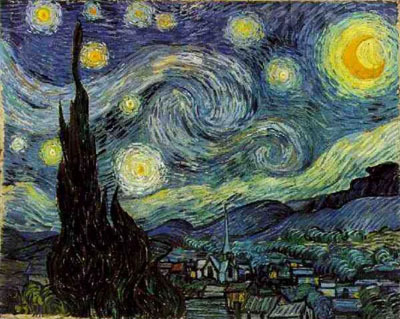
 Starry Night, 1888, Vincent Van Gogh
 Van Gogh' Bedroom in Arles, 1889, Vincent Van Gogh
Henri de Toulouse-Lautrec was an artist I grew fonder. His caricatures didn't deprive the psychological depths and his
Women Pulling Up Her Stockings reminded me more obviously darker works by
Egon Schiele.
 Women Pulling Up Her Stockings, 1894, Henri de Toulouse-Lautrec
 Redhead (Bathing), 1889, Henri de Toulouse-Lautrec
 Woman with a Black Boad, 1892, Henri de Toulouse-Lautrec
 The Clown Cha-U-Kao, 1895, Henri de Toulouse-Lautrec
Next, I was enraptured by another favorite artist of mine - Odilon Redon. I have always loved his mythic subjects and his brilliant color schemes. Even his seemingly dull
Eyes Closed is actually ravishingly beautiful, which used the language of symbolism with elements of sleep, death and renaissance bust. His
Sleep of Caliban was typical of his style and just breathtakingly lovely.

Eyes Closed, 1890, Odilon Redon,
 The Sleep of Caliban, 1895-1900, Odilon Redon
The Symbolism "school" included works of varied styles, such as
The Poor Fisherman by Pierre Puvis de Chavannes, which employed a Christ-like suffering figure, simplistic and monumental;
Orpheus by Gustave Moreau - rich, ornate, pensive and retrospective; and
The Snake Charmer, by Henri Rousseau - mysterious, otherworldly and dangerous:
 The Poor Fisherman, 1881, Pierre Puvis de Chavannes
 Orpheus, 1865, Gustave Moreau
 The Snake Charmer, 1907, Henri Rousseau
The sensualist Pierre Bonnard was well represented as well. I love his
The Man and the Woman with two lovely contrasted nudes, separated by vertical objects, with the woman small and balled up, and the man stretched full height and confident. The lovely impasto of low value and harmonious paints were a wonder. That can be said of his
Woman Dosing on a Bed (Indolent Woman) as well, which boasted beautiful colors, though monochromatic, and looked like the inside of an oyster, lustrous and shining.
 The Man and the Woman, 1900, Pierre Bonnard
 Woman Dosing on a Bed (Indolent Woman), 1899, Pierre Bonnard
I also like his whimsical
The White Cat, which somewhat looked like a work by Toulouse-Lautrec:
 The White Cat, 1896, Pierre Bonnard
What I don't like were his two decorative panels: Water Games (The Voygage) and Pleasure (not pictured) - with their ghastly orange decorative borders, they looked rather like representations of easy-going hell:
 Decorative Panel: Water Games (The Voygage), 1906-10, Pierre Bonnard
Other works could be described as somewhat decorative are quite lovely, though
The Talisman, the Aven at the Boss d'Amour by
Paul Sé
rusier was rather semi-abstract but it did have design quality to it so I mention it in this group.
 The Talisman, the Aven at the Boss d'Amour, 1888, Paul Sérusier
Other such "decorative" works included those by Maurice Denis and Ker-Xavier Roussel. They were also lovely and not without deeper meanings. Calling them decorative did not mean they were shallow, especially
Landscape with Green Trees (Green Trees) (Procession Under the Trees) by Maurice Denis, which could be called symbolism work as well:
 The Muses, 1893, Maurice Denis
 Landscape with Green Trees (Green Trees) (Procession Under the Trees), 1893, Maurice Denis
 The Terrace, c. 1892, Ker-Xavier Roussel
It was a most exulted exhibit and I would go back again in two weeks' time.
During this wonderful run, De Young Museum was hit by a little controversy regarding sketching in the museum. Apparently someone tried to make sketches in this crowded show and was told not to. In order to clarify the matter,
De Young Museum published its sketching policy online:
We'd like to take a moment to clarify the museum's sketching policy, in light of the recent and rather controversial article in the San Francisco Chronicle. We welcome and encourage artists to be inspired by and learn from our collections—sketching is permitted for all visitors in the permanent collection galleries at both the de Young and Legion of Honor. With prior notice and approval, artists can also use easels and paints in the permanent collection galleries.
Rules about sketching in traveling exhibitions are determined by two factors—the agreement with the lending institution or collector, and the volume of visitors to an exhibition. Lenders often prohibit sketching in proximity to their works of art when on view at another museum instead of in their own galleries. Sketchers have a tendency to limit crowd flow by blocking access to popular paintings for a long period of time. Because we are the only museum in North America to host Van Gogh, Gauguin, Cezanne and Beyond our daily attendance is very high. With the galleries so crowded, it is virtually impossible to allow sketching.
Come sketch in the museum's permanent collection galleries this weekend, December 18 and 19. The first 20 visitors to check in at the de Young's information desk on Saturday and Sunday will receive a complimentary sketch pad, pencil, and one general admission pass to the permanent collection galleries.
This was a sensible policy therefore I felt no need to call for a sketching-in.
Thank you, De Young Museum.



 Posts
Posts


