Showing posts with label Paris. Show all posts

Saturday, November 14, 2015

My Featured Work: Sorrow and Suffering, a Diptych Commemorating the Tragedies of our Time

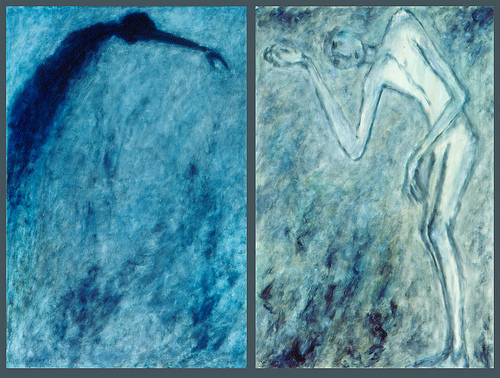
Human history is sadly saturated with sorrow and suffering, a theme resonates strongly with me. In 2003, I made a diptych of oil paintings, titled "Sorrow and Suffering", to record the pain people suffered and will suffer at the hands of ruthless and/or reckless political leaders, when George W. Bush was brandishing his excuse to invade Iraq.

Diptych - Sorrow and Suffering / 雙面圖 - 悲哀和苦難 / Diptychon - Traurigkeit und Leiden  
Sorrow and Suffering
Oil on Canvas 
Completed in 2003

Since that fateful invasion, the unstable Mideast became ever more explosive and the human suffering ever escalated. Yesterday a series of concerted attacks on civilians in the great city Paris shocked and saddened the civilized world and this diptych expresses my feeling aptly.

Originally posted on my website: Featured Works.

Related posts on Art · 文化 · Kunst:
- My Featured Work - Portrait Painting "Grandma"

- "Arabesque" and Other Paintings Inspired by Literature
- A Portrait - First Painting Completed in 2012 - Matthew Felix Sun
- "Sibyls" - Portraits of Old Women
- "Diptych - Dawn" Won Another Award - Matthew Felix Sun

Saturday, June 7, 2014

My Favorite Sculptures in Cathédrale Notre Dame de Paris

Whenever Cathédrale Notre Dame de Paris was mentioned, one often thinks of the fantastic gargoyles on the rooftop and the rose windows above the portals, justifiably so.  Yet, despite all those famous objects, and the holy artifacts in the treasury, I would cite the below two sculptures as my favorite from the cathedral.

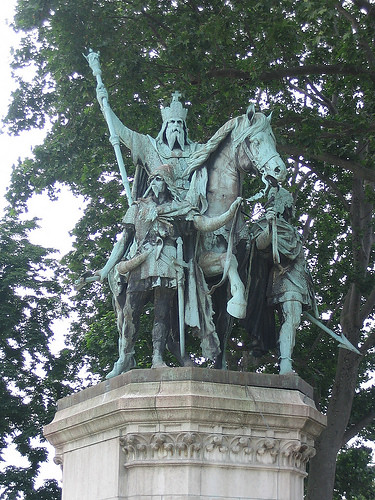
My first favorite was a bronze equestrian statue of Charlemagne, weather beaten, hollow looking yet undeniably grand, dominating the side plaza.  The green patina interwove with dark sooty patches, adding senses of history to this marvelous sculpture.

IMG_8227 _ Cathédrale Notre Dame de Paris, 2008
Equestrian Statue of Charlemagne

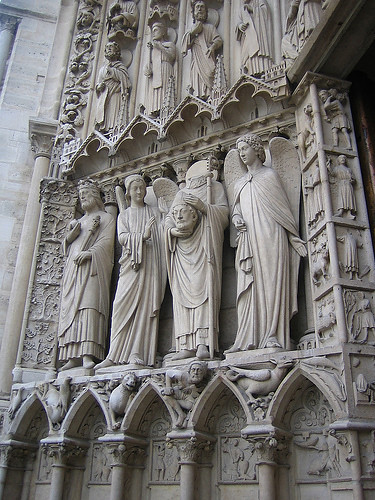
My second favorite was one of the many figures by one of the portals to the cathedral, centering on the patron saint Denis of Paris, who was the third century Bishop of Paris and was martyred shortly after 250 AD. According to legend, after his beheading, he picked up his head and walked ten kilometres (six miles) and preached a sermon during his final voyage.

Saint Denis, along with other figures, including two winged angels, stood on pedestals supported by strange beasts and figures, looked quite serene, with their flowing draperies, in their simplistic lines, like the creations of master draftsman, formed a memorable but not ungainly sight for this ghastly story.

IMG_8242 _ Cathédrale Notre Dame de Paris, 2008
Saint Denis and Angels

My Favorite Museum Collection Series
>> My Favorite Museum Collection Series 80: My Favorite Paintings at Albertina Museum, Vienna
<< My Favorite Museum Collection Series 78: My Favorite Sculptures in Église de Saint-Germain-des-Prés

List of My Favorite Artworks in the Museums I've Visited  


Other Related posts on Art · 文化 · Kunst:
- My Favorite Sculptures in Basilique Saint-Denis (Paris)
- My Favorite Paintings at Église Saint-Sulpice, Paris
- Magnificent Churches in Vienna
- My Favorite Sculpture and Painting at Church of Our Lady, Bruges
- My Favorite Paintings in Cathedral of Our Lady, Antwerp (Antwerpen), Belgium
- Architectural Wonder - the Cathedral of Christ the Light in Oakland

Thursday, May 29, 2014

My Favorite Sculptures in Église de Saint-Germain-des-Prés

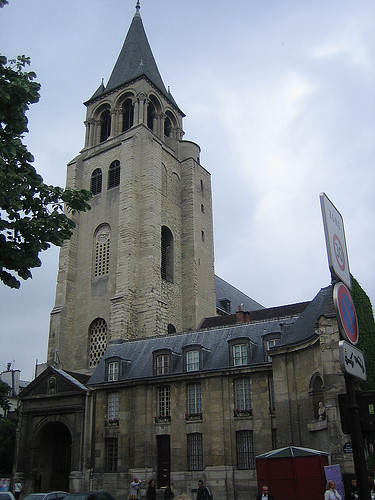
IMG_8089, Église de Saint-Germain-des-Prés, ParisThe ancient abbey, Église de Saint-Germain-des-Prés, founded in the 6th century, was one of the most revered institutions in Paris, both as religious site and a cultural landmark in the Latin Quarter.

I was lucky enough to have stayed in its vicinity in my two trips to Paris, and have visited and walked by its imposing structure many times.  If the building itself was more eye-catching, many sculptures in the dimly-lit interior and in the modesty garden were more enchanting - seemingly neglected, abandoned, even damaged, which however, perversely created a certain authentic gloomy charm, which far preferable than a restoration à la Las Vegas. 

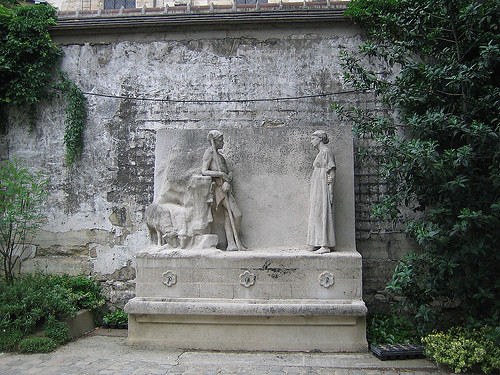
My favorite sculpture there was an outdoor high relief in a semi-deserted garden, depicting a shepherd on the left, leaning against a rock, long staff in hand, in a casual pose, facing a rather rigid looking maiden or matron, standing at the far right.  If there were three women in the group, I'd say that it was the Judgement of Paris.  With only one woman or goddess present, therefore, I couldn't determine what the story was.  Looking closer, it seemed to me that the woman was judging the shepherd.  Perhaps, the story ought to be from the Bible, instead of my bible, the Greek mythology? 

IMG_8108, Église de Saint-Germain-des-Prés, Paris

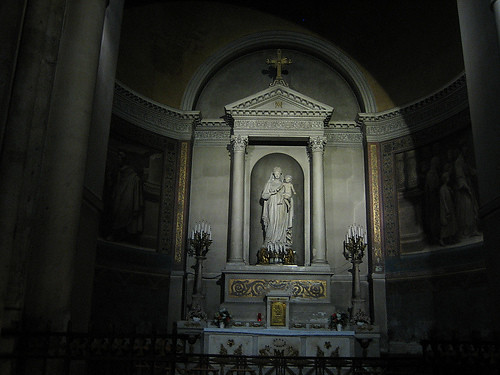
My second favorite sculpture was doubtless about Virgin Mary and the Child, in a small niche altar inside the dark interior.  I loved its simplicity and purity, which practically shone in the midst of the semi-darkness.

IMG_8107, Église de Saint-Germain-des-Prés, Paris

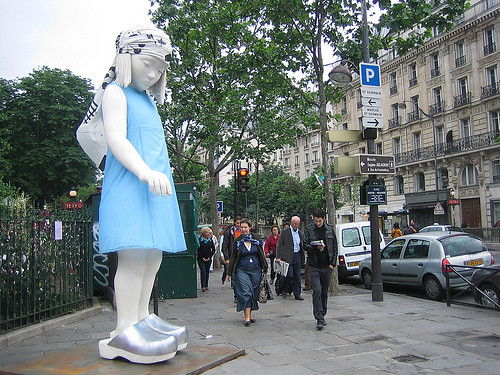
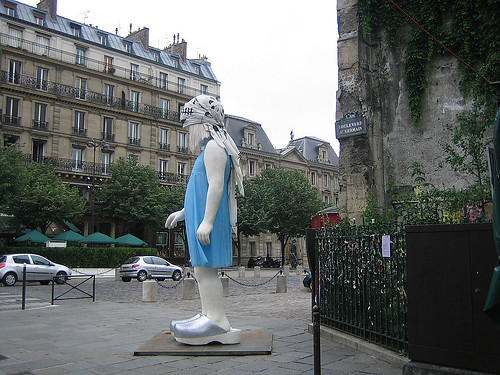
In addition, there was a giant cartoon maiden, in pink blue dress and silver shoes, standing in front of the moss-covered ancient building during my second trip to Paris in 2008, and the clashing contrast left an indelible impression. If it was not permanent, then it was quite a delight.

IMG_8092, Église de Saint-Germain-des-Prés, Paris IMG_8112, Église de Saint-Germain-des-Prés, Paris


My Favorite Museum Collection Series
>> My Favorite Museum Collection Series 79: To be continued
<< My Favorite Museum Collection Series 77: My Favorite Artworks in Panthéon, Paris

List of My Favorite Artworks in the Museums I've Visited  


Other Related posts on Art · 文化 · Kunst:
- My Favorite Paintings at Église Saint-Sulpice, Paris
- My Favorite Sculpture and Painting at Musée d'Art moderne de la Ville de Paris
- Basilica di San Petronio and San Domenico in Bologna
- My Favorite Sculptures in les Jardins du Ranelag, Paris
- Basilica Santuario Santo Stefano, Bologna
- My Favorite Sculpture and Painting at Church of Our Lady, Bruges
- Magnificent Churches in Vienna
 

Sunday, April 27, 2014

My Favorite Sculptures in le Jardin des Tuileries

Le Jardin des Tuileries, the former royal garden dated back to Catherine de Medicis in the 16th century, situates between the Louvre and Place de la Concorde, is a wonderful place for Parisians to promenade, meet, and display.

It also hosts a wonderful museum, Musée de l'Orangerie, built to host the amazing series of Claude Monet's Les Nymphéas (Water Lilies).  Besides major works by Monet, it also collected many important late 19th - early 20th century modern works (Paul Guillaume collection).

In 2000, when I visited Paris for the first time, Musée de l'Orangerie was closed for renovation and only during my second trip to Paris in 2008, was I able to see Les Nymphéas and other amazing works inside the oval-shaped museum.

Artworks in Paris were not confined inside museums, therefore we saw many sculptures in the ground of Jardin des Tuileries.

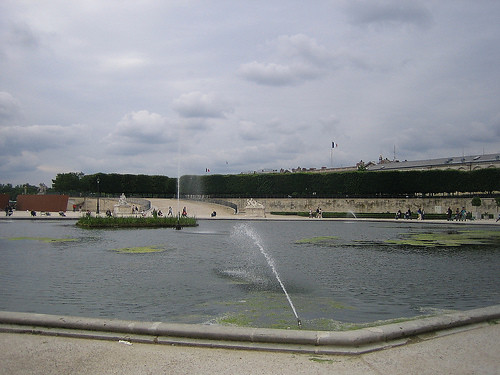
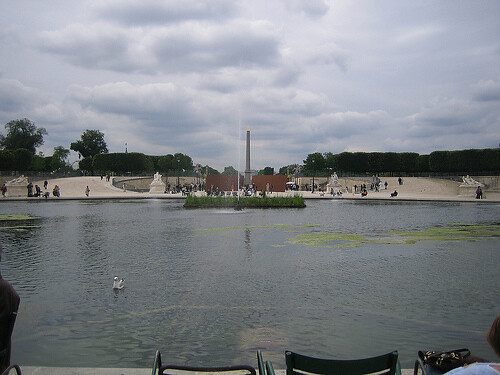
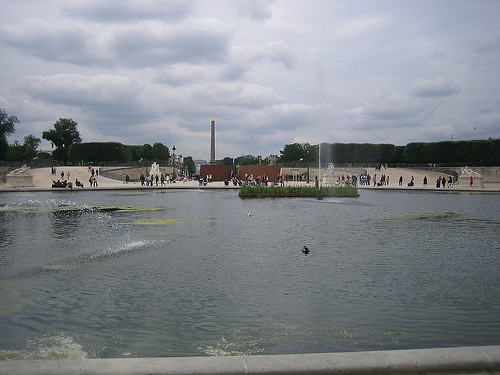
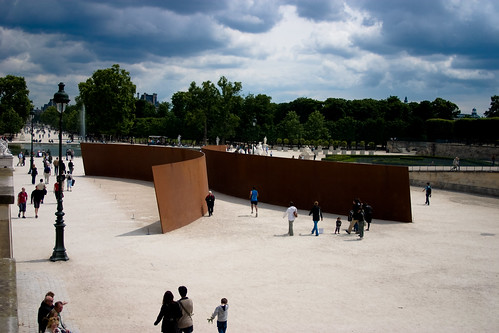
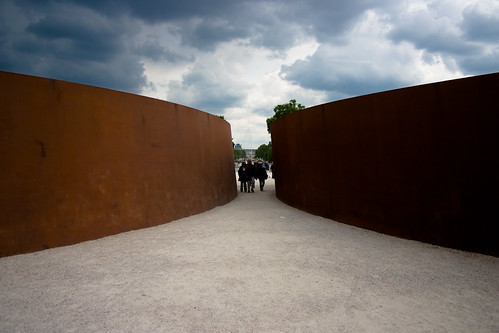
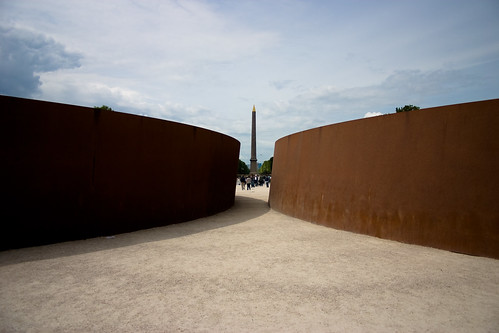
The most amazing one was a gigantic modern work, by American artist Richard Serra, Clara-Clara, which consisted of two giant curved steel plates, forming an opened doorway, echoing the carriage driveway behind it.  The sculpture sat in the center of the elongated Jardin and from the opening of the "arms", seen from the side of the reflection pond, one could see the distant obelisk in the Place de la Concorde.  Seen across the pond, one could see a tall jet of water fountain competing with the obelisk.

IMG__7907 - Clara Clara, Richard Serra, Jardin des Tuileries, Paris 2008

IMG_7900 - Clara Clara, Richard Serra, Jardin des Tuileries, Paris 2008

IMG_7897 - Clara Clara, Richard Serra, Jardin des Tuileries, Paris 2008

The fun part was walking around it, examining the changing shapes from various vantage points, and walking through the opening and to admire the "strategically placed" obelisk in the middle of the opening of the outstretching sensuous arms of Clara-Clara.

Clara Clara - Richard Serra - Jardin des Tuileries
Photo courtesy: Tybo

Clara Clara - Richard Serra - Jardin des Tuileries
Photo courtesy: Tybo

Clara Clara - Richard Serra - Jardin des Tuileries
Photo courtesy: Tybo

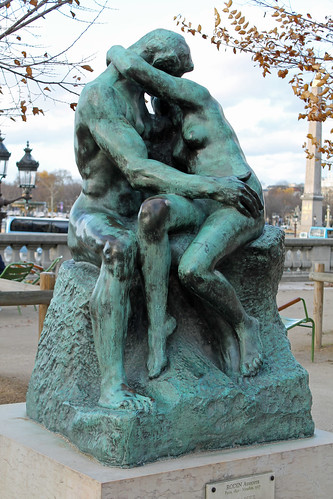
The second favorite sculpture of mine in le Jardin des Tuileries was Le Baiser (The Kiss) (1934 cast of the marble original), by omnipresent Auguste Rodin. It was a typical Rodin, monumental, sensual, life-like and larger than life.  Despite the metal material, and the though marvelous but unnatural green patina, the lovers were every inch the flesh and blood beings.

The Kiss by Rodin
Photo courtesy: Sarah Stierch

IMG__7910 - The Kiss, Auguste Rodin, , Jardin des Tuileries, Paris 2008


My Favorite Museum Collection Series
>> My Favorite Museum Collection Series 76: My Favorite Drawing and Painting in Musée Cognacq-Jay, Paris
<< My Favorite Museum Collection Series 74: My Favorite Artwork at Musée de Cluny - Musée national du Moyen Âge, Paris

List of My Favorite Artworks in the Museums I've Visited  


Other Related posts on Art · 文化 · Kunst:

- My Favorite Sculptures in Jardin du Luxembourg, Paris
- My Favorite Sculptures in les Jardins du Ranelag, Paris
- Richard Serra in Grand Palais, Paris
- Rodin and Richard Serra in Cantor Arts Center, Stanford University
- Inside Richard Serra's Sculpture "Sequence" at Cantor Arts Center, Stanford University
- Richard Serra Drawing and 2010 SECA Art Award at SFMOMA
- My Favorite Sculptures at Musée Rodin, Paris
- Revisiting Norton Simon Museum in Pasadena
- My Favorite Sculptures at Cimetière du Père-Lachaise, Paris
- Art in the Streets of Shenyang, China
- A Day at Palace of Fine Arts & Crissy Field in San Francisco

Wednesday, April 23, 2014

My Favorite Artwork at Musée de Cluny - Musée national du Moyen Âge, Paris

Not far from Jardin du Luxembourg in Paris, lies Musée de Cluny, officially known as Musée National du Moyen Âge, which boasts many magnificent ancient artifacts.  Even for people who are not usually interested in the Medieval era, if they are open-minded enough, they might be pleasantly surprised by many surprisingly vital things they'll encounter there, and might even re-assess their own notions of stilted Middle-Age.

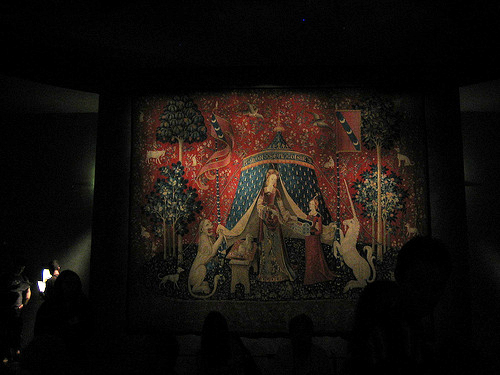
My favorite collection in this museum was a group of six tapestries, under the name of La Dame à la licorne - The Lady and the Unicorn: My only desire and five senses. In the dark room, the pale pink tapestries glowed with unbridled sensuality and it was the culmination of the chivalry culture of the romantic era.

Musée National du Moyen Âge: Lady_and_the_Unicorn by Atlant
Photo courtesy of Atlant

La Dame à la licorne: A mon seul désir, Musée National du Moyen Âge, Paris, 2008

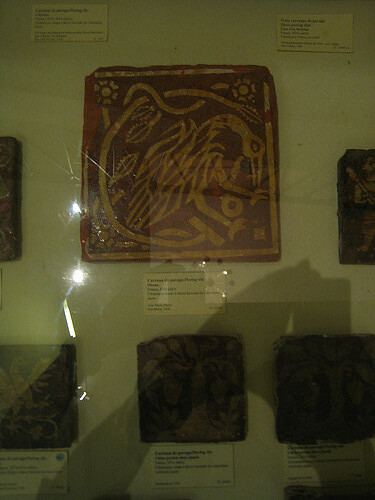
My second favorite object was harder to pick amongst numerous wonderful things and finally I decided on an ancient tile with a bird dominating the center of the square, painted light on maroon colored background. Evocative pose, rich coloration, fluid lines, economical yet rich in detail, it was startlingly modern and authentically ancient. 

Ancient Tile - Musée national du Moyen Âge, Paris, 2008


My Favorite Museum Collection Series
>> My Favorite Museum Collection Series 75: My Favorite Sculptures in le Jardin des Tuileries
<< My Favorite Museum Collection Series 73: My Favorite Artworks at Musée National Eugène Delacroix, Paris

List of My Favorite Artworks in the Museums I've Visited  

Other Related posts on Art · 文化 · Kunst:
- Musée de Cluny - Musée national du Moyen Âge, Paris
- The Cloisters - The Metropolitan Museum of Art, New York City
- My Favorite Paintings at Musée Marmottan Monet
- My Favorite Sculptures at Musée Rodin, Paris
- Revisiting Norton Simon Museum in Pasadena
- My Favorite Paintings from Musée Picasso, Paris
- My Favorite Sculptures at Cimetière du Père-Lachaise, Paris
- My Favorite Paintings in Cathedral of Our Lady, Antwerp (Antwerpen), Belgium

Friday, April 11, 2014

My Favorite Artworks at Musée National Eugène Delacroix, Paris

Musée National Eugène Delacroix (Musée Delacroix) in Paris is a modest museum which though contains works from nearly every phase of Delacroix’s career, covering many of his themes, along with some of his memorabilia.

According to the museum, "Magdalene in the Desert, exhibited at the 1845 Salon and one of the museum’s major paintings, is a most unusual religious composition, as compared to Education of the Virgin, painted in Nohant in 1842. The museum also boasts the artist’s only three attempts at fresco, which were done in Valmont (1834)."

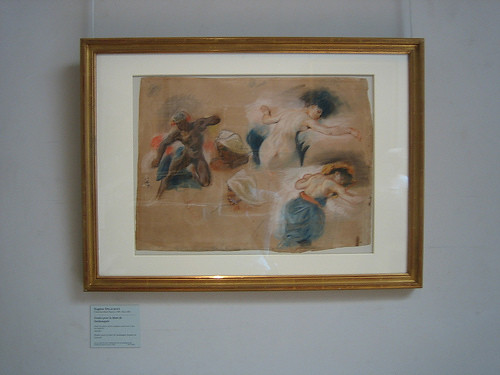
These paintings, sketches and other works were intimate and quite personal, comparing to his more monumental works often encountered in more exalted institutions, such as Musée du Louvre. Incidentally, one of my two favorite artworks in Musée Delacroix was a preparation work for his gigantic La Mort de Sardanapale (Death of Sardanapalus), collected by Louvre. 

IMG_9000 - Study for La Mort de Sardanapale, Eugène Delacroix, Musée Delacroix, Paris, 2008

Though concentrating on a small slice of the huge final composition, this study conveyed the same strange mix of terror and abandon.  With its exceptionally delicate coloration, its figures looking like exotic birds in strange poses, this study was eerily beautiful and even evoked the calm world of Albrecht Dürer's meticulous watercolor still life.  Being a romanticist, Delacroix's work though was naturally more sweeping in execution; being a study, it also carried impressionistic traits.

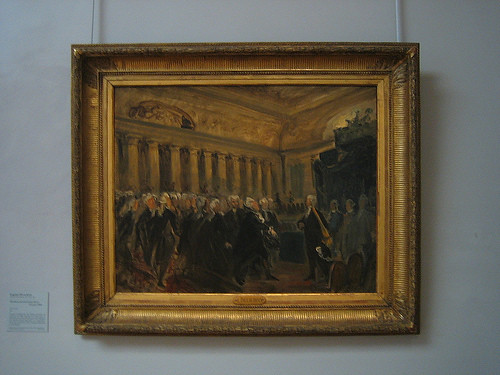
My second favorite work there was another study for another historical moment - Study for Mirabeau Confronts the Marquis de Dreux-Brézé, during the French Revolution, over the procedure therefore substance of the congress of three estates.

IMG_9004 - Study for Mirabeau Confronts the Marquis de Dreux-Brézé, Eugène Delacroix, Musée Delacroix, Paris, 2008

This study was both energetic and economic.  The eloquence of the painting lay in the restrained bod languages of the grandees, whose multiplying dark frocks and gray wigs foreshadowed the mob scenes soon to come, and the gilded panels and roof of the interior clashed violently with the somber and unsmiling figures of the confronting parties.  Despite being a sketch, it was a masterpiece, similar to many very revealing and satisfying study sketches by Pieter Paul Rubens. 

The final composition of this work is in the Ny Carlsberg Glyptotek in Copenhagen.  One day I'd love to see it there, and to see whether it would be one of my two favorites there or not.


My Favorite Museum Collection Series
>> My Favorite Museum Collection Series 74: My Favorite Artwork at Musée de Cluny - Musée national du Moyen Âge, Paris

<< My Favorite Museum Collection Series 72: My Favorite Artworks at Maison de Victor Hugo, Paris 

List of My Favorite Artworks in the Museums I've Visited  

Other Related posts on Art · 文化 · Kunst:
- My Favorite Paintings at Musée Marmottan Monet
- My Favorite Sculptures at Musée Rodin, Paris
- Revisiting Norton Simon Museum in Pasadena
- My Favorite Paintings from Musée Picasso, Paris
- The Museum of Modern Art, New York City
- My Favorite Sculptures at Cimetière du Père-Lachaise, Paris
- My Favorite Paintings in the Courtauld Gallery at Somerset House, London
- My Favorite Paintings in Cathedral of Our Lady, Antwerp (Antwerpen), Belgium

Wednesday, April 2, 2014

My Favorite Artworks at Maison de Victor Hugo, Paris

After visiting Balzac's former residence, a trip to Maison de Victor Hugo, Paris was in order and there, in the crazily decorated old flat in a fashionable building with a lovely courtyard in Le Marais district, I was amused by some quite idiosyncratic decorations and odd collections. 

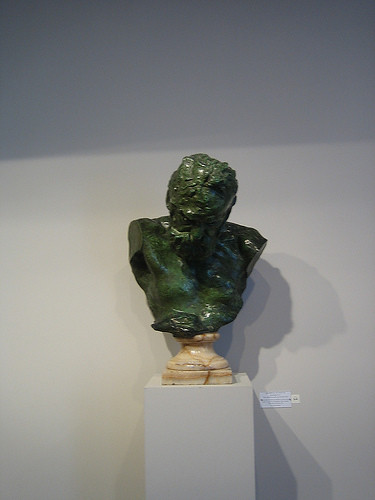
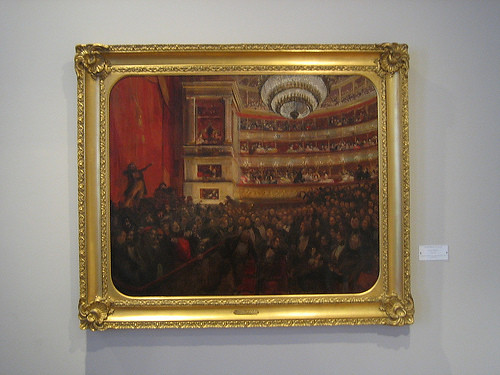
Amongst such clutters, several sculptures, paintings and prints stood out and my two favorites there were a bust of Hugo and a painting depicting the battle between classists and romanticists during the performance of his play, Hernani.

The Victor Hugo, buste héroïque was once again by the great French sculptor Auguste Rodin (1840-1917).  This bronze sculpture presented the triangle-shaped bust of a lean and brawny Hugo, without clothes and stripped of his arms, precariously perched on a small marble stand.  Head bent down, he was lost in his own thoughts, not dissimilar to Le Penseur, the most celebrated work by Rodin.

IMG_8803 _ Victor Hugo, buste héroïque, Auguste Rodin, 1902 (2), 1908, Bronze, Maison de Victor Hugo, Paris, 2008
Victor Hugo, buste héroïque, Auguste Rodin (1840-1917), 83 x 56 x 65 cm, 1902 (2), 1908, Bronze (fonte Alexis Rudier)

The painting, Performance of 'Hernani' by Victor Hugo in 1830, aka, The Battle of Hernani, by Paul Albert Besnard was quite virtuosic in depicting an animated crowd scene; if its artistic value was not the most accomplished, it did command viewers' attention and was hard to forget, and that made it a wonderful work. 

Hernani was Hugo's romantic play, during its premiere, in anticipating attacked from the classists, Hugo enlisted the support of fellow romanticists to combat the opposition and indeed the play had caused fights amongst the audience.  It was one of the watershed moment of the course of artistic development.  The painting captured the maniac atmosphere of that significant moment wonderfully. 

IMG_8800 _ Performance of 'Hernani' by Victor Hugo in 1830, Paul Albert Besnard, Maison de Victor Hugo, Paris, 2008
Performance of 'Hernani' by Victor Hugo in 1830, Paul Albert Besnard


My Favorite Museum Collection Series
>> My Favorite Museum Collection Series 73: My Favorite Artworks at Musée National Eugène Delacroix, Paris

<< My Favorite Museum Collection Series 71: My Favorite Artworks in La maison de Balzac, Paris

List of My Favorite Artworks in the Museums I've Visited


Other Related posts on Art · 文化 · Kunst:
- My Favorite Paintings at Musée Marmottan Monet
- My Favorite Sculptures at Musée Rodin, Paris
- Revisiting Norton Simon Museum in Pasadena
- My Favorite Paintings from Musée Picasso, Paris
- The Museum of Modern Art, New York City
- My Favorite Sculptures at Cimetière du Père-Lachaise, Paris
- Fifteen Authors Influenced Me Most and Watching Shakespeare in China
- Swiss Author and Dramatist Friedrich Dürrenmatt
- Molotov's Magic Lantern: A Journey In Russian Histoy by Rachel Polonsky and Some Journeys of My Own
- Review of "As Above, So Below" by Rudy Von B. Rucker

Saturday, March 29, 2014

My Favorite Artworks in La maison de Balzac, Paris

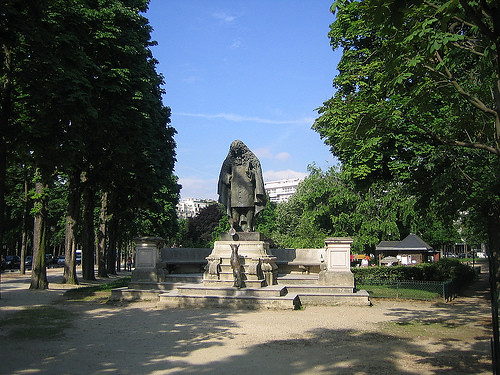
Honoré de Balzac was the first French author I encountered via his immortal Le Père Goriot, when I was still in elementary school, therefore I had a great affection for this great novelist and societal historian.

In 2008, when I returned to Paris, I made my way to his former residence, La maison de Balzac, in the western edge of the city, near Musée Marmottan Monet and Jardins du Ranelag in its vicinity. Balzac rented the top floor of that rather modest house, from 1840-1847 under his housekeeper's name (Mr. de Breugnol), evading his creditors from the city.

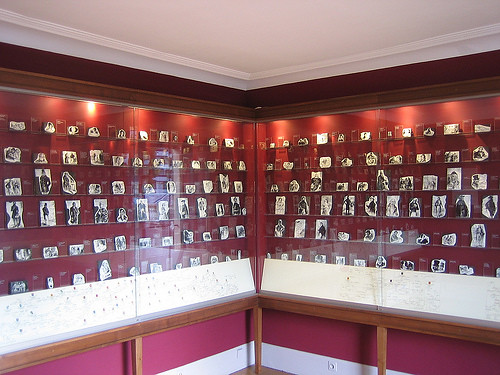
I loved Balzac's keen and cutting observation of the colorful characters populated the brutal society in Paris and provinces, and was delighted to see a roomful print blocks of main characters from his enormous, though unfortunately unfinished, La Comédie humaine.  Amongst those characters, my favorite had always been Eugène de Rastignac, a charming and innocent lad from province to a roguish and cynic though not without redeeming qualities, featured in several of his novels in this series.

Print blocks of characters from La Comédie humaine by Honoré Balzac, Le maison de Balzac, Paris, 2008
Print blocks of characters from La Comédie humaine by Honoré Balzac

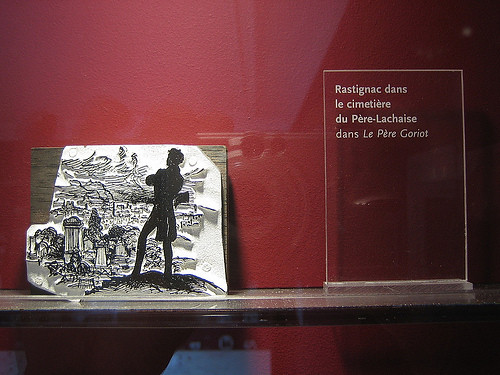
In the block below, Rastignac, after having buried the self-sacrificing Père Goriot, swore to fight with the corrupted city and its high society, before he jumped into the battle headlong, by joining his mistress, the younger daughter of Père Goriot, Delphine, Baroness de Nucingen.  It was the moment of truth and resolution, a moment of leaping from innocence to corruption.  The image was an utterly bleak and most biting assessment of the glittering Paris and its dazzling society.

IMG_8879 _ Eugène Rastignac dans le cimetière du Père-Lachaise dans Le Père Goriot, a main character from La Comédie humaine by Honoré Balzac, Le maison de Balzac, Paris, 2008
Eugène de Rastignac dans le cimetière du Père-Lachaise dans Le Père Goriot

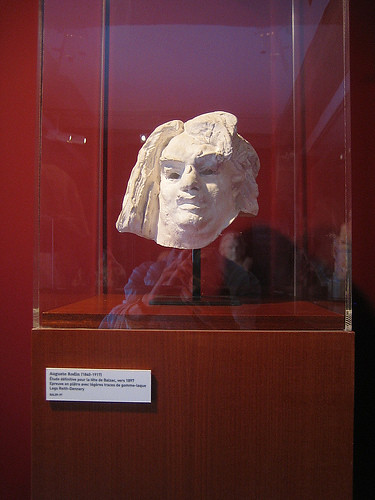
My second favorite artwork there was a definitive study of a head sculpture of the novelist by Auguste Rodin, made around 1897 - Étude définitive pour la tête de Balzac.  Behind exuberant air of the novelist, Rodin captured his sharp gaze and presented him as simultaneously sagely and clownish, embodying the broad spectrum of his oeuvre and his epoch. 

Sculpture of Honoré Balzac, Le maison de Balzac, Paris, 2008
Étude définitive pour la tête de Balzac, vers 1897, Auguste Rondin


My Favorite Museum Collection Series
>> My Favorite Museum Collection Series 72: My Favorite Artworks at Maison de Victor Hugo, Paris

<< My Favorite Museum Collection Series 70: My Favorite Sculptures in Jardins du Ranelag, Paris

List of My Favorite Artworks in the Museums I've Visited


Other Related posts on Art · 文化 · Kunst:
- My Favorite Paintings at Musée Marmottan Monet
- My Favorite Sculptures at Musée Rodin, Paris
- Revisiting Norton Simon Museum in Pasadena
- My Favorite Paintings from Musée Picasso, Paris
- The Museum of Modern Art, New York City
- My Favorite Sculptures at Cimetière du Père-Lachaise, Paris
- Fifteen Authors Influenced Me Most and Watching Shakespeare in China
- Swiss Author and Dramatist Friedrich Dürrenmatt
- Molotov's Magic Lantern: A Journey In Russian Histoy by Rachel Polonsky and Some Journeys of My Own
- Review of "As Above, So Below" by Rudy Von B. Rucker

Sunday, March 23, 2014

My Favorite Sculptures in les Jardins du Ranelag, Paris

On my way to Musée Marmottan Monet in the 16th arrondissement of western Paris, I encountered a lovely park, Les Jardins du Ranelagh, nearby, which obviously provided much pleasure to the residents nearby, and also boasted many amazing sculptures.

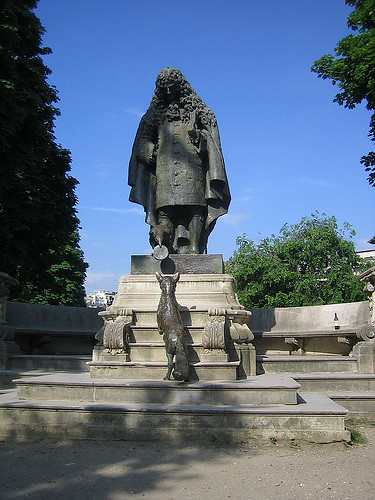
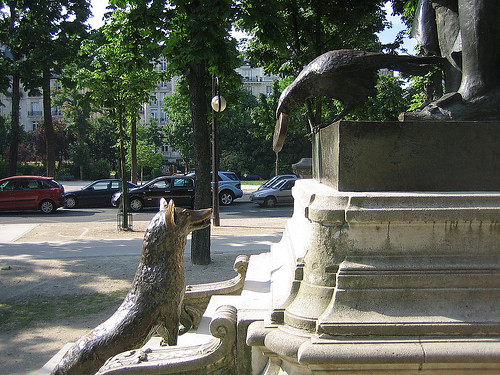
Of those, I found these two below most interesting.  The first one was a bronze, Hommage à Jean de La Fontaine (1983) by Charles Corréia (1945-1988).  The sculpture featured one of the most famous fables by Jean de La Fontaine, Le Corbeau et le Renard (The Fox and the Crow), depicting the cunning fox cheating the cheese out of the crow's mouth by flattery, observed by the poet.

IMG_8862 _ Hommage à Jean de La Fontaine (1983) by Charles Corréia (1945-1988), Jardins du Ranelag, Paris

IMG_8863 _ Hommage à Jean de La Fontaine (1983) by Charles Corréia (1945-1988), Jardins du Ranelag, Paris

IMG_8864 _ Hommage à Jean de La Fontaine (1983) by Charles Corréia (1945-1988), Jardins du Ranelag, Paris

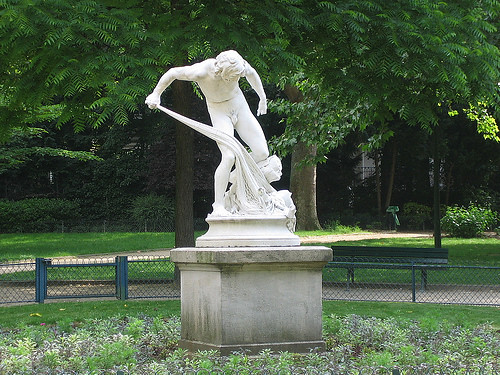
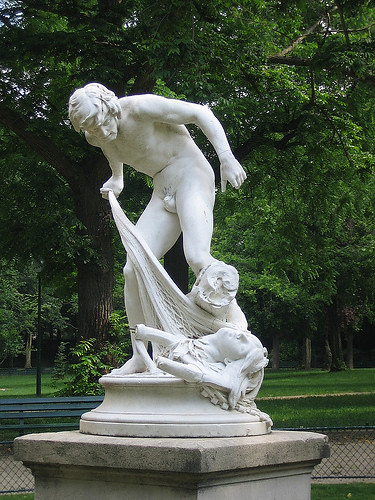
The second of my favorite sculpture there was a marble, Pêcheur ramenant la tête d’Orphée dans ses filets (Fisherman bringing the head of Orpheus in his nets), the sad ending of the immortal Orpheus myth. The sculpture was dynamic, lively, powerful, elegant and melancholic.  Unforgettable.

IMG 8901 _ Pêcheur ramenant la tête d’Orphée dans ses filets (1883), Louis-Eugène Longepied (1849-1883), Marbre, Jardins du Ranelag, Paris

IMG 8902 _ Pêcheur ramenant la tête d’Orphée dans ses filets(1883), Louis-Eugène Longepied (1849-1883), Marbre, Jardins du Ranelag, Paris

IMG 8903 _ Pêcheur ramenant la tête d’Orphée dans ses filets (1883), Louis-Eugène Longepied (1849-1883), Marbre, Jardins du Ranelag, Paris IMG 8904 _ Pêcheur ramenant la tête d’Orphée dans ses filets (1883), Louis-Eugène Longepied (1849-1883), Marbre, Jardins du Ranelag, Paris


My Favorite Museum Collection Series
>> My Favorite Museum Collection Series 71: My Favorite Artworks in La maison de Balzac, Paris
<< My Favorite Museum Collection Series 69: My Favorite Sculptures in Cimetière de Montmartre, Paris

List of My Favorite Artworks in the Museums I've Visited


Other Related posts on Art · 文化 · Kunst:
- My Favorite Sculptures at Cimetière du Père-Lachaise, Paris
- Grand Palais in Paris
- My Favorite Sculptures in Jardin du Luxembourg, Paris
- My Favorite Paintings at Musée Marmottan Monet
- Musée de Cluny - Musée national du Moyen Âge, Paris
- A Day at Palace of Fine Arts & Crissy Field in San Francisco
- The Song of Orpheus

Monday, March 3, 2014

My Favorite Sculptures in Cimetière de Montmartre, Paris

Cemeteries in Paris are often amazing places to visit - not only it consists a pilgrimage to the resting spots of so many renown artists and thinkers, but a brief immersion of an sculptural Eden. 

Cimetière de Montmartre, not far from the fabled club Moulin Rouge, though less renown and less frequently visited than Cimetière du Père-Lachaise, was just as astonishing in its cultural and artistic richness. There were so many beautiful spots there I saw in my visit there more than five years ago, and much more I didn't have time and energy to see them all. Amongst what enchanted me during that brief visit, I choose these two below as my favorite sculptures I encountered there:

One was a bronze sculpture at the tomb of Otto Klaus Preis (1936-2003) in Avenue de la Croix, one of the most beautiful ancient quarries of Montmartre, featuring a man who overcomes a tombstone, created by Paul Landowsky (1875-1961), author of the Sainte-Genevieve du Pont de la Tournelle in Paris, and Christ the Redeemer in Rio de Janeiro. The striding naked man was in full swing, aided by a sturdy stick, resolutely to overcome whatever was ahead of him.  It was full of vitality, and upon close examination, delicate beauty.  Quite a mixture yet harmoniously done.  This spot gave visitors reassurance more than anything else.

IMG__7840 - Otto Klaus Preis (1936-2003), Cimetière de Montmartre, Paris, 2008

My second favorite was the sculpture of Jean Bauchet (1906-1995), former director and performer (acrobat and singer) of Moulin Rouge, then owner of the club, Director of Casino de Paris and the Théâtre du Chatelet, creator of casinos in Lebanon and Morocco. Long before his death, he had this imposing Male Nude Bronze by Bernard Richard installed on his his grave spot.

Though I didn't care for all those fancy hats he wore, the sculpture itself impressed me deeply.  Everything about the sitter was monumental - huge bulk of body, huge head, strong limps, large hands and feet, in a pose reminiscent of Rodin's the Thinker, and that implied a huge personality and thinking mind.  If Monsieur Bauchet didn't become a most exalted artist during his life time, in his afterlife, his lookalike became a piece of true art.

IMG__7856 - Jean Bauchet (1906-1995), Moulin Rouge artist (acrobat and singer), and owner of Moulin Rouge, Director of Casino de Paris and the Théâtre du Chatelet, by Bernard Richard


My Favorite Museum Collection Series
>> My Favorite Museum Collection Series 70: My Favorite Sculptures in Jardins du Ranelag, Paris

<< My Favorite Museum Collection Series 68: My Favorite Sculptures at Château de Versailles

List of My Favorite Artworks in the Museums I've Visited


Other Related posts on Art · 文化 · Kunst:
- My Favorite Sculptures at Cimetière du Père-Lachaise, Paris
- Grand Palais in Paris
- Musée de Cluny - Musée national du Moyen Âge, Paris
- Travel Inspired Paintings
- Get Ready for the Treasures from Musée d’Orsay
- Picasso: Masterpieces from the Musée National Picasso, Paris - De Young Museum, San Francisco
- Birth of Impressionism at De Young Museum, San Francisc

Monday, February 17, 2014

My Favorite Sculptures in Basilique Saint-Denis (Paris)


Cathédrale royale de Saint-Denis, or simply Basilique Saint-Denis, is a very old and important cathedral in the outskirt of Paris, with its choir completed in 1144, considered to be the first medieval Gothic architecture ever built. Its rose window at the west portal was probably the first example of a rose window within a square frame, which was to become a dominant feature of the Gothic facades of northern France. Historically, the church was the burial place of the French Kings, with nearly every king from the 10th to the 18th centuries being buried there, plus many from previous centuries, including the beheaded Louis XVI and his queen, and the crystal urn containing their son, the young Dauphin's mummified heart. In addition, this abbey served as the locale for the coronation of many French queens.

In 2008, I visited this ancient place and was deeply impressed by the stern-looking cathedral and the historical and cultural sediments accumulated there.  The medieval building itself was the most impressive sight and particularly those relief adorned many portals.  One of the my favorites was the relief above the right portal, depicting Christ administers the Eucharist to Saint Denis and his companions on the eve of the Martyrdom, in the middle of the tympanum while the executioners closing in from both sides.

The line drawings like clean contours of the mythical figures, archaic looking, ancient, emaciated and strange, formed a scene of acceptance and dignity, rather than terrifying or terrified.  The martyrdom was never more serene and becalming. 

IMG_8405 _ Christ administers the Eucharist to Saint Denis and his companions on the eve of the Martyrdom, Basilique de Saint-Denis (Portail droit), Paris, France, 2008
Christ administers the Eucharist to Saint Denis and his companions on the eve of the Martyrdom, Basilique de Saint-Denis (Portail droit)

There were many sculptures, mostly burial monuments, inside the vast basilica, from humble to massive.  I found the effigies of Henry II of France (31 March 1519 – 10 July 1559) and his queen Catherine de' Medici (13 April 1519 – 5 January 1589) the most memorable - they were lying in full regalia, self-important and forbidding, yet held their hands in devote supplication, at once vulnerable and noble.  Such dichotomy always made the work much more interesting and even these two somewhat off putting nobles appealing.

IMG_8430 _ Tombs of Henry II of France and his wife Catherine de' Medici, Basilique de Saint-Denis, Paris, France, 2008
Tombs of Henry II of France and Catherine de' Medici


My Favorite Museum Collection Series

>> My Favorite Museum Collection Series 68: My Favorite Sculptures at Château de Versailles
<< My Favorite Museum Collection Series 66: My Favorite Paintings at Église Saint-Sulpice, Paris

List of My Favorite Artworks in the Museums I've Visited


Other Related posts on Art · 文化 · Kunst:
- Grand Palais in Paris
- Musée de Cluny - Musée national du Moyen Âge, Paris
- Travel Inspired Paintings
- Get Ready for the Treasures from Musée d’Orsay
- Picasso: Masterpieces from the Musée National Picasso, Paris - De Young Museum, San Francisco
- Birth of Impressionism at De Young Museum, San Francisco

Wednesday, June 5, 2013

My Favorite Paintings at Église Saint-Sulpice, Paris

Old European churches are often art treasure troves and Église Saint-Sulpice in Paris is just on of such amazing institutions. 

According to Wikipedia, at 113 metres long, 58 metres in width and 34 metres tall, it is only slightly smaller than Notre-Dame and thus the second largest church in the city. It is dedicated to Sulpitius the Pious. During the 18th century, an elaborate gnomon (part of a sundial that casts the shadow), the Gnomon of Saint-Sulpice, was constructed in the church.

Many people learned of this cathedral through Dan Brown's bestseller, The Da Vinci Code, while I through a French opera, Jules Massenet's Manon. In both works, pivotal scenes took place in this cathedral, therefore it earned a few paragraphs before I narrate on my favorite paintings it housed.

Saint-Sulpice, Paris, June 2008 - IMG_8115 The gnomon, Saint-Sulpice, Paris, June 2008 - IMG_8142

The above pictures showed the interior of the church and the gnomon (in the background) and the brass line on the floor.  You can see the detail of the gnomon in the larger picture below:

Saint-Sulpice, Paris, June 2008 - IMG_8123

Constructed by the English clock-maker and astronomer Henry Sully, the gnomon was also used for various scientific measurements: This rational use may have protected Saint-Sulpice from being destroyed during the French Revolution.

The sight of this gnomon in the obelisk shape was unusual but it couldn't hold my interest long and soon I wandered away to see many magnificent stained glasses and then, in the Chapel of the Holy Angels, some unforgettable mural paintings by Eugène Delacroix, who painted scenes from The Bible, in the effort to repair the extensive damages the church suffered during the Revolution.  

My favorite mural there was the Jacob Wrestling with the Angel, dynamic in composition, romantic in scene setting and the result was both somewhat unsettling and absolutely beautiful.

Jacob Fights with the Angel, Eugène Delacroix, Saint-Sulpice, Paris, June 2008 - IMG_8145

Jacob Fights with the Angel (Detail), Eugène Delacroix, Saint-Sulpice, Paris, June 2008 - IMG_8151

My second favorite painting in Saint-Sulpice was St Michael defeats the Devil, again by Delacroix.  This painting had the similar atmosphere and dynamism as Wrestling.  The major difference was that St Michael was mounted on the ceiling therefore the St Michael's triumph was presented as a brilliant celestial vision and his victory had a cosmic feeling versus the more intimate and personal one of the Wrestling.  The colors in this painting was more brilliant and the Archangel occupied the absolute center of the painting, being the unchallenged center focus of this celebratory and lovely painting.

St Michael defeats the Devil, Saint-Sulpice, Paris, June 2008 - IMG_8148

My Favorite Museum Collection Series

>> My Favorite Museum Collection Series 67: My Favorite Sculptures in Basilique Saint-Denis (Paris)
<< My Favorite Museum Collection Series 65: My Favorite Sculptures in Jardin du Luxembourg, Paris

List of My Favorite Artworks in the Museums I've Visited


Other Related posts on Art · 文化 · Kunst:
- Grand Palais in Paris
- Musée de Cluny - Musée national du Moyen Âge, Paris
- Travel Inspired Paintings
- Get Ready for the Treasures from Musée d’Orsay
- Picasso: Masterpieces from the Musée National Picasso, Paris - De Young Museum, San Francisco
- Birth of Impressionism at De Young Museum, San Francisco

Wednesday, April 24, 2013

My Favorite Sculptures in Jardin du Luxembourg, Paris

IMG_8032 - Jardin du Luxembourg, ParisIn 2008, when I arrived in my hotel in Paris, I was very pleased to find out that my hotel was very close to the lovely Luxembourg Garden (Jardin du Luxembourg) and I took daily strolls along the beautiful Boulevard Saint-Michel to the garden in order to savor the tranquility there, and to enjoy the companionship of over one hundred statues, monuments, and fountains, mostly in the classical restrained style, plus a few flamboyant modernistic works scattered about on the vast ground (left).

Of these metal or stone statues, I was particularly fond of a bronze one - Faun Dancing on a Wineskin, by Eugène-Louis Lequesne (1851), perhaps because of its convenient location - the faun stood close to the boulevard, facing the main square, just inside wrought-iron fences, always ready to greet me with his infectious wave and the inaudible horn.  It was very dynamic and full of movement and energy; at the same time, the form of the faun, or the boy, was classically graceful and a pure delight to the eyes.  Finally, it had a rich patina of aged bronze, contrasting nicely to the youthful dancing figure.

IMG_8015 - Faun dancing on a wineskin, bronze by Eugène-Louis Lequesne (1851) - Jardin du Luxembourg, Paris
Faun Dancing on a Wineskin, bronze by Eugène-Louis Lequesne (1851)

My second favorite statue in the Garden was a stone statue, La Bocca della Verità by Jules Blanchard, referring to the Roman legend that one tells a lie with one's hand in the Mouth of the Truth, it would be bitten off.  The one in Roma was just a round plate of face; here a female nude made an almost teasing gesture of putting her hand inside the mouth of a quite small shield-shaped face, held in her other hand, as if she was petting a not always obedient pet, whimsical and full of fun.  It often brought faint smiles to its viewers and for that one must be grateful.

IMG_8071 - La Bocca della Verità, statue by Jules Blanchard, Jardin du Luxembourg, Paris
La Bocca della Verità, statue by Jules Blanchard

IMG_8072 - La Bocca della Verità, statue by Jules Blanchard, Jardin du Luxembourg, Paris
La Bocca della Verità, statue by Jules Blanchard


My Favorite Museum Collection Series

>> My Favorite Museum Collection Series 66:  My Favorite Paintings at Église Saint-Sulpice, Paris
<< My Favorite Museum Collection Series 64: My Favorite Sculpture and Painting at Musée d'Art moderne de la Ville de Paris

List of My Favorite Artworks in the Museums I've Visited


Other Related posts on Art · 文化 · Kunst:
- Grand Palais in Paris
- Musée de Cluny - Musée national du Moyen Âge, Paris
- Travel Inspired Paintings
- Get Ready for the Treasures from Musée d’Orsay
- Picasso: Masterpieces from the Musée National Picasso, Paris - De Young Museum, San Francisco
- Birth of Impressionism at De Young Museum, San Francisco
Friday, April 19, 2013

My Favorite Sculpture and Painting at Musée d'Art moderne de la Ville de Paris

Musée d'Art moderne de la Ville de Paris (MAM) (Paris City Museum of Modern Art), is less talked about than other institutions in Paris, such as Musée du Louvre or Musée d'Orsay.  But, a rich city as Paris has much to offer and even its "lesser" museum could be a treasure trove and MAM is just one of such wonderful museums.  I stumbled upon this museum when I wandered about the city alone in 2008, and beside an amazing special exhibit which lured me in, I was very happy to see many wonderful permanent collections there, many of them by masters such as Modigliani, Bonnard, etc.

My pick of the two favorites, however, went to Pablo Picasso, both in the more representative style, which I appreciate more than his later works, whose abstraction and absurdity often baffled me.  Here, I love his wonderfully melancholic bronze bust of a fool, Le Fou, whose sharp and intense feature contrast strongly to the title of the sculpture.  A wisest fool, a soberest crazy one. A lovely bust.

IMG_8923 - Le Fou, 1905, Pablo Picasso - Musée d'Art Moderne de la Ville de Paris, 2008
Le Fou, 1905, Pablo Picasso

IMG_8924 - Le Fou (The Crazy), 1905, Pablo Picasso - Musée d'Art Moderne de la Ville de Paris, 2008

His somber mood carried over to his painting, L'enterrement de Casagemas, the interment of his friend, a fellow Spanish painter Carlos Casagemas (1881 in Barcelona - 17 February 1901 in Paris), who shot himself because of an unrequited love for Germaine Pichot, who was later one of the models depicted in Picasso's Demoiselles d'Avignon.  The funeral scene was a fantastic one -- the mourners on earth juxtaposed with those overtly sensual ones, femmes fatale, in the heaven.  The overall tone was almost religious and devotional.  It is a very strange and moving piece of work, a most tender and personal one. 

IMG_8921 - L'enterrement de Casagemas, 1901, Pablo Picasso, Musée d'Art Moderne de la Ville de Paris, 2008
L'enterrement de Casagemas, 1901, Pablo Picasso


My Favorite Museum Collection Series

>> My Favorite Museum Collection Series 65: My Favorite Sculptures in Jardin du Luxembourg, Paris
<< My Favorite Museum Collection Series 63: My Favorite Paintings at Musée Marmottan Monet

List of My Favorite Artworks in the Museums I've Visited