
Showing posts with label Tapestry. Show all posts

Wednesday, April 23, 2014

My Favorite Artwork at Musée de Cluny - Musée national du Moyen Âge, Paris

Not far from Jardin du Luxembourg in Paris, lies Musée de Cluny, officially known as Musée National du Moyen Âge, which boasts many magnificent ancient artifacts.  Even for people who are not usually interested in the Medieval era, if they are open-minded enough, they might be pleasantly surprised by many surprisingly vital things they'll encounter there, and might even re-assess their own notions of stilted Middle-Age.

My favorite collection in this museum was a group of six tapestries, under the name of La Dame à la licorne - The Lady and the Unicorn: My only desire and five senses. In the dark room, the pale pink tapestries glowed with unbridled sensuality and it was the culmination of the chivalry culture of the romantic era.

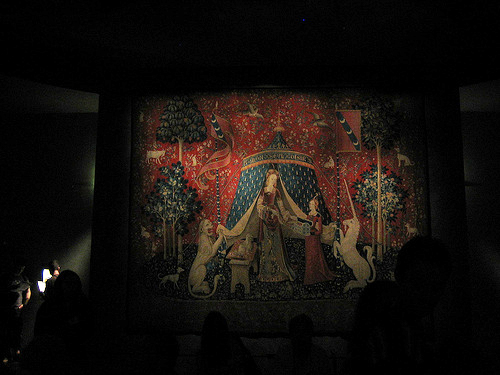
Musée National du Moyen Âge: Lady_and_the_Unicorn by Atlant
Photo courtesy of Atlant

La Dame à la licorne: A mon seul désir, Musée National du Moyen Âge, Paris, 2008

My second favorite object was harder to pick amongst numerous wonderful things and finally I decided on an ancient tile with a bird dominating the center of the square, painted light on maroon colored background. Evocative pose, rich coloration, fluid lines, economical yet rich in detail, it was startlingly modern and authentically ancient. 
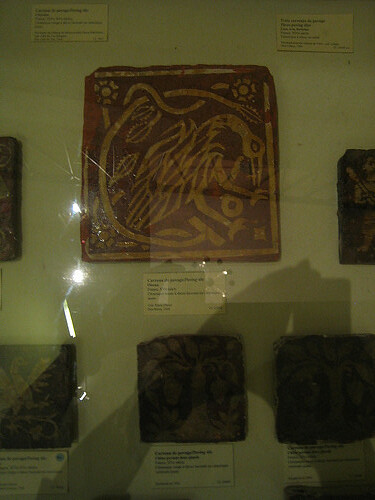
Ancient Tile - Musée national du Moyen Âge, Paris, 2008


My Favorite Museum Collection Series
>> My Favorite Museum Collection Series 75: My Favorite Sculptures in le Jardin des Tuileries
<< My Favorite Museum Collection Series 73: My Favorite Artworks at Musée National Eugène Delacroix, Paris

List of My Favorite Artworks in the Museums I've Visited  

Other Related posts on Art · 文化 · Kunst:
- Musée de Cluny - Musée national du Moyen Âge, Paris
- The Cloisters - The Metropolitan Museum of Art, New York City
- My Favorite Paintings at Musée Marmottan Monet
- My Favorite Sculptures at Musée Rodin, Paris
- Revisiting Norton Simon Museum in Pasadena
- My Favorite Paintings from Musée Picasso, Paris
- My Favorite Sculptures at Cimetière du Père-Lachaise, Paris
- My Favorite Paintings in Cathedral of Our Lady, Antwerp (Antwerpen), Belgium

Thursday, February 2, 2012

My Favorite Collections at The Cloisters, Metropolitan Museum of Art, New York

Metropolitan Museum of Art, New York, has a wonderful branch - The Cloisters, devoted to the art and architecture of medieval Europe, with approximately three thousand works dating from the twelfth through the fifteenth century. The building and its cloistered gardens—located in Fort Tryon Park in Northern Manhattan—are treasures in themselves, effectively part of the collection housed there.

In 2010, I visited it for the first time and blogged about it rather broadly.  Today, I set up another task of choosing two artworks collected there touched me the most.  My picks are a wood sculpture of Crucifix and a tapestry featuring a unicorn in captivity.

The below Crucifix was as moving and otherworldly as a religious devotional piece can be.  Its seemingly stiff and old fashioned curving actually enhanced its mystery to modern eyes.  It was a reminder of the ancientness of Christian cult and the surrounding murals of Mother of God and other Saints complemented this powerful work wonderfully with their multiple-hued coloration and softer lines.  Below the sculpture, narrow slits of lights illuminated the vault reluctantly, and added extra layer of drama and mystery.

Crucifix, Palencia, Castile-León, c. 1150–1200, The Cloisters, The Metropolitan Museum of Art, New York _7894
Crucifix, Palencia, Castile-León, Spain, c. 1150–1200
Corpus: white oak and pine with polychromy, gilding, and applied stones; Cross: red pine, polychromy

The other favorite of my there is "The Unicorn in Captivity".  Crucifix is a religious artifact, while this one is fantastical one, rooted in our ancestors' uninhabited imagination.  It mingled, rather deftly, the secular and spiritual.  It also embodies the medieval people's desire for a world which was pure and bountiful.  Alas, that paradise didn't exist.

The Unicorn in Captive, South Netherlandish, c. 1495-1505  _7852 (m)
The Unicorn in Captive, South Netherlandish, c. 1495-1505
Wool warp with wool, silk, silver, and gilt wefts

The Cloisters web site stated that "The Unicorn in Captivity" may have been created as a single image rather than part of a series. In this instance, the unicorn probably represents the beloved tamed. He is tethered to a tree and constrained by a fence, but the chain is not secure and the fence is low enough to leap over: The unicorn could escape if he wished. Clearly, however, his confinement is a happy one, to which the ripe, seed-laden pomegranates in the tree—a medieval symbol of fertility and marriage—testify. The red stains on his flank do not appear to be blood, as there are no visible wounds like those in the hunting series; rather, they represent juice dripping from bursting pomegranates above. Many of the other plants represented here, such as wild orchid, bistort, and thistle, echo this theme of marriage and procreation: they were acclaimed in the Middle Ages as fertility aids for both men and women. Even the little frog, nestled among the violets at the lower right, was cited by medieval writers for its noisy mating."


My Favorite Museum Collection Series

>> My Favorite Museum Collection Series 7: An Exception - Another Favorite Work from De Young Museum, San Francisco  
<< My Favorite Museum Collection Series 5: My Favorite Paintings at Metropolitan Museum, New York


List of My Favorite Artworks in the Museums I've Visited

Monday, June 28, 2010

Musée de Cluny - Musée national du Moyen Âge, Paris

Recently unveiled Birth of Impressionism: Masterpieces from the Musée d’Orsay in De Young Museum excited me and brought back many happy memories of my trips to Paris.

One of the highlights of my last visit there in 2008 was Musée de Cluny, officially known as Musée National du Moyen Âge. I have often been indifferent to artifacts and did not bother to find out what this museum was all about. Since my hotel practically is next door to this museum, I decided to utilize my downtime between museum hopping to investigate it, intrigued somehow by its look of a medieval ruin in front and well-kept fortress/castle in the side street.

It turned out to be a gem. I saw many beautiful things - furniture, stain-glass, sculpture, etc. None would exceed the beauty of its center pieces - tapestries: La Dame à la licorne.

On my first visit, some rooms were closed and since it was free, I felt more justified to return and see those rooms. Twice, I spent long time in the Unicorn room and was completed enraptured by the tapestries.

Before we get there, I listed below a few samples of other treasures the museum has:

Musée National du Moyen Âge _ 8552

Musée National du Moyen Âge _ 8565

Musée National du Moyen Âge _ 8555

Musée National du Moyen Âge _ 8553

Musée National du Moyen Âge _ 8563

According to Wikipedia: The Lady and the Unicorn (French: La Dame à la licorne) is the modern title given to a series of six tapestries woven in Flanders of wool and silk, from designs ("cartoons") drawn in Paris in the late fifteenth century.

Five of the tapestries are commonly interpreted as depicting the five senses - taste, hearing, sight, smell, and touch. The sixth displays the words "À mon seul désir", whose meaning is obscure, but has been interpreted as representing love or understanding. Each of the six tapestries depicts a noble lady with the unicorn on her left and a lion on her right; some include a monkey in the scene.

http://www.musee-moyenage.fr/collection/oeuvre/tenture-la-dame-a-la-licorne.html
"La Dame à la licorne: A mon seul désir"

http://www.musee-moyenage.fr/cache/media/oeuvres/66-la-dame-a-la-licorne-6-pieces/la-dame-a-la-licorne-lodorat-cl-10832/s,900-8ab23a.jpg
"La Dame à la licorne: l'Odorat "


"La Dame à la licorne: l'Ouïe"


"La Dame à la licorne: le Goût"


"La Dame à la Licorne : le Toucher"


"La Dame à la Licorne : la Vue"

Musée National du Moyen Âge: Lady_and_the_Unicorn by Atlant
Photo courtesy of Atlant

It was a true heaven!