Showing posts with label Mythology. Show all posts

Saturday, January 20, 2018

My Featured Painting - "Paris and Three Goddesses"

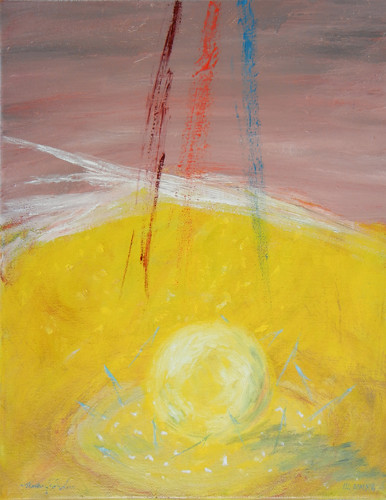
One of my attempts to capture fleeting impressions of well-known Greek mythologies resulted in an abstract painting Paris and Three Goddesses, whose pink and golden color blocks in the background signified the dangerous intermingle of the mortal and immortal worlds. Three powerful goddesses, Hera, Athena and Aphrodite, were represented by three richly colored powerful beams, which penetrated the human world below, while circling like sharks of their prey a small globe — the golden apple, to be awarded to the most beautiful one, planted by the spurned goddess of discord.

Poor Paris, represented by the golden color associated with another golden male beauty Apollo, was pinned down by those powerful beams above, and responded with blue sparks, echoing the beam of Aphrodite alone, risking the wrath of Hera and Athena, for the sake of the most beautiful woman on earth, the Queen of Spartan Helen, the promised bribery from goddess of love, and eventually launched thousand ships and unleashed the ten-year Greco-Trojan war, and caused unspeakable misery for many, many more.

Little ones are perennial pitiful playthings of the powerful ones.

Paris and Three Goddesses / 帕里斯和三位女神 / Paris und drei Göttinnen
Paris and Three Goddesses

Oil on Canvas
14" x 11"
Completed in 2012

This painting is currently in a Group exhibition Color Speaks (Sep. 23, 2017 - Jan. 20, 2018), in Downtown Berkeley’s vibrant art district.

Originally posted on matthewfelixsun.com

Other Related posts on Art · 文化 · Kunst:
- My Featured Painting - Colony
- My Featured Painting - New Century's Shangri-La
- My Featured Painting - Procession
- Featured Painting - Waft
- Featured Painting - Remembrance
- Featured Painting “Mirage” – A World of Ambiguity
- Featured Painting – “Forest Within” – When Reality Met Illusion

Sunday, June 9, 2013

Niobe - An Installation

I have always been drawn to tragic stories, particularly those of cosmic grandeur, often with Greek origins.  The legend of Niobe, a proud princess and mother of fourteen children, seven sons and seven daughters (the Niobids), who boasted of her large family and jeered at goddess Leto, who had only two children, the twins Apollo and Artemis, resulting in unbearable tragedy, was one of my favorites.

Gods were not to be mocked at and the offended Leto sent her children to revenge her honor.  Apollo and Artemis started to shoot arrows and killed Niobe’s sons and daughters one by one.  Niobe’s plea to spare at least one daughter came too late, and none of her fourteen children were spared.  The loss was so great, the grief so heavy, that Niobe turned into stone, yet even the stone continued to weep tears.


The Weeping Rock in Mount Sipylus, Manisa, Turkey, has been associated with Niobe's legend since Antiquity, Source: RKTanitim

Since I started my “White Dress” series, I have been exploring the expressive possibilities of this motif and the results often took me by surprise, and further fanned my curiosity, and wanted to probe ever further.

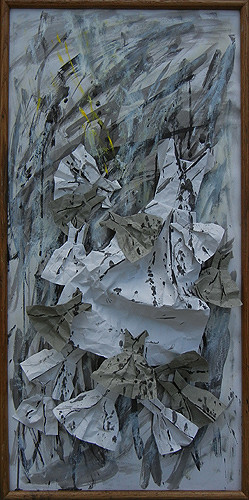
Though my recent well-received “Stringed White Dresses – An Installation” was a success, I felt that the origami dresses in that installation were too prim, too orderly.  I wanted to create something more chaotic.  For the composition, I imagined a large dress, like a queen bee, surrounded by smaller ones; this fit the Niobe story perfectly.
After several attempts, I decided on the sizes of the dresses and chose white dresses to represent female and grey to represent male characters.  Before I folded the origami dresses, I crumpled the paper to give them a more lively look.  I put black ink and brown wash on paper to create the chaos in the background, some areas were covered with white oil wash to enrich the texture and to give more contrast to the dresses taped over the drawing paper, and finally some yellow oil streaks to suggest the ungodly gods’ touches.

To finish the entire assemblage, I pinned the little daughter Niobe tried to save onto her with a needle. Finally, I freely splashed black ink over the ensemble, and that constituted my final touch.


Niobe / 尼俄柏 / Niobe


Other Related posts on Art · 文化 · Kunst:
- Unexpected Successes of "Stringed White Dresses - An Installation"
- "White Dress" Series Continues - A New Drawing and a New Painting
- One More Painting Featuring White Dress
- My Next Show - Prince Street Gallery, Chelsea, New York
- White Dresses - First Painting Finished in 2011

Friday, March 30, 2012

"Paris and Three Goddesses" in Oil

A couple weeks ago, I posted my pastel drawing of Paris and Three Goddesses, together with the oil painting of "Helen of Troy", my small series of presenting familiar Greek tragedies in semi-abstract fashion.

Now, my oil version of this Paris is completed, which though has the same composition and color palette, but has definitely somewhat different finish - brighter, richer and more sensual, perhaps if I have done more of pastel, I could accomplish more with that medium:

Paris and Three Goddesses / 帕里斯和三位女神 / Paris und drei Göttinnen
Paris and Three Goddesses
Oil on Canvas
14" x 11"

Below is the Pastel version:

Paris and Three Goddesses / 帕里斯和三位女神 / Paris und drei Göttinnen
Paris and Three Goddesses
Pastel on Paper


Matthew Felix Sun's Paintings Completed in 2012 by Matthew Felix Sun photoset

Wednesday, March 28, 2012

My Favorite Sculptures at Loggia dei Lanzi (Loggia della Signoria), Firenze

Just outside the wonderful Palazzo Vecchio, Firenze, another art treasure trove left a long-last impression on me - a covered public corridor, full of amazing sculputres - Loggia dei Lanzi, or Loggia della Signoria.

The best work there was the Perseus by Benvenuto Cellini's Perseus with the Head of Medusa:

Perseus, Benvenuto Cellini, Loggia dei Lanzi (Loggia della Signoria), Firenze _ 8080 - 500


Perseus with the Head of Medusa, Bronze, Benvenuto Cellini

This graceful statue, resembles so much of Michelangelo's and Donatello's David, in spite of the materials used.  They all shared the same noble disposition, youthful ardor and innocence, yet with some world-weariness.  Their bodies polished and elegant, their attitude reticent, their mixed reaction to their defeated opponents, instilled some humility and humanity to these fabled heroes. The sculpture was very detailed and polished, down to the fantastic winged helmet and the less than terrible, twisted body of Medusa.  This Cellini creation, along with those of Donatello, were a bit more mannered, less classically restrained, than that by Michelangelo.  Weapon raised, a bit more flamboyant and I love it even better.

The other most amazing sculpture was a relative recent one, The Rape of Polyxena by Pio Fedi, completed in 1865:

The Rape of Polyxena, Pio Fedi, Loggia dei Lanzi (Loggia della Signoria), Firenze _ 8082 - 500
The Rape of Polyxena
Pio Fedi in 1865

This story was about the greatest and the handsomest Greek warrior during the Trojan war - Achilles, attempting to taken away the Trojan princess Polyxena. Here, the determined Achilles, struck down Polyxena's brother, presumably Prince Troilus, held her pitilessly with his left hand, and ready to beat back the imploring Trojan queen, Hecuba. The further twist of the story was Achilles let her know his only weakness and she betrayed this secret to her brothers Paris and Deiphobus, and Paris shot and kill Achilles.  After the war, the ghost of Achilles demanded the sacrifice of Polyxena.

Such a terrible story.  Such a moving monument.  The group sculpture was highly dramatic, forming an impressive pyramidal shape, classic and grand.  The contours of the bodies, on three levels, guided our eyes from the base all the way to the very tip of the group, the deadly weapon poise to kill. The cleanness of the composition and execution, avoided a tangled terrible mess, and presented us a restrained reaction of an ancient tragedy, instead of a melodrama.


My Favorite Museum Collection Series

>> My Favorite Museum Collection Series 23: My Favorite Frescoes at Santa Croce, Firenze
<< My Favorite Museum Collection Series 21:  My Favorite Artworks at Museo di San Marco, Firenze


List of My Favorite Artworks in the Museums I've Visited

Wednesday, March 21, 2012

A Pastel Paris and an Oil Helen

Continuing my effort to present emotions of the familiar Greek tragedies in more abstract terms, I recently completed a pastel drawing, Paris and Three Goddesses and an oil painting, Helen of Troy.

Again, I am not trying to give a narrative account of the stories; rather, I wanted to capture what immediate reaction I had once their immortal names were invoked:

Paris and Three Goddesses / 帕里斯和三位女神 / Paris und drei Göttinnen
Paris and Three Goddesses
Pastel on Paper
Completed in 2012

Helen of Troy / 特洛伊的海倫 / Helena von Troja
Helen of Troy
Oil on Canvas
11" x 14"
Completed in 2012

Matthew Felix Sun's Abstract - 抽象 - Abstrakt photoset


Matthew Felix Sun's Drawing - 素描 - Zeichnung photoset


Tag: Greek Abstract

Thursday, March 8, 2012

The Eyes of Electra - A New Semi-Abstract Painting Completed

Last weekend, I finished my new painting - "The Eyes of Electra".  This is a series of small paintings on the theme of Greek mythology.

I have done a few such paintings - narrative and more or less traditional, such as Minotaur, or The Song of Orpheus:

Minotaur / 牛頭怪 / Minotaur  The Song of Orpheus / 奧菲厄斯的歌 / Das Lied des Orpheus

However, it seemed to me that I wanted to rid myself of the narrative shackle and want to present the raw emotion or the undercurrent of those stories in its rawest terms - flashes of impressions.  Considering that last year I had been exploring the expressive power of patterns and spatial relationships, this new approach was a natural path to me, at this juncture.

The Eyes of Electra, the first of this series I completed, was probably the darkest one - I wanted to present the claustrophobic poisonous atmosphere Electra insisted on the palace, where her mother murdered her father, aided by her mother's lover, who was actually revenging for his own family who had suffered in the hands of her father.

Electra, who gave name to a psychological complex, ever vengeful, stalked her besieged and frightened mother, day and night, beneath every archway, behind every wall.  Her blood-shod eyes flashing, her look terrible.  She, became a sister of furies.  She morphed from victim to victimizer, a serpent.  That, was the theme of my "The Eyes of Electra".

The Eyes of Electra / 伊萊克特拉的眼睛 / Die Augen von Electra
The Eyes of Electra
Oil on Canvas
14" x 11"
Completed in 2012
© Matthew Felix Sun
www.matthewfelixsun.com


Matthew Felix Sun's Paintings Completed in 2012 by Matthew Felix Sun photoset


Matthew Felix Sun's Abstract - 抽象 - Abstrakt photoset


Tag: Greek Abstract

Thursday, February 23, 2012

My Favorite Sculptures at Museo Nazionale Romano, Roma

The last museum I visited in Roma is Museo Nazionale Romano (Roman National Museum), which hosted an array of wonderful, even spectacular sculptures, including a version of a marble Discobolus (Disc Thrower), which is as iconic as Leonardo's Mona Lisa and Venus de Milo.  However, despite my love for this famous image, I found this particular version of Discobolus, discovered in 1906 in the ruins of a Roman villa at Tor Paterno in the former royal estate of Castel Porziano, a bit still and plastic. It was heroic and beautiful for sure, but somewhat meaningless.

Instead, my favorites were two sculptures with understated grandeur, relative static poses belied the hidden tension.

The first was a marble statue of the Roman emperor, August as Pontifex Maximus.  It was a full length sculpture, capturing the emperor, in flowing robe, walking quietly, as if weighing something of considerable importance.  It's a fleeting moment, unguarded, without officious pomposity.  A high-born nobleman for sure, but also intensely human.  Pensive, and a bit sad.

August as Pontifex Maximus, Palazzo Massimo alle Terme (Museo Nazionale Romano), Roma, Italia _ 0288
August as Pontifex Maximus, Palazzo Massimo alle Terme (Museo Nazionale Romano), Rome, Italy

However, that sadness would be eclipsed easily by the grand tragedy of the Dying Niobid, another marble sculpture, capturing one of the queen Niobe's fourteen children being shot to death by the vengeful arrows of the slighted Apollo and Artemis, when Niobe boasted that she had much greater number of children than those of Leto, Mother of Apollo and Artemis.

The Dying Niobid, fleeing, was shot on her back, faltered to be on her knee, bent backwards, both hands reached to the killing tool on her back.  Her frontal torso and one leg exposed, revealing the beauty and the vulnerability of this tragic figure.  Her face was peaceful, almost like asleep, without obvious pain, though she did have a questioning look upon closer inspection.  Even her pose, though unbalanced, was not in painful twist.  The sculptor did not want to shock the viewer, rather, he wanted to present this moment in restrained dignity.  The more peaceful she seemed, the greater the sense of tragedy.

Dying Niobid
Dying Niobid, Palazzo Massimo, Museo Nazionale Romano, Rome
Source: diffendale


My Favorite Museum Collection Series

>> My Favorite Museum Collection Series 13: My Favorite Artworks at Basilica Sancti Petri (Papal Basilica of Saint Peter)
<< My Favorite Museum Collection Series 11: My Favorite Artworks at Galleria Borghese, Rome


List of My Favorite Artworks in the Museums I've Visited

Monday, May 23, 2011

The Continuity and Survival of Cultures

Last weekend, I watched the Werner Herzog documentary "Cave of Forgotten Dreams" and I was deeply impressed by the maturity of the 32,000 year old paintings in some caves in France and the impenetrability of that particular culture.


32,000 years is beyond our understanding and as Steve Masover pointed out
but here's what made the hair on the back of my neck stand on end: at least one of the sets of animal paintings, Herzog narrates, is formed of an image applied to a blank wall of the cave, and another superimposed on it five thousand years later.

Yeah, I can blithely talk about "32,000 years ago" or "billions and billions of stars" or a "national debt of $14,000,000,000,000." But as I say them, those numbers feel empty of meaning. One loses hold of scale.

But five thousand years? That's a concrete number I can get my head around.

Why is that? Maybe because five thousand years is the entire span of recorded human history?
However, I have to say that these 32,000 year old paintings are recorded human history as well, just we have completely lost connection to them.

Despite the fact that these paintings reside in France, it would be a stretch to claim that they are part of the French culture we know of.

This trigger me to think deeper about the continuity and survival of cultures.  Let's stay in France for a while.  Can we say the current culture the same as those of Carolingian dynasty, of Louis XIV or of Napoleon era? Or the Gaul?  Can a culture shocked and brutalized by traumatic events such as French Revolution claim its survival?  Does the existence of a land and its continuous population ensure the continuity of the culture?  Furthermore, how to ensure the survival of a culture, any culture, in a fast changing time?

Can we say the German culture is that of Schiller, Goethe or Wagner? Of Protestant and Catholic?  What about the ancient history which traced back before their conversion to Christianity under Fire and Swords of Charlemagne?

In Greece, in Italy, the current cultures are different from their former, more exulted polytheism cultures.  Therefore, are the current cultures there still Greek or Roman culture?

Moving our focus to Asian.  Centuries ago, Japan adopted many aspects from Chinese culture, yet it is distinctly different from either Chinese or more ancient Japanese culture.  What would we call the current Japanese culture?  Sino-Japanese or Japanese?

China also yields many thoughts and debates here. 

In mainland China and Taiwan, people though still can understand, with training, ancient texts, but none speak and write that way anymore.  China went through primitive communes, feudal society, imperial time and republics.  The majority Han people were conquered multiple times, most significantly by the Mongols and the Manchu people, both severe blows to the continuity of the culture.  Let's not forgot the First Emperor, in his drive to control people's thoughts, banned all schools of philosophy but Confucius.  The cultures before and after that watershed moment can hardly be the same.  The savagery of Culture Revolution and other political campaigns before and after have done away with many Chinese traditions.  It was upon overseas Chinese to carry on those traditions, for better or for worse.  Mainland China and Taiwan separated for more than sixty years and the differences between those two sides are as striking as they are similar.  Which one is more authentic? 

In China, there are many Muslims, many of them are the descendants of merchants came through the Silk Road.  Are their culture part of Chinese culture, or their own?  Theirs cannot be said the same as the prevailing cultures in Arabia, or other part of the Islamic world.  What is the culture of theirs?

A small group of Jewish also settled in a small area of China, and maintained certain, corrupted form of Jewish rituals.  Are they Jewish or Chinese?

If they are less authentic, was is because that they had left their ancient land?  But many Jewish people are more orthodox without Israel than within.  Does originating land guarantee the continuity and survival of culture?

This moved me to think of Tibetans. Today, Tibetans living outside Tibet can openly worship Dalai Lama while people inside cannot.  If the political structure continues, the Tibetan tradition would rely on the outsider to carry on.  Yet, the lifestyles without the Himalaya plateau would never be the same.  Can we say for certain that Tibetan culture will survive?  When Dalai Lama proposed to abolish the reincarnation of his institution, wouldn't that a break from the Tibetan culture of centuries already?

Cultures do usually shrive in its originating land.  But not necessarily so.  As mentioned above, many Chinese traditions are to be found in Singapore, USA, Taiwan, or Japan, rather than in China.  Catholicism is more energetically embraced in Southern America than in Europe.

Without the land, culture can survive, if rather rarely.  Jewish people, wandering about for millenniums, managed to carry on their traditions.  It is not a stretch to say that if Israel cease to be a Jewish state, Jewish culture would not disappear along with it.  This also points out the fallacy of insisting on the survival of Israel as a political entity to ensure the continuity and survival of Jewish culture.

I love to hear my Jewish friends' stories of their living and working in Kibbutz many year ago.  It seems that Israel at one time, poised to be the shining example of human brotherhood.  Alas, the Israel today is no long that idealistic one.  It is just as cynical and corrupt the hostile neighbors.

By trying to survival by all means, at all costs, Israel has collectively betrayed its history, its suffering and morphed tragically from oppressed to oppressor.

Should we do our utmost to ensure the continuation and survival of these, when they have lost their souls?

This reminded me the myth of Tithonus or Tithonos (Ancient Greek: Τιθωνός), the lover of Eos, Titan of the dawn. Wikipedia related the story thus:

"Eos kidnapped Ganymede and Tithonus, both from the royal house of Troy, to be her lovers. The mytheme of the goddess's mortal lover is an archaic one; when a role for Zeus was inserted, a bitter new twist appeared: According to the Homeric Hymn to Aphrodite, when Eos asked Zeus to make Tithonus immortal, she forgot to ask for eternal youth (218-38). Tithonus indeed lived forever

"but when loathsome old age pressed full upon him, and he could not move nor lift his limbs, this seemed to her in her heart the best counsel: she laid him in a room and put to the shining doors. There he babbles endlessly, and no more has strength at all, such as once he had in his supple limbs." (Homeric Hymn to Aphrodite)"
Without vitality, morality, what is left in a culture?  I can only wonder.

Bombed Bridge, III / 炸斷的橋樑之三 / Bombardierten Brücke, III
© Matthew Felix Sun
Friday, October 29, 2010

The Song of Orpheus

My painting "The Song of Orpheus" included many details and fine points that online presentation often rendered them insignificant and I felt a narrative is necessary to make it more understood.

My Orpheus was a collage of a story.  It started with his descend into Hades to seek his beloved Eurydice, traveling on the River Styx.  His lyre, which persuaded Hades and Persephone to let Eurydice return to the earth, dominated the canvas.  It also took a shape of a strange animal, a linkage to Apollo, even.  After he lost Eurydice twice, the grief driven Orpheus refused to entertain Dionysus' followers who ripped him to pieces.  His skull became an oracle and his flesh and bones were tossed into sky, scattered about and filled the universe with his music and joy.

Thus the marriage of Apollonian and Dionysian spirits ushered in a new era.


>> Video presentations of paintings and drawings, Part II: Tips for Artist: Video Presentations

List of Video Presentation of My Artworks

Wednesday, June 2, 2010

The Song of Orpheus

I just finished a new painting - The Song of Orpheus. This painting was conceived when I read Rainer Maria Rilke's Die Sonette an Orpheus.

This is a dangerous ground I tread into. So many wonderful artworks were created after the Orpheus myth, from paintings to operas. Yet the lure of this myth and the reinterpretation by Rilke was so strong, I pressed ahead.

I see Orpheus as a means to bring joy to the world, through his quest for love and his suffering, and ultimately his death. I saw his lyre singing and I saw his bones being scattered into the highest sphere, as if his notes would crown heaven. Holy ointment burned in his skull, transformed into an oracle, rising up to dance with his ever higher notes. That's the Song of Orpheus.

The Song of Orpheus / 奧菲厄斯的歌 / Das Lied des Orpheus

Tuesday, November 24, 2009

Mythology Series on Synch Chaos (Webzine)

Over the years, I have created a series of paintings based on Western and Chinese myths and legends.

Synch Chaos, a cutural webzine just published a series of my paintings.

Below is the list of the work and the links to the images on my web site ( www.matthewfelixsun.com )

Minotaur
Oil on Canvas, 24″ x 30″, Completed in 2005
http://www.flickr.com/photos/matthewfelixsun/3844905109/in/set-72157621940201251/
Minotaur, as I saw it, was a tragic figure, who was condemned and trapped by fate to his horrible condition and savageries. He welcomed his slayer Theseus, who was approaching fast in a galley. Holding Ariadne’s thread, which will help Theseus to leave his labyrinth, Minotaur pondered on his imminent death and anticipated his own relief with trepidation and anticipation. A large tear rolled down his face, monstrous and beautiful.


Daphne
Oil on Canvas, 30″ x 40″, Completed in 2009
http://www.flickr.com/photos/matthewfelixsun/3867334845/in/set-72157622064751614/
A more or less straightforward rendition of the metamorphosis of Daphne into a laurel tree. Hands and arms of Daphne and the golden torso of Apollo dominated the canvas. In the background, the killing of Daphne’s playmate Leukippos by the jealous Apollo and the chasing of Daphne were simultaneously portrayed, to complete the whole cycle of the story.


Sisyphus
Oil on Canvas, 48″ x 24″, Completed in 2003
http://www.flickr.com/photos/matthewfelixsun/3849117038/in/set-72157622064751614/
I put Sisyphus in the most hard to sustain position, to emphasis the difficulty and impossibility of his task and punishment.


Adam and Eve
Oil on Canvas, 30″ x 40″, Completed in 2008
http://www.flickr.com/photos/matthewfelixsun/3835030818/in/set-72157622064751614/
Adam and Eve were portrayed as sad and resigned figures. Adam cast down his eyes, as if he was trying to avoid eye contact with viewers, or his judges, while Eve reached out to Adam tentatively with right hand, whilst shielding her guilty face with her left hand. A heavy, lead-colored cloud hanging directly above them, shaped like a giant question mark. It also functioned like Damocles’ sword, threatening to crush them both.


Annunciation
Oil on Canvas, 36″ x 48″, Completed in 2002
http://www.flickr.com/photos/matthewfelixsun/3835030876/in/set-72157622064751614/
Virgin Mary, on learning her pregnancy by the holy spirit, wailed for herself and the fate of her unborn son Jesus. She howled in grief beyond console. Perhaps, she was grieving for the entirety of humanity - by then, she must have learned the burden on her shoulders.


Jingwei Filling Up the Sea
Oil on Canvas, 24″ x 36″, Completed in 2008

http://www.flickr.com/photos/matthewfelixsun/3856364733/
Jingwei, in Chinese mythology, perished at a young age in the East Sea. After her death she chose to assume the shape of a bird in order to exact revenge upon the sea by bringing stones and small twigs from the mountains nearby over the sea in an effort to fill it up. Jingwei even has a short dialogue with the sea where the sea scoffs her, claiming that she wouldn’t be able to fill it up even in a million years, whereupon she claims that she will then proceed to take ten million years, even one hundred million years, whatever it takes to fill up the sea so that others would not have to perish as she did.
Again, I grouped a few events together to contain the cycle of the story in one canvas. The predominant feature is a sad fish with large tear. Here, the struggle is between elements and human activity and I tried to give sympathy to both.


Nüwa Creating Humans

Oil on Canvas
30″ x 40″
Completed in 2007
http://www.flickr.com/photos/matthewfelixsun/3848229487/in/set-72157622064751614/
Nüwa is a goddess in ancient Chinese mythology best known for creating mankind and repairing the wall of heaven. This painting is the tribute to my heritage. What can be more fitting then credit a female god as the creator of humans? The sad twist in this canvas is that the humans she created resembled, unfortunately, robots. No creation would be perfect.


Nüwa Patching Up the Sky
Oil on Canvas
30″ x 30″
Completed in 2006
http://www.flickr.com/photos/matthewfelixsun/3834238745/in/set-72157622064751614/
Two powerful gods quarreled and caused the collapse of the pillar which supported the sky and rain powered down to drown the living creatures on earth. This is the independent corroboration of the deluge in the Bible. Nüwa cut off the legs of a giant tortoise and used them to supplant the fallen pillar, alleviating the situation and sealing the broken sky using stones of seven different colors, but she was unable to fully correct the tilted sky. This explains the phenomenon that sun, moon, and stars move towards the northwest, and that rivers in China flow southeast into the Pacific Ocean. She also melted five-colored boulders to seal off the cracks of the sky. Other versions of the story describe Nüwa going up to heaven and filling the gap with her body (half human half serpent) and thus stopping the flood. The image I put forth was an earth-toned large woman, floating against cobalt blue boulders and running water in between, struggling to maintain her balance, in order to finish her Herculean (or shall we say, Nüwaian) job.

Matthew Felix Sun

Sunday, November 22, 2009

Sonette an Orpheus

I just finished re-reading Sonette an Orpheus (Sonnets to Orpheus) by Rainer Maria Rilke and am in a trance. I have just started a painting on the subject of Orpheus - I cannot tell if reading Rilke triggered the project or the project propelled my reading.

Out of the fifty-five poems, the one really impressed into my mind is the last one (No. 26) of Part I:

Du aber, Göttlicher, du, bis zuletzt noch Ertöner,
da ihn der Schwarm der verschmähten Mänaden befiel,
hast ihr Geschrei übertönt mit Ordnung, du Schöner,
aus den Zerstörenden stieg dein erbauendes Spiel.

Keine war da, daß sie Haupt dir und Leier zerstör.
Wie sie auch rangen und rasten, und alle die scharfen
Steine, die sie nach deinem Herzen warfen,
wurden zu Sanftem an dir und begabt mit Gehör.

Schließlich zerschlugen sie dich, von der Rache gehetzt,
während dein Klang noch in Löwen und Felsen verweilte
und in den Bäumen und Vögeln. Dort singst du noch jetzt.

O du verlorener Gott! Du unendliche Spur!
Nur weil dich reißend zuletzt die Feindschaft verteilte,
sind wir die Hörenden jetzt und ein Mund der Natur.

An online English translation is available:
But you, divine, to the last resonating
when swarms of scorned maenads were bent on your murder,
you drowned out their shouting with beautiful order,
from out the destroyers rose uplifting playing.

No one there damaged your head or your lyre,
however they rushed you or rested apart;
and all the sharp rocks they threw at your heart
grew soft when they touched you and able to hear.

In the end they dismembered you, driven by vengeance,
but your sound yet lingered in cliffs and lions,
in forests and birds. Even now, you still sing there.

Oh desolate god! You unending trail out!
Only since blind hatred strew you about
are we now hearers and a mouth for nature.

This project will be the continuation of my Mythology Series.

Below is a quick sketch I made in Cafe Milano, Berkeley and the painting in the very beginning stage.

Monday, November 9, 2009

A New Work - "Heralds"

I was intrigued and inspired by William Kentridge's exhibit at SF MOMA by the interplay of spaces and planes. I started a work with vertical and horizontal plans intersecting each other, with the vertical one rather wavering like curtain. Yet, the simple approach seemed to simplistic to me in the end. I tried to incorporate another intriguing element of Kentridges, by bringing in a outlined shadowing bird (as in his stage design for Die Zauberflöte). But it didn't quite work. Finally, one day, I had a vision of a large shadowy horse galloping in front of my vertical plane. Quickly, I was able to introduce a horse and a raven into the work and it was finished at one last thrust.

The horse and raven also vaguely reflect the messengers in the Norse mythology. Therefore, I named the painting "Heralds".

Sunday, July 19, 2009

"Daphne" - Finally Finished

After more than a year's struggle (or was it two years?), I finally finished the painting Daphne. What a struggle! And for what? I don't even know why the classical theme matters any more in our time. If you are curious, you can see this work in one of the unfinished stages, posted on April 9, 2009 (Myths in My paintings), which was very near completion.

Thursday, April 9, 2009

Myths in My paintings

I'm consistently interested in mythologies of different cultures. Naturally, I'm most familiar with Chinese culture, but China does not have well-developed mythology. A few well known, though sketchy, stories were passed on to my generation, however, and I was able to created a few works out of these.

After Chinese myth, Greek mythology is most familiar to me, and a few works of mine on themes from Greek mythology would be more familiar to the viewers of my work. Therefore I'll skip the explanations of the first three works.

Greek:

Sisyphus


Daphne (unfinished)


Minotaur


I also made a few paintings based on Christian themes:

Adam and Eve


Annunciation


The Triumph of Saint George


Chinese:

Nüwa Creating Human Beings - as in most pagan culture, the creator of human beings was a female. Nüwa is a goddess who out of boredom, played with clay dough and generated human figurines. By breathing on them, she gave them life.


Nüwa Patching Up the Sky - a terrible war between two powerful gods resulted in the collapse of the pillar holding up the sky. Sky was broken and the rain poured down (deluge) and humans suffered. Nüwa took pity on her creations and fixed the pillar, then melted many five-colored stones to patch the sky. The vapors from the heat amused the people therefore Nüwa allowed them to stay, hence the clouds.


Kuafu Chasing the Sun (unfinished) - Kuafu was a giant who wanted to communicate with the Sun. In order to catch up with the sun, he ran from sunrise to sunset. Just when he was reaching the sun, he was exhausted and fell to ground to die - his giant muscles became mountains and hills while his blood was transformed into the rivers and creeks.


Jingwei Filling Up the Sea - Jingwei was a lovely boy who drowned in the sea. From the place he drowned flew out a small bird, who took on a task worthy of Sisyphus: carrying tiny stones in his beak and dropping them into the sea, in order to fill it up, some day.