Visiting the recently closed exhibition of works by Tomás Saraceno at San Francisco MOMA was a uniquely fun experience. SFMOMA described his work as "visually arresting spaces that challenge viewers’ relationship to the built world. ... In this exhibition, visitors wind their way through and below an array of cloud-like, geometrically complex cities, suspended in the air by tethers connecting the structures to the gallery walls, floor, and ceiling."
Visitors were encouraged to discover our inner child, while wandering around the maze. Quite often, viewers became under a trance while contemplating the intricately constructed and mesmerizing web of wires, mirrors, and balloons. Observing the reactions from other visitors were also fascinating.
Besides the main installation, the exhibition also included several very interested small pieces, which complemented the exhibition, and our understanding and appreciation of the artist, particularly "drawings" and "sculptures" incorporating spider silk.
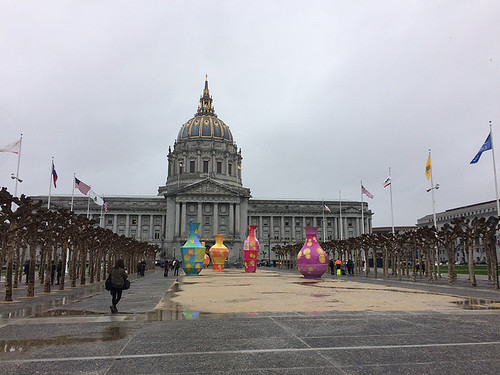
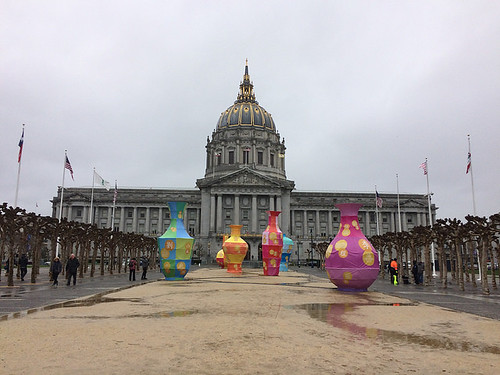
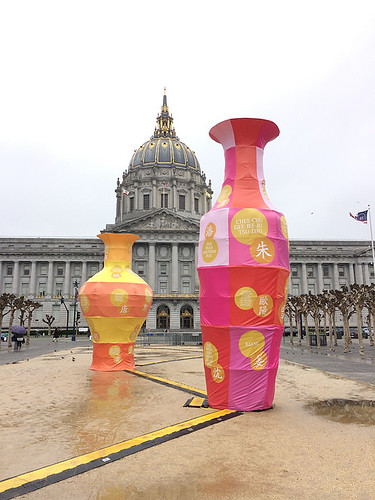
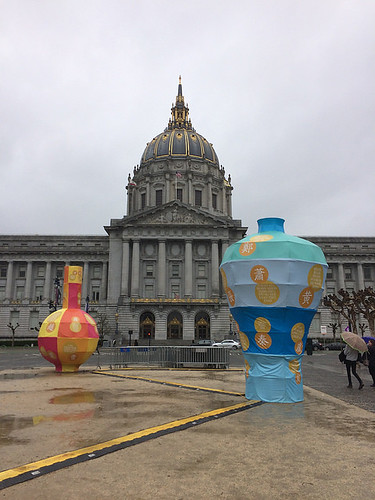
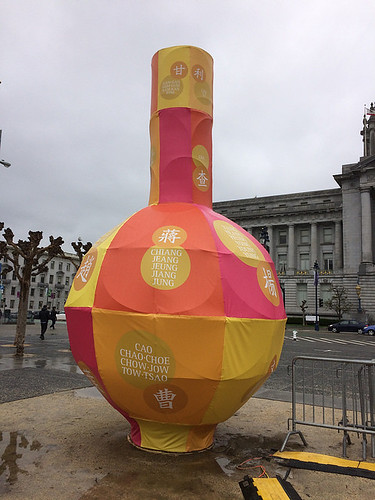
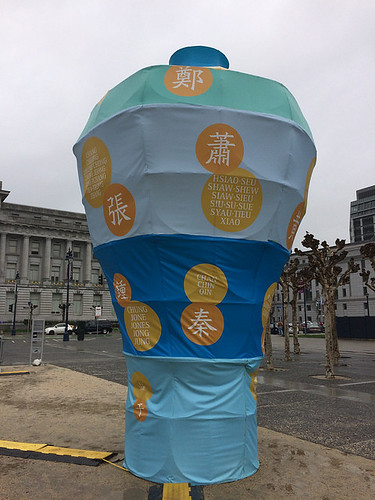
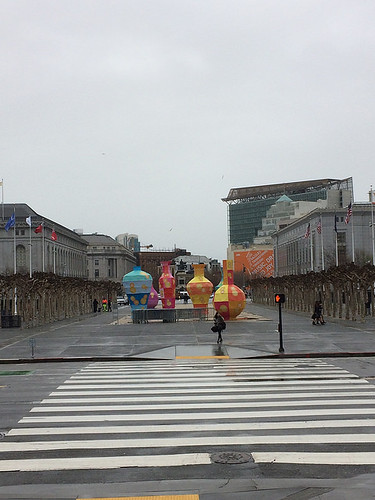
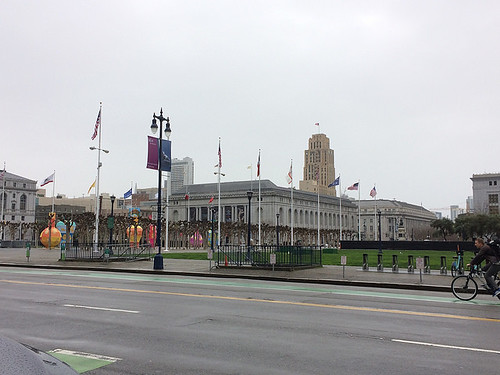
San Francisco Civic Plaza has been consistently presenting some amazing or amusing public installations over the years, and the latest of such efforts are some traditional Chinese vases of various shapes and colors, with some Chinese writing, which seemed to me family surnames.
Pity I didn't see them at night when they were illuminated. In regardless of artistic values, these installations have brought joy to this plaza consistent and for that, we are grateful.
The Blanton Museum of Art of the University of Texas at Austin was a wonderful museum showcasing collection with impressive depth and breadth.
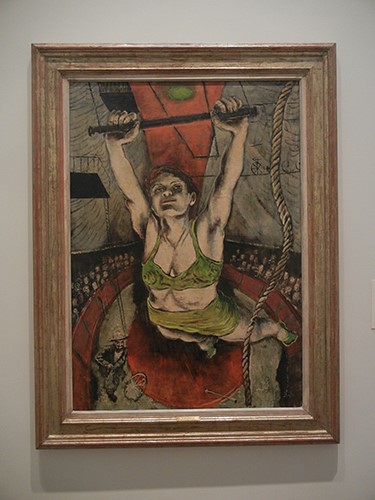
A painting, Woman on Trapeze (1946), by German-born American painter Karl Zerbe (1903-1972) was among one of my favorites there, depicting a circus act, a popular subject in early 20th century, but his woman on trapeze was a different specie from other circus troupers recorded by Picasso, who had left us a considerable volume of his observations and thoughts on that particular group of people. Though tinged with desolation and pensiveness, the Spaniard's circus players were often graceful in forms and poses, often seen resting and meditating between acts, and at most practicing as if for self-amusement, and they congregate in packs; the German artist's circus performer was caught at her most strenuous moment, and despite her lovely dress, her determined and concentrated face with slightly twisted facial features, her perspective-distorted large hands, fearful shadows on her face, her flying away legs, all contributed to a sense of danger and instability, and her corpse like
pale skin, muted further by streaks of dark shadow, conspired to make her look
surreal. And she was all alone. The audience, in horseshoe seats, behind circular red panels, was seen as faceless mass; a single bicyclist, parked in the edge of the central stage, paid no apparent heed to the swinger in the air. A thick rope, slightly curved leftwards, in parallel to her swinging body, counterbalancing her slightly right-curving shape, managed to augment the sense of instability and transience. Though silent, this woman, seemed to be the personification of a barely contained scream, insistent, somewhat helpless, and angry. Though pretty to behold, this painting was terrifying.
Woman on Trapeze, 1946, Karl Zerbe
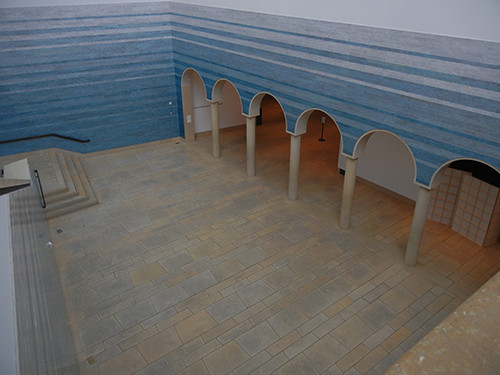
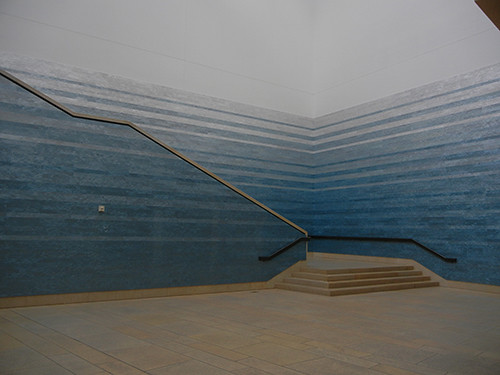
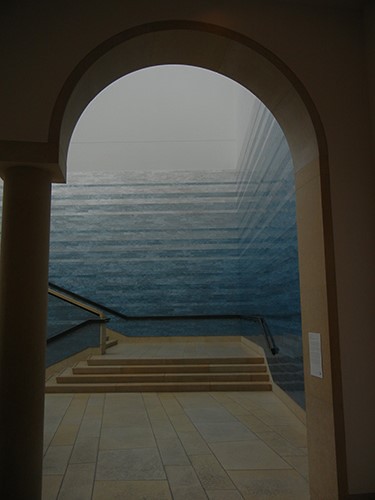
My second favorite, the raison d'être for my visit to this museum, was a site-specific installation by Teresita Fernández (born 1968), Stacked Waters (2009), tiles on the four walls of a large rectangular hall with some loggia arches at the base of one of the long walls, and it was as becalming as Woman on Trapeze was disturbing.
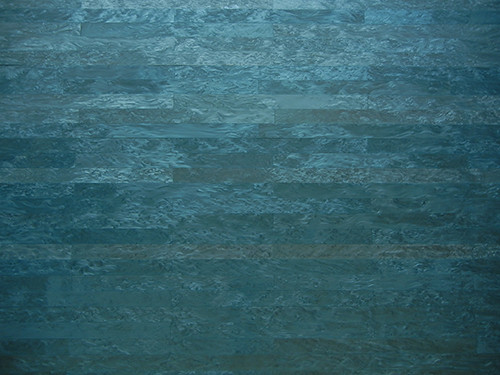
Detail of Stacked Waters, 2009, Teresita Fernández
Upon close inspection, those tiles had a look of shining plastic, with patterns of swirling clouds or waves, or like a glimpse of deep sea or the germinating universe. Those tiles, banded together to form horizontal layers in alternately greenish blue and various shades
of pale gray colors, and as a whole, looked like cross-section of geological
deposits, but with candy-like luminosity. Liquid deposits. Those layers also had different heights, with darker layers grew taller as they approached to the base of the walls, created a vision of gradually settling down, yet never completing such process.
Surrounded by such four shimmering walls, one felt breathless, as if immersed in the depth of cool and hushing water, soundless, motionless, and one would finally be deeply moved, as if some truth of universe had been revealed in front of the incredulous eyes.
It was wonderful to be there alone, to feel the refreshing emptiness; and it was great to be with other visitors, friends or strangers alike, to see how people glad about, like oblivious fish, utterly at home, yet strangely out of place, and utterly entranced.
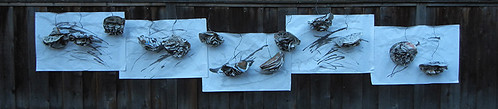
Recently I created an installation Wilting Flowers and fully documented the creation and installation processes.
This new effort was spurred by my continued fascination with paper
material – delicate, malleable, and transitory, characteristics well
suited for hinting at, versus representing, a world full of fragility
and vulnerability, constantly under the threat of total destruction.
My local newspaper, “The San Francisco Chronicle”, served as the
foundation: a segment of our time, distilled and encapsulated. Inky
strokes and splashes were added to the newspaper sheets, which were
folded and tied up to form large flowers, with aluminum wires wrapped
with dyed twine as stems.
For the background, I chose five sheets of plain white paper,
streaked with similar black strokes of ink diluted with various amount
of water.
To install, I attached these background paper to a wall in an uneven
row, then affixed those flowers, 13 total, to those sheets. There were
no strict rules about how to lay out the background sheets and flowers,
as long as the finished installation looked balanced, and the flowers
largely faced outwards.
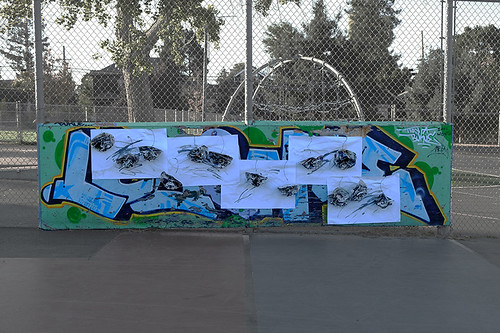
I have installed these sheets and flowers on different surfaces – a
colorful graffitied plywood wall, or somber looking wooden fences, at
different times of the day. The differences between the surfaces, the
different light cast on the wall or fence, background sheets and paper
flowers, all contributed to a murmuring polyphony.
Wilting Flowers
Ink on paper and newspaper, aluminum wire, cotton string
40" x 140" x 5"
Completed in 2016
The gracefully proportioned Palazzo della Ragione in Padova (Padua), Italy, was a unique building, which was not only enormous in dimensions, but functions uniquely as a market place in its lower level, and a civic center on the top tier.
The most outlandish thing, and my favorite, was a huge wooden horse, basked in blue light (or was it painted blue?). According to Padovaincoming.it,
"the big wooden horse kept in Palazzo della Ragione was ordered by
Annibale Capodilista in 1466: it was one of the big machines - and the
only one that has survived - made for an extraordinary celebration that
was organized in Padua, in the squares Piazza dei Signori and Piazza del
Capitanio. The parade saw the participation of all the people in town,
and of more people who had been attracted to town for this exceptional
event." [Source: Padovaincoming.it]
Apparently, Padova artists and civic leaders were the vanguard of flashy blockbuster installations almost mandated in today's art markets. Cynicism aside, the horse was indeed eye-catching and exhilarating.
On the four walls of this gigantic hall, surrounding and contrasting the blue horse, were a series of marvelous allegorical frescoes, all in wonderfully
aged colors, subtle and harmonious. Collectively, they were my second favorite there.
Presented by San Francisco Arts Commission, five exhilarating gigantic white rabbits installation, titled Intrude by Australian artist Amanda Parer, boldly occupied the Civic Plaza of San Francisco, right in front of the City Hall.
According to the curator's note, "Parer's edgy and ephemeral artworks explore the natural world, its fragility and our role within it."
"To the artist, rabbits are animals of contradiction. While they often connote a furry innocence, rabbits are considered an invasive pest in artist's native Australia... Through Intrude, Parer hopes people will thoughtfully consider how humans can change and dominate the environment.
I was utterly enchanted by those artifacts of "Nylon 210D, air blowers, 55w LED floodlights" and failed to pay any attention of the underlying questions intended to probe.
The show ends on April 25th, 2016. Catch them, if you can!





 Posts


