There were many museums in Venice, except for a few art museums, whose art collections were the highlights, such as
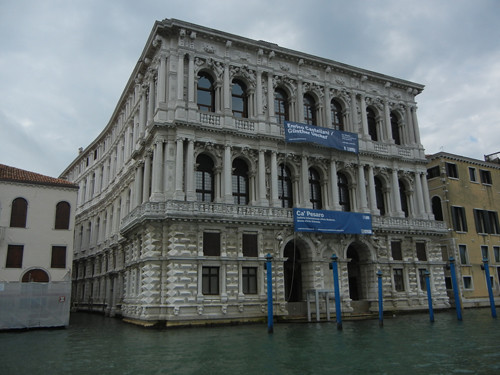
Gallerie dell'Accademia and Collezione Peggy Guggenheim, most of them, however rich their art collections were, such as Ca' Pesaro (Modern Art Museum), often, the palaces and their grand views commanded more attention and respect, though this statement is by no means to belittle their treasure troves; rather, I am trying to emphasis the significance of those gem-like buildings themselves.
The Palaces/Museums in Venice were so numerous that many of them I didn't get chance to step inside, such as Museo di Storia Naturale along the Grand Canal, Museo Archeologico right in the heart of
Piazza San Marco, and Palazzo Cavalli-Franchetti, facing Gallerie dell'Accademia across the Grand Canal. However, even a quick glance from outside was gratifying enough to make me feel I was extremely lucky to be able to see them with my own eyes.
 Museo di Storia Naturale - Fondaco dei Turchi, Venezia


 Museo Archeologico, Piazza Piazza San Marco and details
 Palazzo Cavalli-Franchetti
I did get much closer to
Palazzo Contarini del Bovolo, whose Renaissance spiral staircase, reminiscent of the Leaning Tower in Pisa, was one of the most recognizable landmarks in Venice, and perhaps the most hidden landmark as well. Off Campo Manin, the Palazzo was hidden in a small alley, and after a couple turns, I arrived at a rather cramped courtyard, most of which was enclosed inside a wrought-iron fence, creating a private patrician green amongst a rather plebeian setting.

Isolated from the crowded neighboring buildings, the Palazzo was deceptively grand as it was definitely beautiful. The view atop of the staircase was reported amazing but the Palazzo was closed to public so I was only able to savor the building itself, and the amazing experience of climbing up the staircase was left to imagination.


~~~~~~
Then there were those grand palaces and a "humble" house I did enter and got to admire their sumptuous interiors, along with their often remarkable exteriors and whatever they put on display.
Museo Correr, occupying part of the colonnaded building at the Piazza, facing the Basilica di San Marco was just such an institution, with a mission to document the art and history of Venice.
 Museo Correr


~~~~~~
One of the older palaces in the city, known as
Ca' d'Oro ("golden house") (correctly Palazzo Santa Sofia), was also one of the most beautiful and most admired Palazzi along the Grand Canal. In a sense, it was Venice, evidenced by this painting of mine - depicting Ca' d'Oro but simply titled
Venice:

People particularly admire its delicate Gothic columns, arched windows and fascinated by the asymmetrical façade. On the ground floor, it had a lovely mosaic covered loggia and wonderful marble statues, constantly under threat of high water and on the day of our visit, it was indeed flooded and closed for several hours but we were able to see it later, when we returned from another site.


Ca' d'Oro offered lovely views of the Grand Canal from its loggia and balconies - every angle of the view was a lovely picture.


More over, it had some wonderful art collections, such as the early Renaissance paintings below:

 Madonna and Child with St. John, Andrea del Sarto's Workshop, Ca' d'Oro
~~~~~~
Ca' Pesaro was a Baroque masterpiece and it housed 19th and 20th century collections of paintings and sculptures, as well as some graphic art, and I was eager to see paintings such as
Klimt's
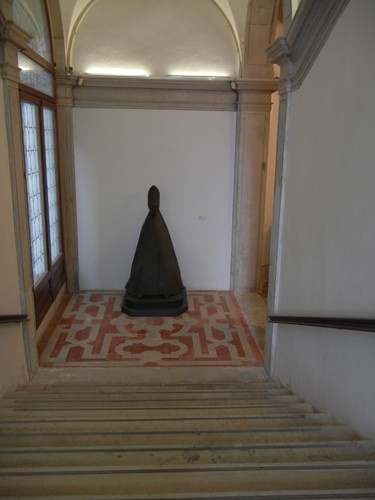
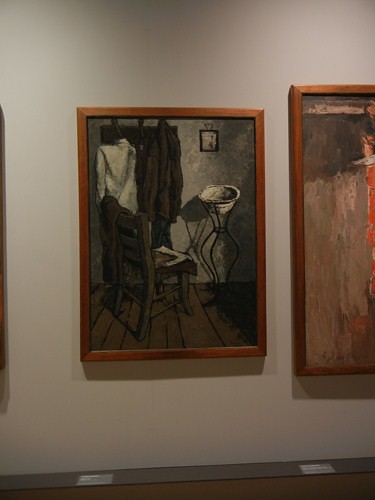
Judith but it not on display. 2012 was the 150th anniversary of Gustav Klimt and perhaps it was included in one of the numerous retrospectives and it might have been in Vienna, where I had indeed seen endless exhibits centering on Klimt. Other paintings and statues on display were quite wonderful and I was glad that I went.


~~~~~~
The strangest Palazzo was
Ca' Rezzonico, a public museum dedicated to 18th-century Venice. The museum was designed to capture the period life through the authentic setting and artifacts, so we saw everything from a gondola in the entrance hall, to an old pharmacy thoroughly equipped with arrays of jars and pots in beautifully inlaid cabinets.


 Old Pharmacy in Cà Rezzonico
The panoramic views Ca' Rezzonico offered, particularly those on the top floors, were quite breathtaking and dramatic, against the threatening dark sky.

The art collections in the Palazzo were fully in line with the peculiar tastes of the 18th century Venetians, decorative, precious but redeemed somewhat by whimsical playfulness and perhaps self-mockery:
 Mondo Novo by Giovanni Domenico Tiepolo
 Priamo chiede ad Achille, Antonio Canova, Cà Rezzonico


~~~~~~
It might have been a letdown to see a "humble" casa after one sumptuous Ca' after another. But the trip to Casa di Carlo Goldoni (Carlo Goldoni's House) was anything but. Casa di Carlo Goldoni was the house of Italian playwrigh
Carlo Goldoni (1707-1793) and it exhibited collections on Goldoni's life and works, as well as artifacts relating to Venetian theater.


Goldoni, a fantastic playwright and comedian, celebrated for his hybrid style of combining the model of Molière with the strengths of
Commedia dell'arte. His lodging, if the arrangement was indeed authentic, was as fanciful as his side-splitting yet never vulgar comedies and sharp observation of slightly pompous and ridiculous Venetian contemporaries of his.

The almost too colorful chandeliers glowed, card table laid, half-covered with embroidered silk frock coat, cumulating in many puppets on the wall and a full set of puppet stage.


Goldoni was really the best known Venetian figure, perhaps, after Casanova. His statue also graced a lovely Campo near where I stayed between
Rialto and Piazza San Marco, and a lively and wonderful theater still carried his name and Italian, or better still, Venetian theater tradition.

 Statue of Carlo Goldoni, Campo San Bartolomeo (left) and Teatro Goldoni (right)
 Teatro Goldoni
Related posts on
Art · 文化 · Kunst:
-
Two Museums in Venice - Gallerie dell'Accademia & Collezione Peggy Guggenheim
-
Il Ghetto di Venezia and Museo Ebraico (Jewish Museum) in Venice
-
Bridges in Venice, Italy
-
San Giorgio Maggiore, Il Redentore, Scuola e Chise Grande di San Rocco, Venezia
-
Magical Piazza San Marco in Venice
-
Teatro La Fenice di Venezia (La Fenice Theatre in Venice)
-
Boy With Frog Sculpture and Punta della Dogana, Venice
Label:
Italy,
Austria and Italy Trip 2012












 Posts
Posts


