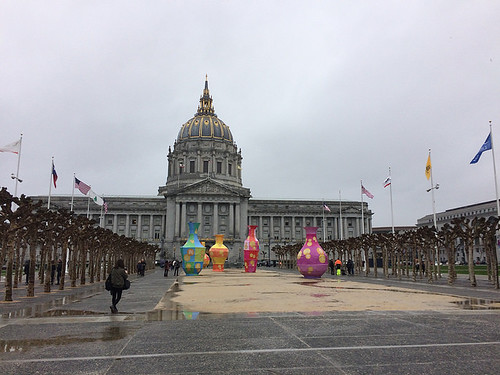
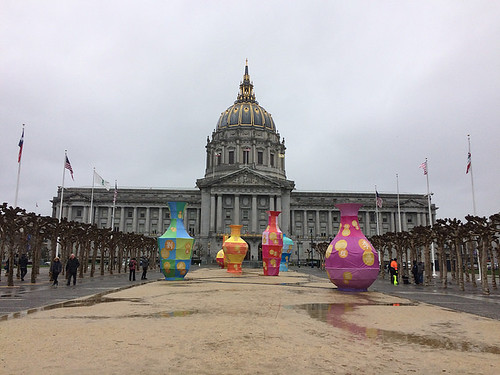
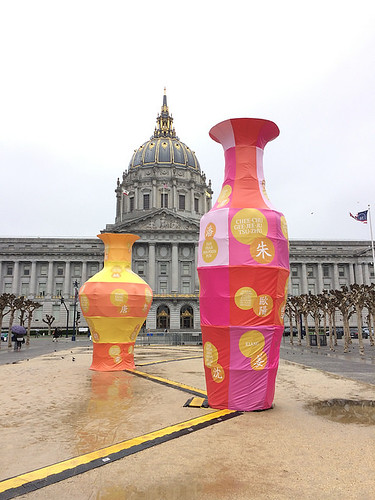
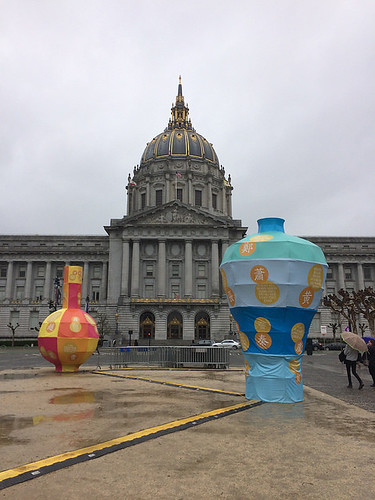
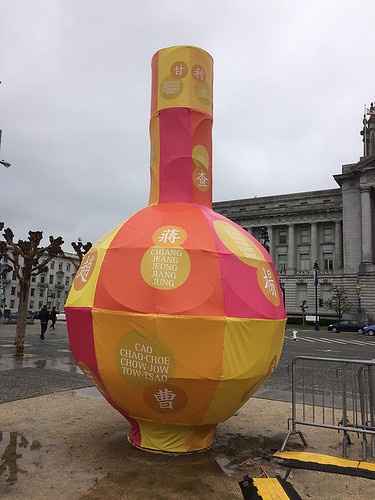
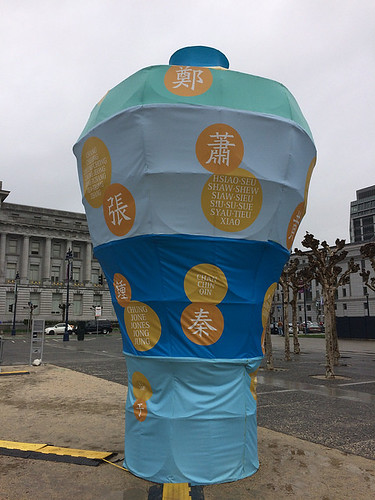
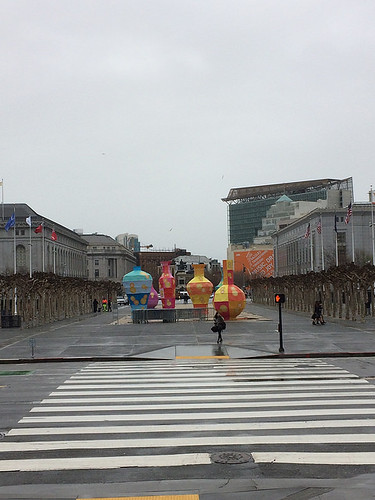
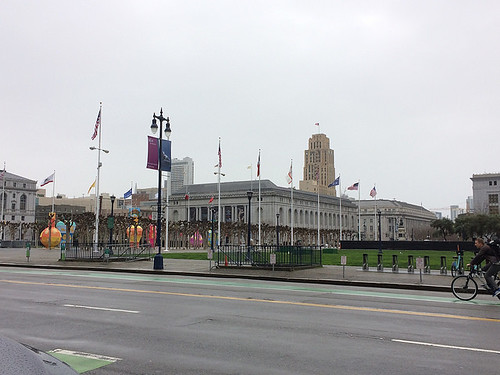
San Francisco Civic Plaza has been consistently presenting some amazing or amusing public installations over the years, and the latest of such efforts are some traditional Chinese vases of various shapes and colors, with some Chinese writing, which seemed to me family surnames.
Pity I didn't see them at night when they were illuminated. In regardless of artistic values, these installations have brought joy to this plaza consistent and for that, we are grateful.
Last weekend, many people around the world watched once again, in horror, the clashes between pro-democratic students and citizens and the governmental apparatus. Hopefully, the situation would not deteriorate into the tragedy took place in Beijing, 25 years ago, when the army, ironically named the People's Liberation Army, shot their way to disperse peaceful demonstrators in Tian'anmen Square (Tiananmen Square) in the heart of Beijing, an event in which I was a peripheral participant.
This time, watching in safety, I experienced what the rest of the world felt when the tragic event unfolded in Beijing and elsewhere in China then, sympathy, dismay, and anger.
The trigger to the mass protest was Chinese government's forcing Hong Kong citizen to choose from 2-3 pre-approved candidates for chief executive in their 2017 election, making a mockery of their universal suffrage.
Once again, young people led the charge in their attempt to secure a better future for themselves, and social media played a major role, though Chinese government is furiously deleting and blocking the spread of the messages.
Did it mean that Hong Kong was irrelevant to China's economy growth, and international image? Did it mean that Hong Kong no longer existed in the censors' minds? It was an ominous sign.
Hong Kong is already a mature, prosperous enclave that has grown relatively immune to the blandishments of mutual prosperity that helped keep it stable for 16 years of Chinese rule. And as a former British colony with its own laws and traditions of liberty, a severe crackdown on mostly peaceful protests would almost certainty backfire here, especially under the glare of international attention.
“On the mainland, as long as you can control the streets with enough
soldiers and guns, you can kill a protest, because everywhere else is
already controlled: the press, the Internet, the schools, every
neighborhood and every community,” said Xiao Shu,
a mainland writer who is a visiting scholar at National Chengchi
University in Taiwan. “In Hong Kong, the streets are not the only
battlefield, like on the mainland.”
At the same time, Hong Kong has been under Beijing’s sovereignty for
long enough now that even modest concessions could easily send signals
across the border that mass protests bring results — something the
authorities in Beijing seem determined to prevent, mainland analysts
say.
Xi, the new leader who consolidated his personal power through party jockeying and anti-corruption purges, has been trying hard to create a benevolent and open image, greatly aided domestically by his glamorous former singer wife, Peng Liyuan, whose celebrity status and easy manner seduced many oppressed folks in China. However, Xi has never exhibited any inclination to listen to the people so far, therefore I have no reason to hope.
The pressing question is, will Hong Kong become Xi's Tian'anmen Square, Berlin Wall, or his - and by extension - his party's Waterloo?



 Posts
Posts


