Showing posts with label Richard Serra. Show all posts

Sunday, April 27, 2014

My Favorite Sculptures in le Jardin des Tuileries

Le Jardin des Tuileries, the former royal garden dated back to Catherine de Medicis in the 16th century, situates between the Louvre and Place de la Concorde, is a wonderful place for Parisians to promenade, meet, and display.

It also hosts a wonderful museum, Musée de l'Orangerie, built to host the amazing series of Claude Monet's Les Nymphéas (Water Lilies).  Besides major works by Monet, it also collected many important late 19th - early 20th century modern works (Paul Guillaume collection).

In 2000, when I visited Paris for the first time, Musée de l'Orangerie was closed for renovation and only during my second trip to Paris in 2008, was I able to see Les Nymphéas and other amazing works inside the oval-shaped museum.

Artworks in Paris were not confined inside museums, therefore we saw many sculptures in the ground of Jardin des Tuileries.

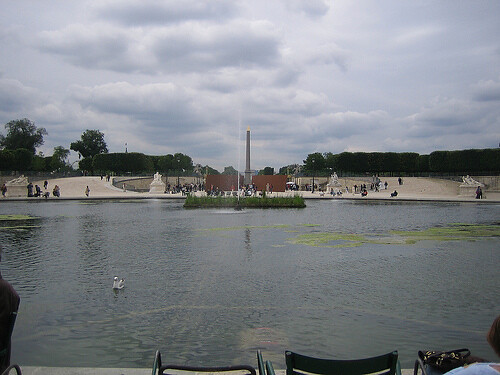
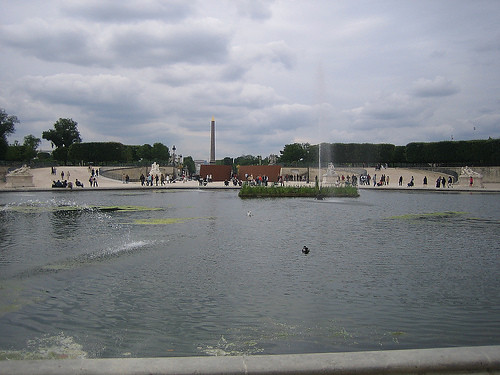
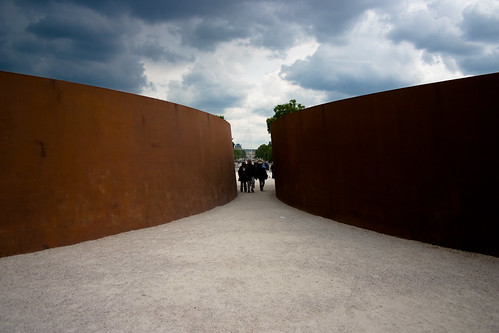
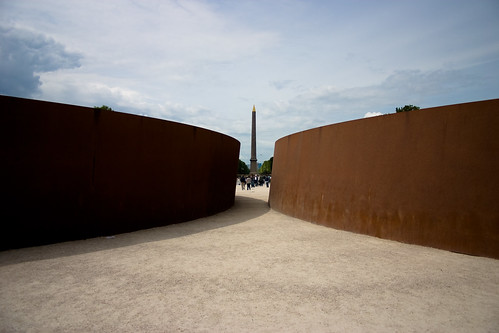
The most amazing one was a gigantic modern work, by American artist Richard Serra, Clara-Clara, which consisted of two giant curved steel plates, forming an opened doorway, echoing the carriage driveway behind it.  The sculpture sat in the center of the elongated Jardin and from the opening of the "arms", seen from the side of the reflection pond, one could see the distant obelisk in the Place de la Concorde.  Seen across the pond, one could see a tall jet of water fountain competing with the obelisk.
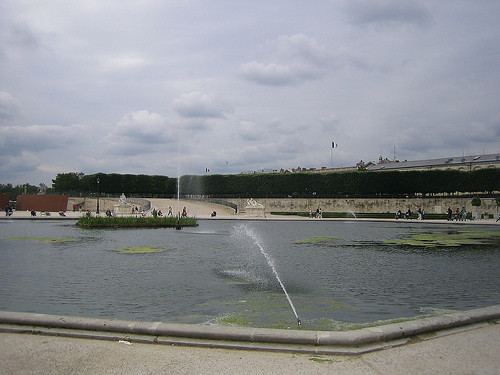
IMG__7907 - Clara Clara, Richard Serra, Jardin des Tuileries, Paris 2008

IMG_7900 - Clara Clara, Richard Serra, Jardin des Tuileries, Paris 2008

IMG_7897 - Clara Clara, Richard Serra, Jardin des Tuileries, Paris 2008

The fun part was walking around it, examining the changing shapes from various vantage points, and walking through the opening and to admire the "strategically placed" obelisk in the middle of the opening of the outstretching sensuous arms of Clara-Clara.
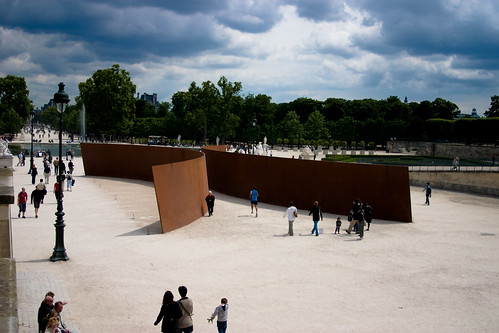
Clara Clara - Richard Serra - Jardin des Tuileries
Photo courtesy: Tybo

Clara Clara - Richard Serra - Jardin des Tuileries
Photo courtesy: Tybo

Clara Clara - Richard Serra - Jardin des Tuileries
Photo courtesy: Tybo

The second favorite sculpture of mine in le Jardin des Tuileries was Le Baiser (The Kiss) (1934 cast of the marble original), by omnipresent Auguste Rodin. It was a typical Rodin, monumental, sensual, life-like and larger than life.  Despite the metal material, and the though marvelous but unnatural green patina, the lovers were every inch the flesh and blood beings.
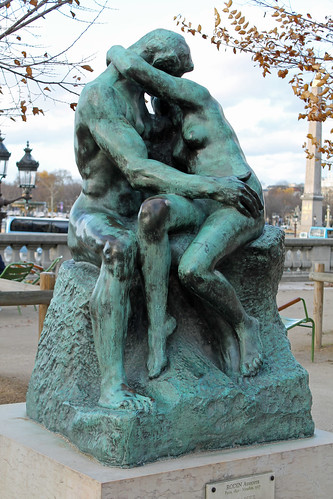
The Kiss by Rodin
Photo courtesy: Sarah Stierch

IMG__7910 - The Kiss, Auguste Rodin, , Jardin des Tuileries, Paris 2008


My Favorite Museum Collection Series
>> My Favorite Museum Collection Series 76: My Favorite Drawing and Painting in Musée Cognacq-Jay, Paris
<< My Favorite Museum Collection Series 74: My Favorite Artwork at Musée de Cluny - Musée national du Moyen Âge, Paris

List of My Favorite Artworks in the Museums I've Visited  


Other Related posts on Art · 文化 · Kunst:

- My Favorite Sculptures in Jardin du Luxembourg, Paris
- My Favorite Sculptures in les Jardins du Ranelag, Paris
- Richard Serra in Grand Palais, Paris
- Rodin and Richard Serra in Cantor Arts Center, Stanford University
- Inside Richard Serra's Sculpture "Sequence" at Cantor Arts Center, Stanford University
- Richard Serra Drawing and 2010 SECA Art Award at SFMOMA
- My Favorite Sculptures at Musée Rodin, Paris
- Revisiting Norton Simon Museum in Pasadena
- My Favorite Sculptures at Cimetière du Père-Lachaise, Paris
- Art in the Streets of Shenyang, China
- A Day at Palace of Fine Arts & Crissy Field in San Francisco

Friday, January 6, 2012

Richard Serra Drawing and 2010 SECA Art Award at SFMOMA

Before the year end, I visited SFMOMA for its Richard Serra drawing retrospective exhibit, a cerebral, intriguing more than exhilaration exhibit.  I enjoyed it very much but due to the photograph restriction, I can only share some images from SFMOMA's website:


They were just as monumental as his more celebrated sculptures, such as the "Sequence", currently in Stanford University and will move to SFMOMA once its new wing completes, though more somber and forbidding.  They were not all drawings - some were done with paint sticks on canvas or linen.  The richness of the texture completely compensated the absence of colors.

I then encountered the 2010 SECA Art Award exhibit, which also included many works from past winning entries.  In those rooms, everything has something to recommend though not every piece struck me as with exceptional depth, incredible beauty or iconographic longevity.  But one piece stood out for its unbridled fun and ever changing shapes and lines - Nest, made of Pencils and Glue, by Gay Outlaw, a 1998 SECA Art Award winner:

Nest, Pencils and Glue, Gay Outlaw, 1998 SECA Art Award _ 9525

Nest, Pencils and Glue, Gay Outlaw, 1998 SECA Art Award _ 9529

Nest, Pencils and Glue, Gay Outlaw, 1998 SECA Art Award _ 9534

Nest, Pencils and Glue, Gay Outlaw, 1998 SECA Art Award _ 9536

Another piece I do live very much was Japanese Maple II, Oil and wax on canvas on panel, by Anne Appleby, 1996 SECA Art Award winner:

Japanese Maple II, Oil and wax on canvas 
on panel, Anne Appleby, 1996 SECA Art Award _ 9523
Japanese Maple II, Oil and wax on canvas on panel, Anne Appleby, 1996 SECA Art Award

Finally, I'll cite a delicate watercolor on paper by Laurie Reid, another 1998 SECA Art Award winner - Love Litany:

Love Litany, Watercolor on paper, Laurie Reid - 1998 SECA Art Award _ 9520
Love Litany, Watercolor on paper, Laurie Reid - 1998 SECA Art Award


Tuesday, November 29, 2011

Inside Richard Serra's Sculpture "Sequence" at Cantor Arts Center, Stanford University

Three weeks ago, I visited Stanford University's Cantor Arts Center and was deeply impressed by an outdoor monumental steel sculpture "Sequence" by Richard Serra.  Due to time constraint, I wasn't able to go inside the twirling spiral spaces formed by curved gigantic steel plates. 


Sequence, Steel, Richard Serra, Cantor Art Museum, Stanford University, California _ 0691

Last Friday, I was able to do just that and I was even more astonished, enchanted and enraptured.  The most interesting aspect, besides its gigantic size and endless changing forms, is the ever changing interplays of colors, shades, shadows and lines.  The warm autumnal sunlight gave it a particularly inviting tinta, in the natural environment, and an unexpected sensuality.

I wonder what it might look like once it's moved to the new wing at SFMOMA. If it would be held indoors, I'm afraid that some of the magic would be lost. Therefore, try to see it, and walk around and through it before it leaves Sanford.

Below are several pictures I took and video compilations:

Steel Sculpture by Richard Serra, Cantor Arts Center, Stanford University _ 8339

Steel Sculpture by Richard Serra, Cantor Arts Center, Stanford University _ 8343

Steel Sculpture by Richard Serra, Cantor Arts Center, Stanford University _ 8341

Steel Sculpture by Richard Serra, Cantor Arts Center, Stanford University _ 8371

Steel Sculpture by Richard Serra, Cantor Arts Center, Stanford University _ 8347

Steel Sculpture by Richard Serra, Cantor Arts Center, Stanford University _ 8344

Steel Sculpture by Richard Serra, Cantor Arts Center, Stanford University _ 8350

Steel Sculpture by Richard Serra, Cantor Arts Center, Stanford University _ 8368

Steel Sculpture by Richard Serra, Cantor Arts Center, Stanford University _ 8349

Steel Sculpture by Richard Serra, Cantor Arts Center, Stanford University _ 8352

Steel Sculpture by Richard Serra, Cantor Arts Center, Stanford University _ 8361

Steel Sculpture by Richard Serra, Cantor Arts Center, Stanford University _ 8346

Steel Sculpture by Richard Serra, Cantor Arts Center, Stanford University _ 8379

Steel Sculpture by Richard Serra, Cantor Arts Center, Stanford University _ 8376

Steel Sculpture by Richard Serra, Cantor Arts Center, Stanford University _ 8382

Sequence, Steel Sculpture by Richard Serra, Cantor Arts Center, Stanford University _ 8351

Steel Sculpture by Richard Serra, Cantor Arts Center, Stanford University _ 8367

Steel Sculpture by Richard Serra, Cantor Arts Center, Stanford University _ 8388


Wednesday, October 13, 2010

Richard Serra in Grand Palais, Paris

The story of Monet's exhibit in Paris brought back my wonderful visit to the site - Grand Palais.  In June 2008, when I was in Paris, by chance, I learned an exhibit at Grand Palais and I had the chance to visit it twice.  Grand Palais was built for World Expo and has a vast space.  From 2007, Grand Palais started to invite famed artists to fill up the interior, starting with Anselm Kiefer in 2007 and Richard Serra in 2008. It was an amazing exhibit:

Richard Serra, Grand Palais, Paris 2006 - 1

Richard Serra, Grand Palais, Paris 2006 - 2

Richard Serra, Grand Palais, Paris 2006 - 4

Richard Serra, Grand Palais, Paris 2006 - 3

Richard Serra, Grand Palais, Paris 2006 - 5

Richard Serra, Grand Palais, Paris 2006 - 6