
Showing posts with label Cantor Arts Center. Show all posts

Tuesday, November 15, 2016

My Favorite Paintings at Iris & B. Gerald Cantor Center for Visual Arts at Stanford University

Iris & B. Gerald Cantor Center for Visual Arts at Stanford University was known for its amazing Rodin sculpture collections, but its painting collections were also remarkable.

My favorite was a semi-abstract by Richard Diebenkorn, titled Window. This painting was striking in its bold division of the canvas into several flat areas of brilliantly contrasting colors - bright blue, neutral orange and muted green, plus a narrow stretch of varying gray. Some details of depicted objects, large or small, helped to break otherwise monotonousness of each area, and artfully joined them together. The painting also drew viewers in with its many shapes and forms, and enigmatic relationships of planes, and trickery of view points. Those objects, seemingly readily identifiable, but upon closer examination, tended to shift away from the initial impressions. This painting's evocative atmosphere, intriguing composition, and strategic placement of objects, reminded me of mature Matisse in similar interior/exterior setting. This painting was exemplary in both representational and abstract worlds.
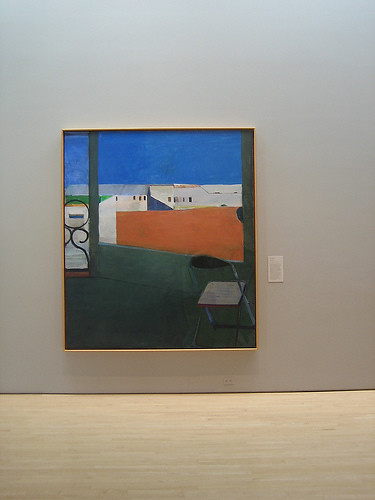
Window, Richard Diebenkorn _ 1887
Window, Richard Diebenkorn

My second favorite was a portrait by Max Pechstein, Kurish Bride, I.  This was a boldly outlined and modeled portrait of a lovely young woman, in a simple black and white dress or blouse, adorned with wildflower garland and red and pink scarf, high-cheeked and wide eyed, solid yet sensual, sedated yet hopeful, and almost joyous. One particularly striking aspect was that her face was painted in unnatural and even sickly green, but it complimented well of her dark eyes, ruddy cheeks and scarlet lips. Furthermore, against deep red backdrop, and offset by pale green over light brown, the colors clashed dramatically and excitingly, and made her face commend all the attention. The large area of red background echoed and contrasted her ruddy cheeks and scarlet lips, and the scarf, thus firmly connected to the central figure. A riotously outburst of colors and emotions.
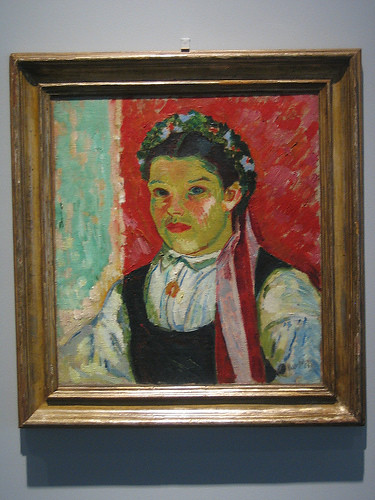
Kurish Bride, I, Max Pechstein _ 1909
Kurish Bride, I, Max Pechstein


My Favorite Museum Collection Series
>> My Favorite Museum Collection Series 149: My Favorite Paintings at Anderson Collection at Stanford University
<< My Favorite Museum Collection Series 147: My Favorite Engravings at Seattle Art Museum

List of My Favorite Artworks in the Museums I've Visited

Other Related posts on Art · 文化 · Kunst:
- Anderson Collection at Stanford University
- Paintings at Cantor Arts Center, Stanford University
- Rodin and Richard Serra in Cantor Arts Center, Stanford University
- Inside Richard Serra's Sculpture "Sequence" at Cantor Arts Center, Stanford University
- Auguste Rodin at Cantor Arts Center, Stanford University
- Andy Goldsworthy's Stone River in a Lush Setting
- Four Chinese Masters's Works at Cantor Arts Center, Stanford University
- Second Thoughts on the Sculpture "The Blind" by Lorado Taft
- Richard Serra Drawing and 2010 SECA Art Award at SFMOMA
- My Favorite Sculptures at Institut für Klassische Archäologie, Karl-Franzens-Universität Graz

Tuesday, November 29, 2011

Inside Richard Serra's Sculpture "Sequence" at Cantor Arts Center, Stanford University

Three weeks ago, I visited Stanford University's Cantor Arts Center and was deeply impressed by an outdoor monumental steel sculpture "Sequence" by Richard Serra.  Due to time constraint, I wasn't able to go inside the twirling spiral spaces formed by curved gigantic steel plates. 


Sequence, Steel, Richard Serra, Cantor Art Museum, Stanford University, California _ 0691

Last Friday, I was able to do just that and I was even more astonished, enchanted and enraptured.  The most interesting aspect, besides its gigantic size and endless changing forms, is the ever changing interplays of colors, shades, shadows and lines.  The warm autumnal sunlight gave it a particularly inviting tinta, in the natural environment, and an unexpected sensuality.

I wonder what it might look like once it's moved to the new wing at SFMOMA. If it would be held indoors, I'm afraid that some of the magic would be lost. Therefore, try to see it, and walk around and through it before it leaves Sanford.

Below are several pictures I took and video compilations:

Steel Sculpture by Richard Serra, Cantor Arts Center, Stanford University _ 8339

Steel Sculpture by Richard Serra, Cantor Arts Center, Stanford University _ 8343

Steel Sculpture by Richard Serra, Cantor Arts Center, Stanford University _ 8341

Steel Sculpture by Richard Serra, Cantor Arts Center, Stanford University _ 8371

Steel Sculpture by Richard Serra, Cantor Arts Center, Stanford University _ 8347

Steel Sculpture by Richard Serra, Cantor Arts Center, Stanford University _ 8344

Steel Sculpture by Richard Serra, Cantor Arts Center, Stanford University _ 8350

Steel Sculpture by Richard Serra, Cantor Arts Center, Stanford University _ 8368

Steel Sculpture by Richard Serra, Cantor Arts Center, Stanford University _ 8349

Steel Sculpture by Richard Serra, Cantor Arts Center, Stanford University _ 8352

Steel Sculpture by Richard Serra, Cantor Arts Center, Stanford University _ 8361

Steel Sculpture by Richard Serra, Cantor Arts Center, Stanford University _ 8346

Steel Sculpture by Richard Serra, Cantor Arts Center, Stanford University _ 8379

Steel Sculpture by Richard Serra, Cantor Arts Center, Stanford University _ 8376

Steel Sculpture by Richard Serra, Cantor Arts Center, Stanford University _ 8382

Sequence, Steel Sculpture by Richard Serra, Cantor Arts Center, Stanford University _ 8351

Steel Sculpture by Richard Serra, Cantor Arts Center, Stanford University _ 8367

Steel Sculpture by Richard Serra, Cantor Arts Center, Stanford University _ 8388


Thursday, November 17, 2011

Rodin and Richard Serra in Cantor Arts Center, Stanford University

Cantor Art Museum, Stanford University, California _ 0674 Cantor Art Museum, Stanford University, California _ 0653

Two weeks ago, before I went to Palo Alto for the opening of "Scapes" juried exhibit at Pacific Art League, which included my painting "Lake", I stopped by the Cantor Arts Center at Stanford University briefly.

I had visited the museum many times, including accompanying my visiting parents from China, and saw many wonderful permanent collections and special exhibit.  This time, since I had little time, I was really only skipping along the surface; even so, I still managed to record many amazing pieces.

Cantor Art Museum, Stanford University, California _ 0655

Cantor Art Museum, Stanford University, California _ 0658

The special exhibit was "Rodin and America: Influence and Adaptation" (through 1 Jan 2012), which juxtaposed many sculptures, sketches and works in other media by Auguste Rodin and other American artists under his influences.  The work I admire most was Lorado Taft's extremely dramatic "The Blind", which predated Jose Saramago's Blindness (The City of Blind):

Cantor Art Museum, Stanford University, California _ 0660

Cantor Art Museum, Stanford University, California _ 0668

After that, I did see some of its famous Rodin collections:

Cantor Art Museum, Stanford University, California _ 0669

I was mostly enchanted by the "Spirit of Eternal Repose", a 1898 Plaster work:

Cantor Art Museum, Stanford University, California _ 0719

Cantor Art Museum, Stanford University, California _ 0715

Cantor Art Museum, Stanford University, California _ 0725
Other sculptures stood out are:

Cantor Art Museum, Stanford University, California _ 0671
Horse, bronze, Deborah Butterfield

Cantor Art Museum, Stanford University, California _ 0700
Untitled, 1989, Welded and rusted steel and rubber, Mark Lere

Cantor Art Museum, Stanford University, California _ 0706
Granite Circle, Richard Long (on the balcony)

I didn't have much time therefore only looked permanent painting collections very quickly and these are Admirable paintings inside the museums are:

Cantor Art Museum, Stanford University, California _ 0709
Front: Pink Companion, 1991, Cedar and graphite, Ursula von Rydingsvard; Left: Angel, 1983, Oil on Canvas, Sean Scully; Right: Untitled #14, 1969, John McLaughlin

Cantor Art Museum, Stanford University, California _ 0678
Rodin and the Dancing Body: Tracing a Lineage

Cantor Art Museum, Stanford University, California _ 0704
Man with Hand to Face #2, 1960, Oil on canvas, Nathan Oliveira

Cantor Art Museum, Stanford University, California _ 0707
Window, 1967, Oil on Canvas, Richard Diebenkorn

Then, there would always be the meditative "Stone River" by Andy Goldsworthy:

Cantor Art Museum, Stanford University, California _ 0727

Stone River, Andy Goldsworthy, Cantor Art Museum, Stanford University, California _ 0737

And the last, the new temporary addition to Cantor Art Center, the rusty steel sculpture "Sequence" by Richard Serra.  It was amazingly large, rustic yet sensual, almost echoed the Diebenkorn's "Window" (above):

Cantor Art Museum, Stanford University, California _ 0702

Cantor Art Museum, Stanford University, California _ 0696

Sequence, Steel, Richard Serra, Cantor Art Museum, Stanford University, California _ 0690

Sequence, Steel, Richard Serra, Cantor Art Museum, Stanford University, California _ 0665

Sequence, Steel, Richard Serra, Cantor Art Museum, Stanford University, California _ 0666

Then, yesterday, SFGate.com reported that Richard Serra's immense sculpture "Sequence", "the interlocking steel spirals - which are 13 feet tall and together weigh a whopping 235 tons - will reside come 2016 in the Howard Street gallery of SFMOMA's new wing [Fischer Collection]. And since the addition's ground floor will be clad in glass, the much-praised "Sequence" should be visible even when the museum is closed.

As for 'Sequence,' it's not far away if you want a peek before 2016: This summer it was installed outdoors at the Cantor Arts Center on the Stanford campus."

My time at Stanford this time was too short for me to enter into the swirls.  I definitely would get inside them before it moved to San Francisco.  It looked amazing on Stanford campus and it is intriguing to see how it looks in San Francisco Museum of Modern Art (SFMOMA).


Related article: Second Thoughts on the Sculpture "The Blind" by Lorado Taft

Sunday, May 23, 2010

Paintings at Cantor Arts Center, Stanford University

Finally, I'm coming to talk about the paintings at Cantor Arts Center at Stanford University. It has some very fascinating modern works and several beautiful 18th century or older European paintings. Adding to this exulted group, there are several paintings command my attention through various virtues even though they are quite sentimental and suspect of being kitsch.

My favorite one is Angel by Sean Scully

Angel, Sean Scully _ 1853
Angel, Sean Scully

Great Anselm Kiefer was represented by Jakobs Traum (Jacob's Dream):

Jakobs Traum, Anselm Kiefer _ 1865

Jakobs Traum, Anselm Kiefer _ 1867

Jakobs Traum, Anselm Kiefer _ 1872

Jakobs Traum, Anselm Kiefer _ 1874

There are three very beautiful Richard Diebenkorn pieces:

Window, Richard Diebenkorn _ 1887
Window

Ocean Park #94, Richard Diebenkorn _ 1893
Ocean Park #94

Ocean Park #94 (Details), Richard Diebenkorn _ 1895
Ocean Park #94 (Details)

Ocean Park #94 (Details), Richard Diebenkorn _ 1896
Ocean Park #94 (Details)

Disintegrating Pig, Richard Diebenkorn _ 1880
Disintegrating Pig

Other modern works include:

Mirror, Skull, and Chair, Paul Wonner _ 1877
Mirror, Skull, and Chair, Paul Wonner

Interior with Cityscape, Elmer Nelson Bischoff _ 1889
Interior with Cityscape, Elmer Nelson Bischoff

Fall 1964, Frank Lobdell _ 1882
Fall 1964, Frank Lobdell

Untitled (Scene with ''X''), Elmer Nelson Bischoff _ 1891
Untitled (Scene with ''X''), Elmer Nelson Bischoff

Modernism European works include:

Parklandschaft, Erich Heckel _ 1907
Parklandschaft, Erich Heckel

Kurish Bride, I, Max Pechstein _ 1909
Kurish Bride, I, Max Pechstein

Paul (Details), Henri Matisse _ 1906
Paul (Details), Henri Matisse

Not my favorite painters, I dido find the thinly painted background in Thomas Cowperthwait Eakins's portrait of Professor William D. Marks interesting:

Portrait of Professor William D. Marks, Thomas Cowperthwait Eakins _ 1916
Portrait of Professor William D. Marks, Thomas Cowperthwait Eakins

I'm in the period of reconnecting to drawing, thus this little drawing appeals me:

Saint Paul's from Saint Martin's-in-the-Fields, William Evans of Bristol _ 1918
Saint Paul's from Saint Martin's-in-the-Fields, William Evans of Bristol

Sentimental? Yes. But I like the color scheme and particularly the color of the pants very beautiful:

The Magdalen, Jean-Jacques Henner _ 1922
The Magdalen, Jean-Jacques Henner

There were three beautiful Madonnas:

The Virgin and Child with the Infant St. John, Jacopo del Sellaio _ 1838
The Virgin and Child with the Infant St. John, Jacopo del Sellaio

Madonna and Child with Saint John the Baptist and an Angel, Domenico di Bartolomeo Ubaldini _ 1834
Madonna and Child with Saint John the Baptist and an Angel, Domenico di Bartolomeo Ubaldini

Madonna in Glory (Details), Carlo Dolci _ 1836
Madonna in Glory (Details), Carlo Dolci

... and a Satan:

Satan Summoning his Legions, Thomas Stothard, R.A. _ 1843
Satan Summoning his Legions, Thomas Stothard, R.A.

... plus a figure somewhere in between:

Napoleon Bonaparte, Andrea Appiani _ 1824
Napoleon Bonaparte, Andrea Appiani