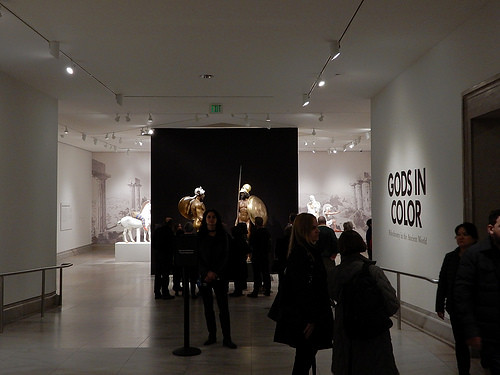
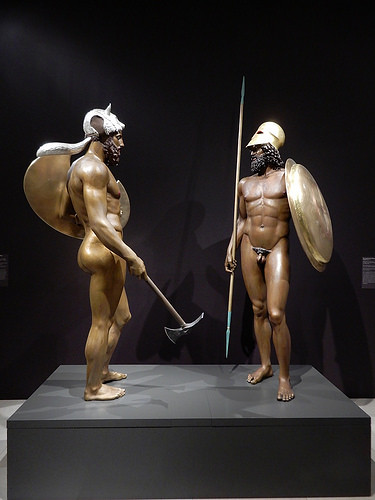
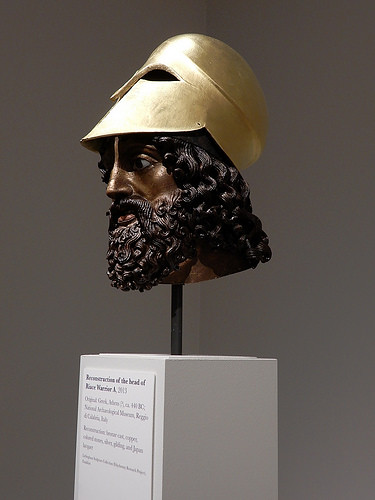
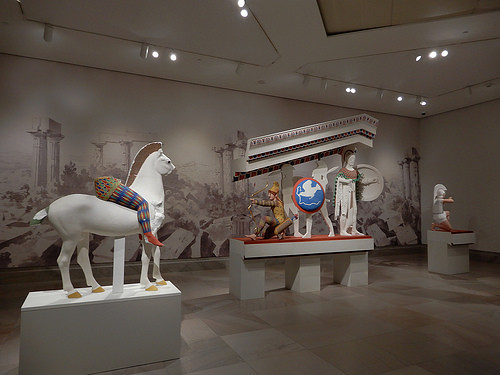
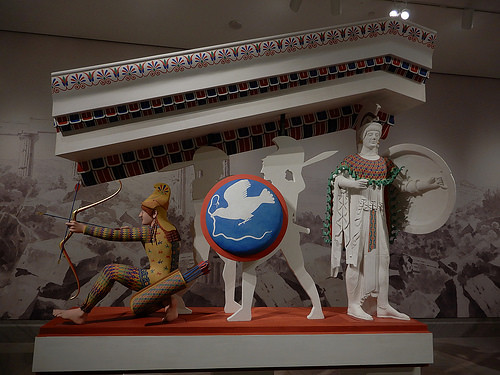
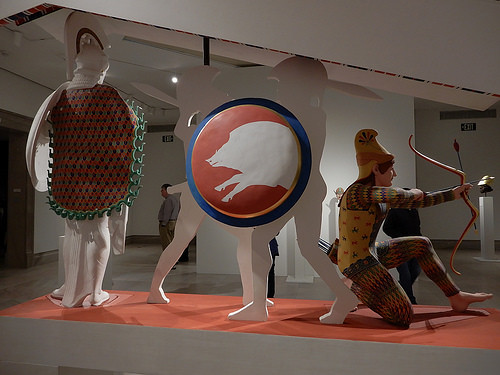
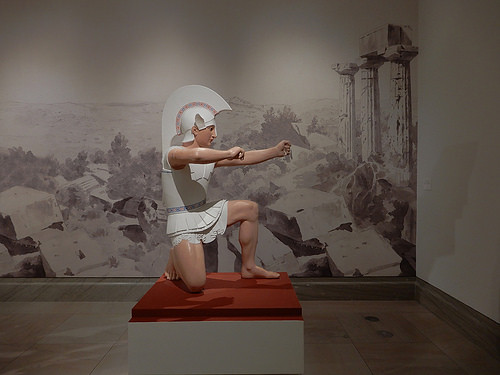
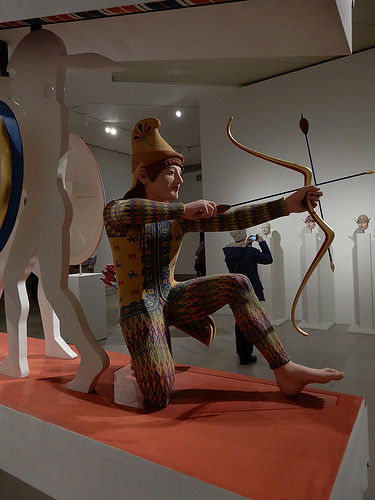
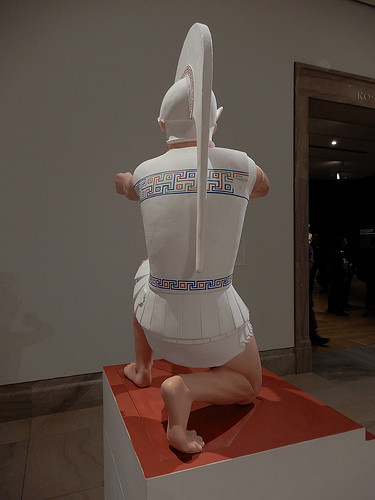
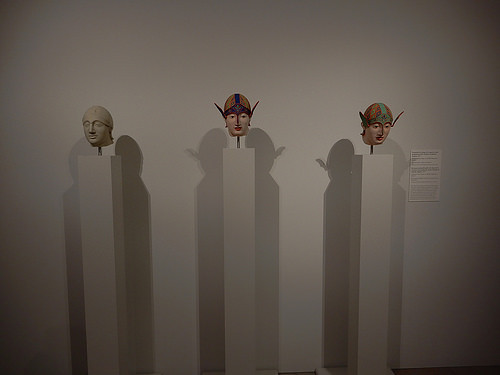
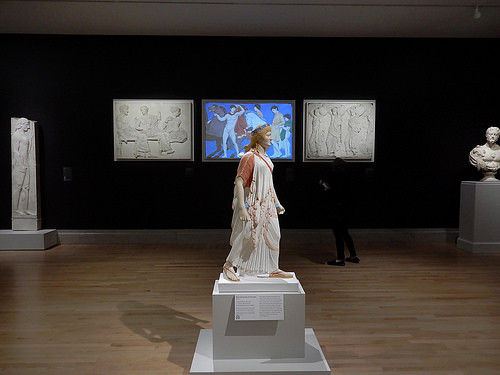
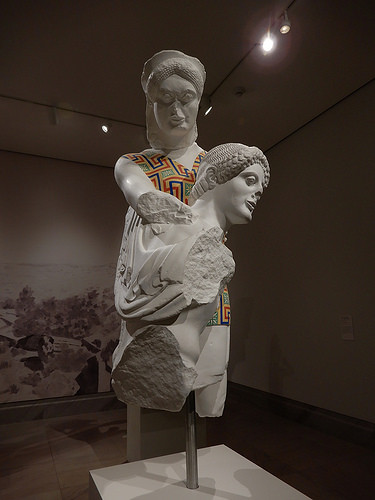
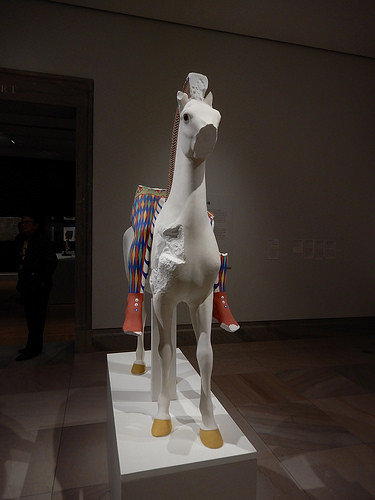
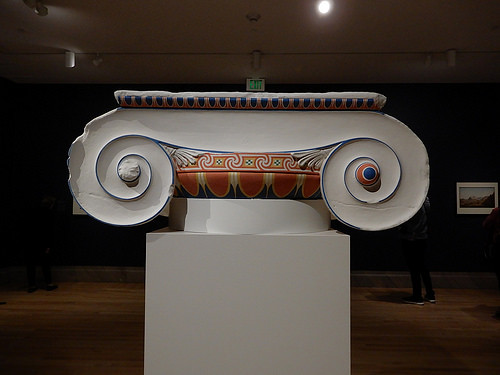
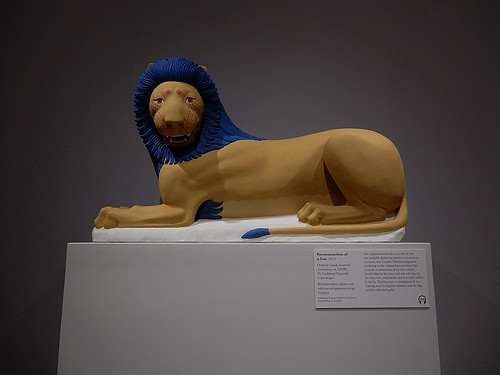
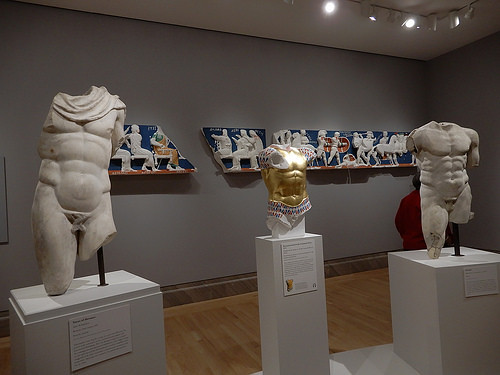
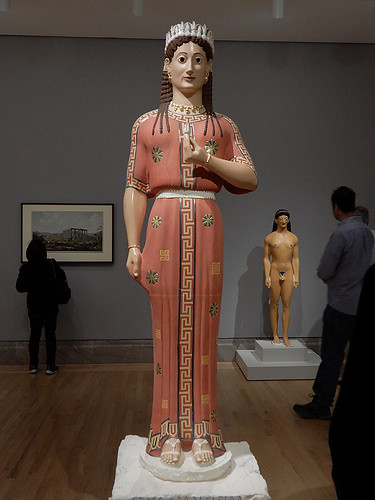
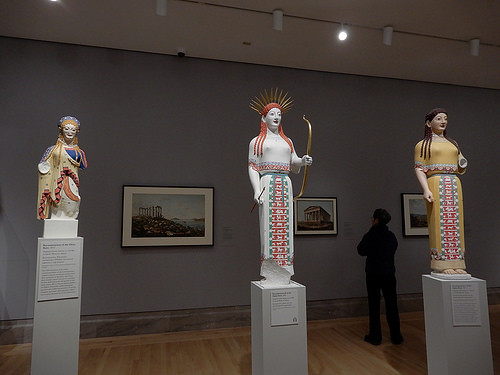
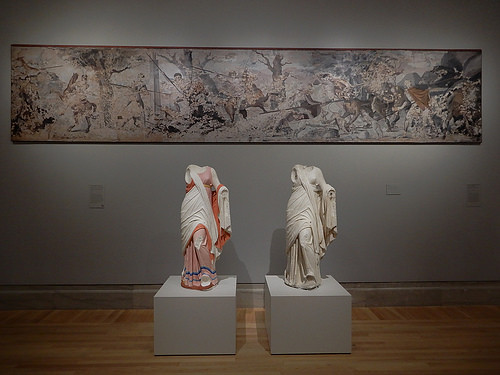
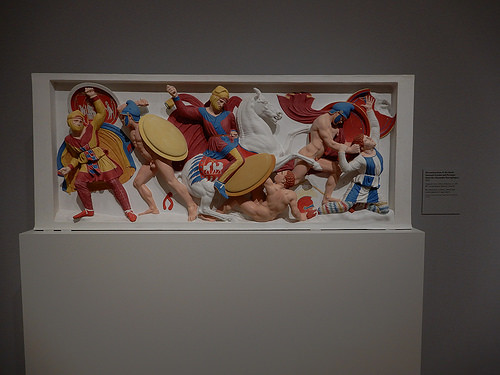
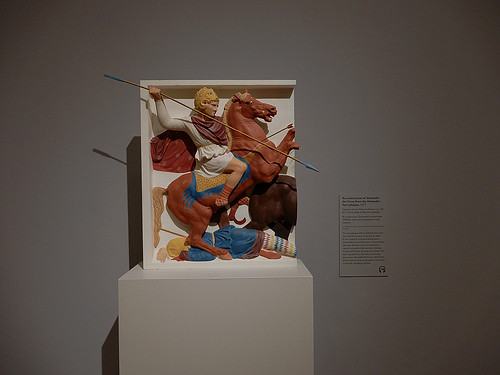
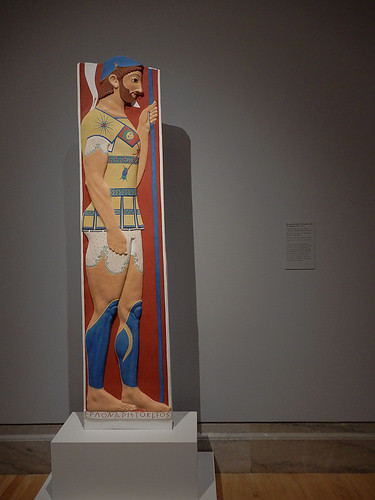
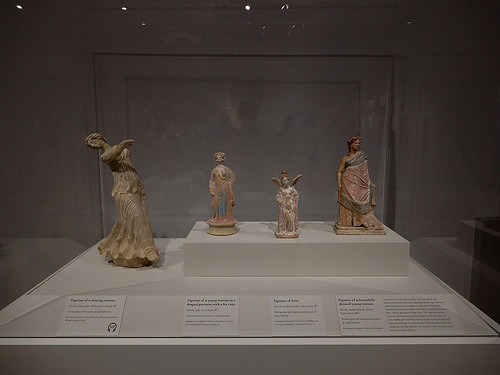
A quite unique exhibition titled Gods in Color: Polychromy in the Ancient World (October 28, 2017 – January 7, 2018), in San Francisco's Legion of Honor Museum, allowed viewers to explore classical sculpture "restored" in their original vibrant colors.
According to the exhibit, some ancient artifacts still retained their original colors, while some colors were determined through chemical analyses to identify numerous
preserved elements of bronze polychromy. "Ancient sculpture and architecture from Greece and Rome will be
revealed as intended—garishly colorful, richly ornamented, and full of
life—along with original sculpture from the Near East, Egypt, Greece,
and Rome..."
To the thoroughly conditioned modern eyes, the idealized beauty of antiquities of purity, was wildly disrupted by bursts of bright and gaudy colors, if not violated. To be fair, when sculptures were yanked out of their natural settings, pure ones were easily to appreciate than multicolored ones, which might be more in harmony with sumptuous and brilliant settings of the origins.
Reconstruction of a lion, 2012 (c 550BC)
Torso of Hermes 2nd C., Recon. B of the Cuirassed Torso, 2005 (c 470BC), Herakles
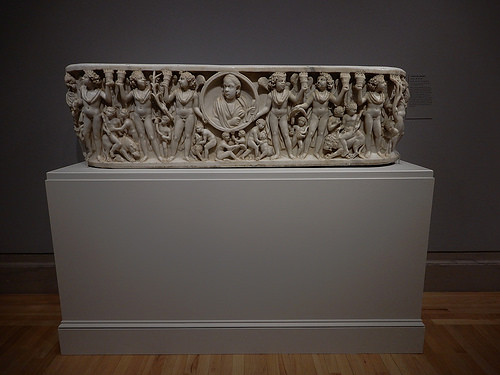
Alexander Sarcophagus
Figurine, 2nd C BC, Figurine, 2nd-1st C BC, Figurine of Eros, 3rd C BC, Figurine, 3rd or 2nd C BC
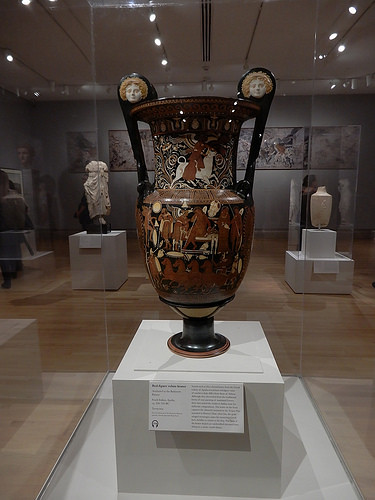
Red-figure volute krater, c 330-320 BC
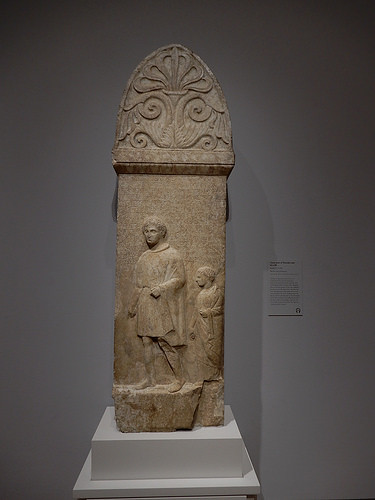
Funerary lekythos with a young woman, c 375BC - Gods in Color (l) & DSCN0043 _ Grave stele of Poseides and his wife, c 275BC (r)
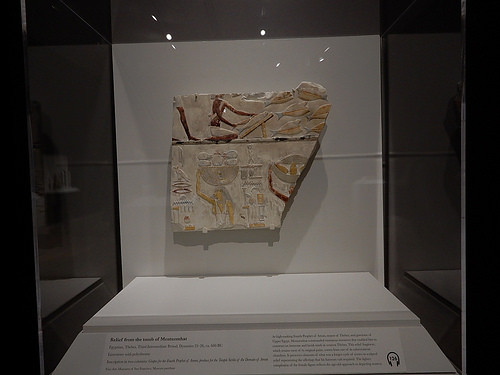
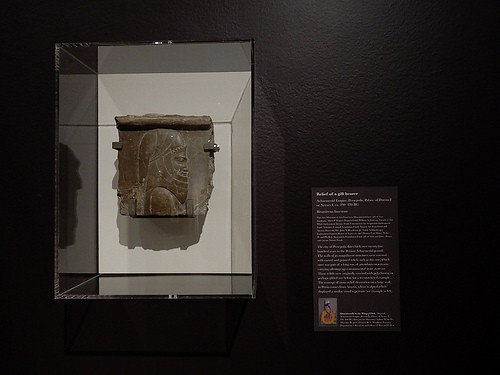
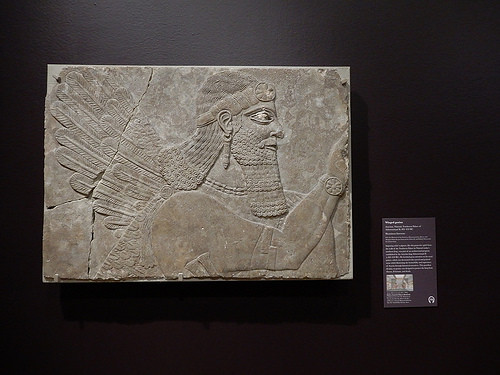
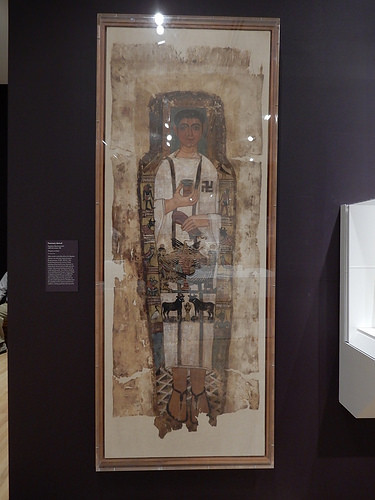
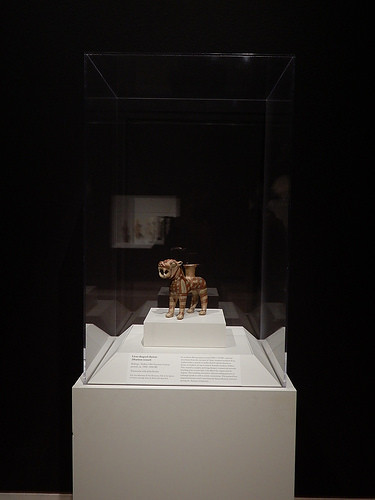
The exhibition also included a collection of Egyptian, Assyrian, and Persian antiquities, illustrating a
range of painted colors, which are still visible on some of the artifacts.
Ever since the opening of the new Greek and Roman Wing at the Metropolitan Museum of Art on April 20, 2007, I longed to visit it. Finally, I got chance to admire the beautiful hall, as well as incredible collections there. In the same trip, I also concentrated on Byzantine works, which I had not paid much attention in my previous visit. For a museum as big as the MET, I had to strategize and concentrate on a portion of its vast collections in order to really look at the art, instead of just greetings and then moving on.
I found this introductory video online and it can guide my dear readers who are not familiar with this project.
At the entrance hall to the Greek and Roman wing, visitors can see most imposing statues and columns.
Below pictures are only the corridors to the big display rooms at the end and smaller ones on the sides.
Greek sculptures from all periods are included and I can spend hours and hours in these rooms.
Marble head of a youth from a relief, Greek, late 4th century B.C., Said to be from Rhodes
Beyond the beautiful sculptures so identified with Greek culture, there were many other objects with high historical, cultural and artistic values. I particularly love the weird small sculpture below, like the Female Figure with strange profile and the Harp Player in the strange pose, and terracotta and metal artifacts below:
Marble female figure, Cycladic, Final Neolithic, c. 4500-4000 B.C.
Marble female figure, Cycladic, Final Neolithic, c. 4500-4000 B.C.
Marble seated harp player, Cycladic, Early Cycladic I-Early Cycladic II, c. 2800-2700 B.C.
Terracotta neck-amphora (storage jar), Greek, Attic, Proto-Attic, second quarter of the 7th century B.C.
Terracotta krater, Greek, Attic, Geometric, c. 725 B.C.
Terracotta neck-amphora (jar) with twisted handles, Greek, Attic, c. 440 B.C.
Two Bronze Helmets, Greek, South Italian, mid-4th-mid-3rd century B.C.
Terracotta sarcophagus rim, East Greek, Clazomenian, last quarter of the 6th century, B.C.
Gold phiale (libation bowl), Greek, 4th-3rd century B.C.
Roman Art obvious continued Greek tradition but also developed in the directions of its own distinction. Beyond the usual busts closely associated to Roman arts, I love those murals and mosaics very much.
Marble head of a Greek General, Roman, 1st-2nd century A.D.
Marble head of an athlete, Roman, Antonine period, c. A.D. 138-92, Copy of a Greek bronze statue of c. 450-425 B.C.
Marble Sarcophagus, Roman, about A.D. 220-230
Roman Portrait of a young boy
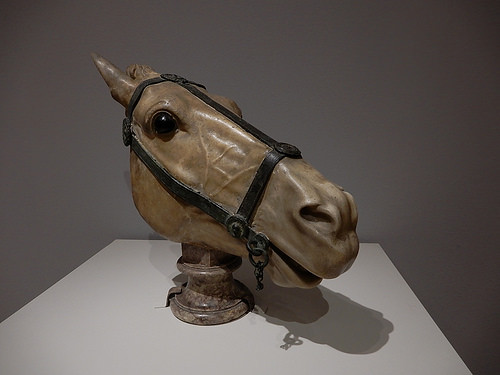
Bronze medallion of Mantinea - BETOYPIOC, bust of Antinous, favorite of Hadrian_TOIC APKACI, horse Mantinea, A.D. 130-137
Byzantine Art collection is relatively small and I had hard time to locate them - they were underneath the main staircases facing the entrance hall. There were some incredible fabrics from that period and Byzantine Egypt but my batteries went dead before I could capture some images.
I had been to the Egyptian wing before but somehow, I totally missed the gigantic reconstructed Temple of Dendur, Egyptian, Dendur, Nubia, Roman period, ca. 15 B.C. They were quite well preserved - mysterious and imposing, yet not uninviting, due to the bright light in this room.
The last portion of the artifacts from ancient worlds I want to include in this post mostly contained gold masks and crafts from South America, Mexico, Columbia, etc. They were stunningly rich and slightly grotesque. Most interesting thing to me was that they resembled some huge bronze masks I saw in Sanxingdui, Sichuan Province, China. Perhaps, there were some hidden connections since that particular civilization emerged and disappeared mysteriously as well and didn't resemble much of other part of Chinese culture. Strange indeed.




 Posts


