Showing posts with label North Korea. Show all posts

Wednesday, March 22, 2017

A Glimpse of North Korea from Dandong, China

Last May, I took a day trip to Manchurian city Dandong, the large border Chinese city next to North Korea.

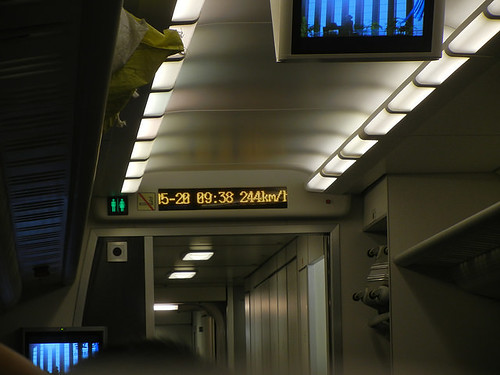
I entertained myself during the short train ride from my home city Shenyang, when the scenery got dull, by observing the speed of the train, which had reached 244 km/hr (152 mi/hr).

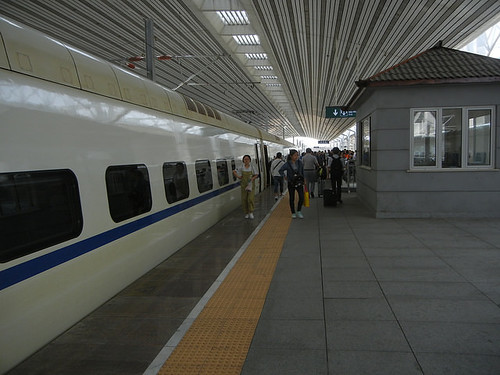
DSCN2528 - High Speed Train in Dandong, Liaoning, China

DSCN2521 - Train to Dandong, 244km:hr

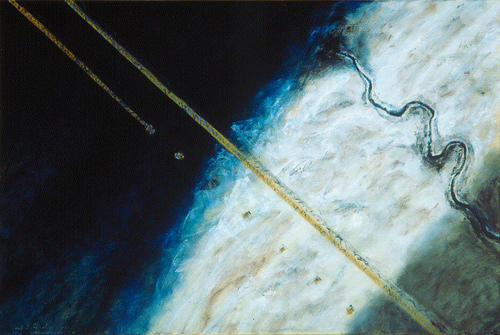
Dandong was the entry point of the Chinese "Volunteer" Army and military materials pouring into the battlefields of Korean War in 1950s. The bridge connecting Dandong and North Korea was bombed during the war and it remained damaged, as a relic of the war, stood next to a later bridge, which channeled legal or illegal imported and exported goods between China and North Korea. The image of destruction had made a strong impression on me, and I even made a painting of those parallel bridges, titled "Bombed Bridge, III".

Bombed Bridge, III / 炸斷的橋樑之三 / Bombardierten Brücke, III
Bombed Bridge, Oil on Canvas, 24"x36", 2007

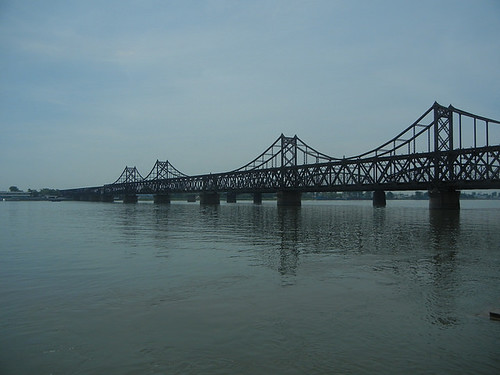
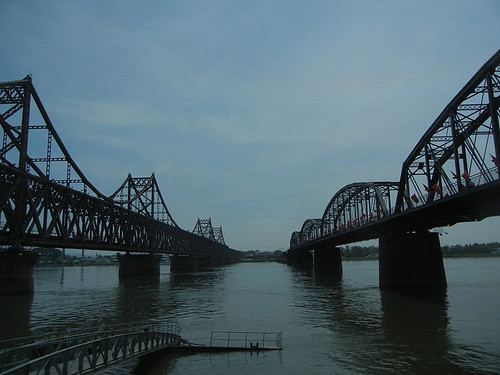
It should be noticed that the damage to the old bridge was limited to the North Korea's side only, while the rest remained intact inside Chinese territory. At the right vantage point, one could see both bridges stood side by side over Yalu River.

DSCN2550 - Bridges over Yalu River

DSCN2657 - Bridges over Yalu River


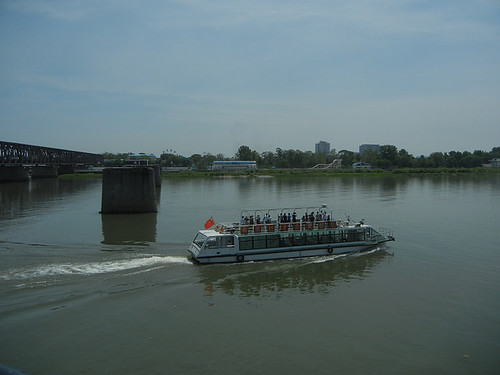
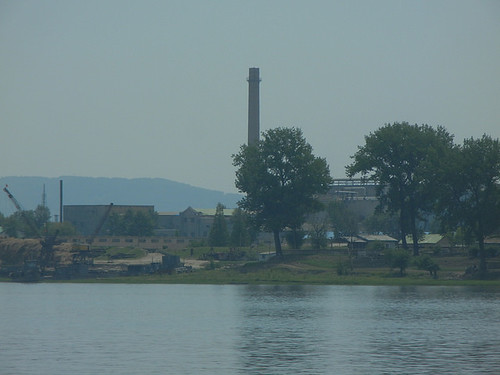
I took a little river cruise along the river, so as to take a quick survey of the border region of North Korea, Sinuiju.

DSCN2713 - Cruise boat on Yalu River

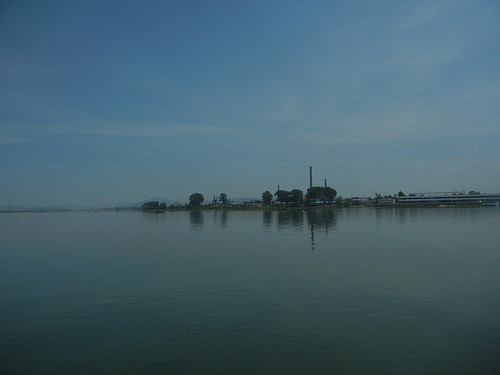
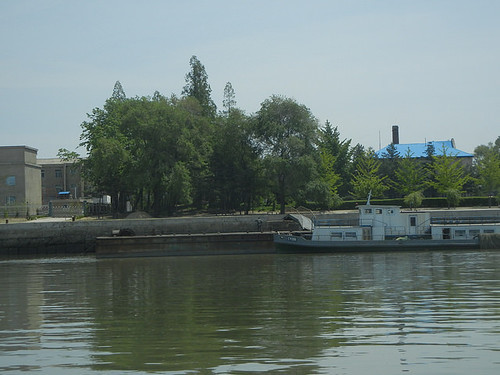
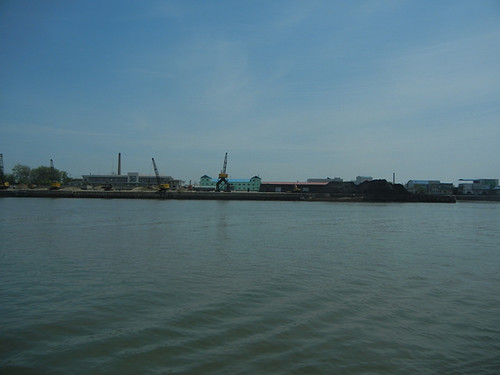
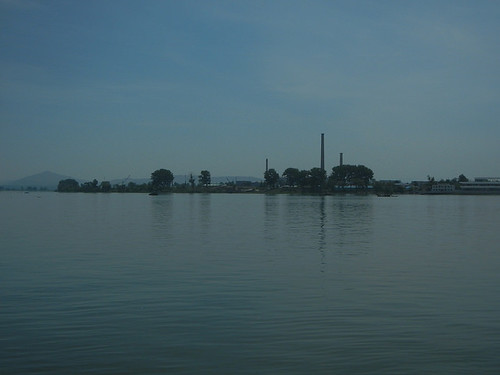
DSCN2732 - A glimpse of North Korea from Dandong, China

DSCN2744 - A glimpse of North Korea from Dandong, China

DSCN2757 - A glimpse of North Korea from Dandong, China

DSCN2562 - A glimpse of North Korea from Dandong, China

DSCN2563 - A glimpse of North Korea from Dandong, China


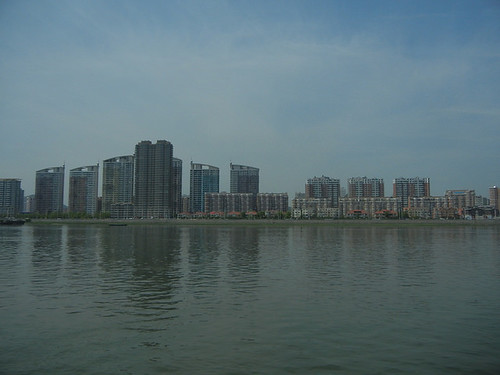
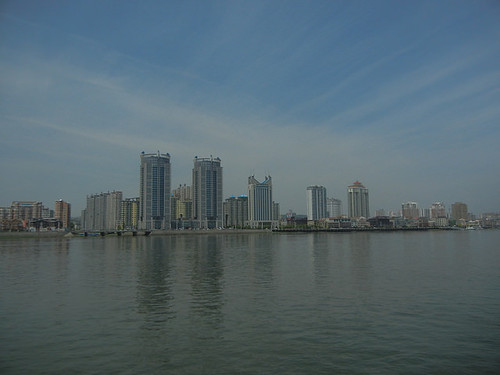
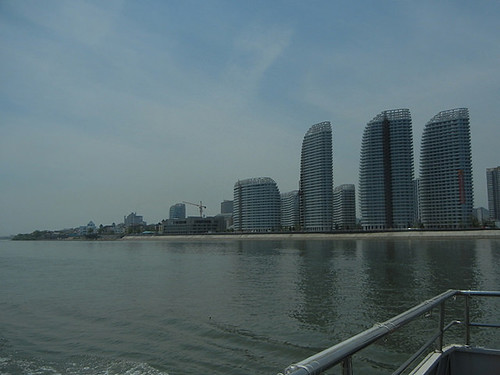
Looking back at Dandong, which though in the economic depressed rust belt Northeast China, comparing to the slow-paced North Korea, looked like a thriving metropolis:

DSCN2780 - Border city Dandong, China

DSCN2781 - Border city Dandong, China

DSCN2758 - Border city Dandong, China


It seemed so arbitrary that one could be born in a "wrong region", or at a "wrong time". Or both. And for the unlucky ones, hope simple didn't exist.


Related posts on Art · 文化 · Kunst:
- Best Transit Airport - Seoul/Incheon International Airport
- Supermarkets in Shenyang, China
- Tram and Subway in Shenyang, China
- Industrial Museum of China in Manchurian Shenyang
- New Subway System in Shenyang, China
- Glances of Manchurian City Shenyang
- Kitsch

Saturday, June 1, 2013

Devastating Novel "The Land of Green Plums" by Herta Müller

Herta Müller in 2007
Amrei-Marie unter
cc-by-sa3.0 und GFDL
Recently I read a devastating novel, The Land of Green Plums, by Romanian-born German writer Herta Müller (17 August 1953-), and have been haunted by the unbearable hard life she depicted unflinchingly ever since.  The original title, however, was Herztier, Heart Animal, or Heart Beast as the phrase translated by Michael Hofmann for Picador Book.  Besides being a novelist, Müller is also a poet, essayist and she was the recipient of the 2009 Nobel Prize in Literature. Born in Niţchidorf, Timiş County in Romania and her native language is German.[wikipedia]

The novel was set at the height of Ceauşescu's reign of terror and a mere daily existence was a heroic struggle, particularly for intellectuals.  The green plums were referring to omnipresent surveillance agents who chewed on those plums constantly.  Heart Animal was a living presence inside an individual the state was striving to stamp out like wildfire.  The stories she told was intentionally episodic and not always coherent and logical, thus she created a hallucinatory atmosphere and a nightmarish living environment one could not escape from.  The novel impressed me  most by its accurate depiction of seemingly inconsequential but cumulatively enormous burdens the state imposed upon individuals.  The book was a devastating read, particularly for people like me who grew up under the similar circumstances, if not as severe, and have close relatives and friends suffering the similar oppressions even now, more so than I had ever experienced, as the political situation in China gets more insufferable as the Communist Party's legitimacy gets shakier and the totalitarian regimes get lonelier.

The Land of Green PlumsThe language Müller employed was halting and haunting yet deceptively simple, and the images she conjured up hallucinatory, the morals clear, through tortuous paths. I have to quote some passages from the translated version, which would eloquently correlate all the points I just made.

Its preface was a poem by Gellu Naum (August 1, 1915 – September 29, 2001) was a prominent Romanian poet, dramatist, novelist, children's writer, and translator.[wikipedia]
   Everyone had a friend in every wisp of cloud
   that's how it is with friends where the world is full of fear
   even my mother said, that's how it is
   friends are out of the question
   think of more serious things                                             
                                     
                                        - Gellu Naum
On Page 94, Müller wrote:
I have been interrogated by Captain Pjele on his own without the dog Pjele. Maybe the dog Pjele was having a break, to eat or sleep. Maybe the dog Pjele was off in one of the building's many hidden rooms being trained, either learning something new or practicing something he already knew, while Captain Pjele was interrogating me. Maybe the dog Pjele was with the man and the canvas bag, on the tail of someone else in the street. Maybe with a different man and no canvas bag. Maybe the dog Pjele was following Kurt while Captain Pjele was interrogating me. How many men were there, and how many dogs? As many as a dog has hairs.
On Pages 121-122:
If Frau Margit spent too long reading and ate too many wafer scraps, her stomach would get so holy that she would belch as she peeled the potatoes, and then she would swear even more. Since I've known Frau Margit, holy for me means a dry, whitish crackling in the mouth that makes you belch and swear.
Finally, on Page 177:
On her wrist she had one of my father's dead wristwatches. Why do you wear if, I asked, if it doesn't work? Nobody can see that, she said, and you have one too. Mine works, I said, otherwise I wouldn't be wearing it. If I wear a watch, it makes me feel more secure, she said, even if it's not working. Then why ask me what time it is? I said.

Because that's all I can talk to you about, said Mother.
It was a most memorable book, beautiful and repulsive simultaneously.


The Orphan Master's Son


Ashamed of Oneself - Reading Book "Never Let Me Go"
- Molotov's Magic Lantern: A Journey In Russian History by Rachel Polonsky and Some Journeys of My Own
- David Malouf's Ransom
- Review of "As Above, So Below" by Rudy Von B. Rucker
- Banned Books in Mao's China

Friday, December 23, 2011

Remembering Mao's Death

The death of the dictator of North Korea Kim Jong-Il triggered a wave of show of grief in that isolated country.  To many informed, Kim Jong-Il was a ruthless and heartless ruler who brought his people to calamities after calamities.  Yet, his people mourned his passing.


I suspect that their sorrow demonstrated in the pictures above is largely genuine.  It's not like they are stupid but they are deceived.

The power of propaganda and brain-wash cannot be underestimated.

The pictures above reminded me what happened in China, when their Chairman Mao Zedong died in September 1976.

Many people cried as if the world came to an end and as if they indeed had lost a most caring father, despite the fact that Mao's long reign had been very destructive and oppressive, which could only be topped by the cruelty of the Khmer Rouge in Cambodia.  Some historical pictures showed how Chinese people showed their collective grief.


I was very young and just started my school. The overwhelming showing off grieve by the adults made a great impression on me, with mixture of fear and joy.  It was the kind joy when a calamity we had often prayed for, say before an unprepared final exam, miraculously materialized.

However, I knew that such joy was not to be revealed.  At the time, I was not aware of the evilness of Mao therefore didn't harbor any hatred against him yet.

On the national mourning day, we were herded to some room lying between our make-shift classroom, rented in residential area by local government due to lacking classrooms in schools, and my home for a memorial service.  The grim atmosphere in the dark room again was impressive and if anyone in my class cried, I suspect it was mostly due to fear or hallucination.  But I didn't witness any because we had to bow our heads and look at our feet.  Or others' feet.  I heard a rumor that a girl spat on her cloth shoes to make them wet as if soaked by tears.  I suspected that this was just malicious gossip, but couldn't dismiss it with absolute confidence.  We first-graders were capable of playing many tricks to score over others, in order to wangle some praises from our teachers.

When I returned home, I rested in the hallway before I entered our flat, to ensure that any trace of schadenfreude smile be erased from my face.  Before I finished hiding my glee, my mother suddenly came out of our flat and startled me.  I must looked unnatural due to my inexperience and not having mastered the requisite art of deception.  She insisted on interpreting my abashment as the result of my being caught weeping out of grief and felt embarrassed by that and heaped upon me with extravagant praises which I tried to evade in vain.  She would not or refused to understand my explanation.  Perhaps, her version would have put her mind at better ease?

Anyway, during those days, kids had a little bit more leverage to do whatever we pleased.  Besides, after we'd witnessed how adults howling like wounded animals in the most ungainly ways, their collective authorities eroded quite a bit.

Sometimes, it was even comical.

The last picture above showed that all the mourners had a black band on their left arms - a sign for mourning in then China.  If the deceased were a woman, the band should be worn on the right arms by her mourners.

In one P.E. class in the following days, we were drilled repeated to turn left or right because some of my classmates had trouble in following the commands of "Left Turn" and "Right Turn".  Some of us were not quite able to tell left from right.  To make things simple, our P.E. teacher told us that it were our left arms wearing the black band, therefore, we ought to turn towards that direction when he called out "Left Turn".

Even so, one boy still turned to his right on such command.  Our P.E. teacher was furious and almost struck the poor boy before he realized that the boy was wearing his black band on his right arm.

I don't remember the name and the face of that poor boy.  But he must be a poor one.  I remember that most of us have beautiful shining new black band made of some nice, wrinkle-free material while his was a miserable looking one, trimmed out of an old pair of trousers or jacket.  Surely his parents did not purchase black cloth for the band despite the fact that all residents were given extra rations for cloth that month and for that we despised him and laughed at his mistake most heartily.

Thursday, May 27, 2010

Kitsch

Recently, a rare "art" exhibit opened in Vienna's MAK Museum -- Flowers for Kim Il Sung; Art and Architecture from the Democratic People's Republic of North Korea. The museum says it is the first time major paintings from the Korean Art Gallery in Pyongyang have been shown abroad.

There are more than 100 oils, water colors and traditional Korean ink paintings, dating from the 1960s to the present day. The life depicted there are pure "joy". Apparently, Northern Korean live in a land not dissimilar to the wonderland created by Thomas Kinkade.

These so called are are as naive as sinister. Being charitable, we can call it communism kitsch.

Noon time, by Yang Myong Ryong, 1963

Kim Jong Il, the supreme commander of the KPA, deeply concerned over the soldiers' diet, by Ri Chol, 2000

I happen to be reading Milan Kundera's The Unbearable Lightness of Being. I actually am reading precisely these few paragraphs now:

The feeling included by kitsch must be a kind the multitudes can share. Kitsch may not, therefore, depend on an unusual situation; it must derive from the basic images people have engraved in their memories: the ungrateful daughter, the neglected father, children running on the grass, the motherland betrayed, first love.

Kitsch causes two tears to flow in quick succession. The first tear says: How nice to see children running on the grass!

The second tear says: How nice to be moved, together with all mankind, by children running on the grass!

It is the second tear that makes kitsch kitsch.

The brotherhood of man on earth will be possible only on a base of kitsch.

And no one knows this better than politicians. Whenever a camera is in the offing, they immediately run to the nearest child, lift it in the air, kiss it on the cheek. Kitsch is the aesthetic ideal of all politicians and all political parties and movements.

Those of us who live in a society where various political tendencies exist side by side and competing influences cancel or limit one another can manage more or less to escape the kitsch inquisition: the individual can preserve his individuality; the artist can create unusual works. But whenever a single political movement corners power, we find ourselves in the realm of totalitarian kitsch.

When I say "totalitarian," what I mean is that everything that infringes on kitsch must be banished for life: every display of individualism (because a deviation from the collective is a spit in the eye of the smiling brotherhood); every doubt (because anyone who starts doubting details will end by doubting life itself); all irony (because in the realm of kitsch everything must be taken quite seriously); and the mother who abandons her family or the man who prefers men to women, thereby calling into question the holy decree "Be fruitful and multiply."

In this light, we can regard the gulag as a septic tank used by totalitarian kitsch to dispose of its refuse.
People should realized that kitsch is not the monopoly of certified totalitarian countries such as North Korea. Texas can proudly join the rank.

Devils' Dance / 魔鬼的舞蹈 / Teufels Tanz