Showing posts with label Tradition. Show all posts

Friday, May 13, 2011

Shark Fin and "Waste Not" - True Chinese "Tradition"

Shark fin soup? Yum! Foie gras? Yuck.
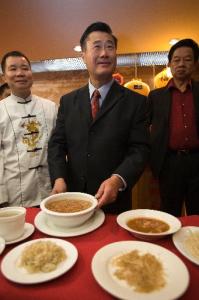
Shark fin soup is considered delicacy by many Chinese, particularly those live near the ocean and are wealthy, manifested by Cantonese speakers in the US. In order to curb the cruel shark finning in international waters, legislators in California proposed to outlaw the title ingredient in shark fin soup. Some Asian, particularly of Chinese descend, opposed it and calling it an assault on Chinese culture, such as San Francisco mayor hopeful Leland Yee, and mayor Ed Lee. Yet, the very same politician Leland Yee, the vocal opponent of shark fin ban, voted for foie gras ban in 2004

However, most Chinese-Americans, including me, support the ban. Associated Press reports that "a poll released Friday by the Monterey Bay Aquarium indicated strong support of a fin ban among Californians. More than three-quarters of the 600 registered voters surveyed said they support the bill. Of the 218 respondents who were Chinese-American, 70 percent said they support it."

Calling eating shark fin soup a Chinese tradition, as did Leland Yee and Ed Lee, is preposterous.

For example, let's cast eyes on an installation "Waste Not" in San Francisco's Yueba Buena Center for the Arts (YBCA) by Chinese artist Song Dong.

The installation features more than 10,000 household items ranging from pots and basins to blankets, bottle caps, toothpaste tubes, and stuffed animals, junk by most people's up-to-date standard, collected by Song's mother over half a century dating back to the Cultural Revolution, demonstrates the evolution of China within the 20th century and reveals the societal implications of modern China. They also express how he personally copes with his country's rapid development, while retaining a spiritual connection to the past.

YBCA described Song and his work as "especially powerful in expressing the effects of radical change and social transformation on members of his own family. It is this latter aspect of his work that has set him apart from the many extraordinary artists who have also been grappling with the rapid changes China is experiencing.

"Waste Not follows the Chinese concept of wu jin qi yong or 'waste not,' as a prerequisite for survival. A core theme of Waste Not is the idea that people, everyday objects and personal stories are not only spiritually rich in thematic material but recognizable evidence of the impact of politics and history on family life."

I wonder what Song's mother thinks of the shark fin soup, if she ever heard of it.

This so called cultural tradition has never linked to the masses and have nothing to do with people who struggle to put floor, rice, corn, or sorghum on their tables.

Some Chinese people, mostly Cantonese speakers who are well-known for their reckless taste for novelty, would sacrifice many other things to satisfy their desire, often pure vanity.

Like, shark fin soup, another quirky taste favored by Cantonese speakers is Nostoc flagelliforme, or Fat choy (Fa Cai in Mandarin) -- hair moss or hair weed, a terrestrial cyanobacterium (a type of photosynthetic bacteria) that is used as a vegetable in Chinese cuisine. When dried, the product has the appearance of black hair. For that reason, its name in Chinese means "hair vegetable." When soaked, this vegetable has a very soft texture which is like very fine vermicelli, and an appearance very similar to long, black, human hair.

The last two syllables of this name in Cantonese sound the same as another Cantonese saying meaning "struck it rich" (though the second syllable, coi, has a different tone) -- this is found, for example, in the Cantonese saying, "Gung1 hei2 faat3 coi4" (恭喜發財, meaning "wishing you prosperity"), which is often proclaimed during Chinese New Year. For that reason, this product is a popular ingredient in dishes used for the Chinese New Year. [source: wikipedia]

Collecting Fa Cai is very damaging to the vegetation. Since 1980s, with the dominance of commerce by and concentration of wealth in Cantonese speakers, what they like became fads in China and the results were rapid destroy of feeding pasture and the growth of desert.

Perhaps, Ed Lee and Leland Ye should visit those devastated places in northwest China in order to savor their "culture".

When I grew up in Mao's China, in my province, Liaoning Province, a residence was rationed to 7 oz. cooking oil per month. In a port city in Liaoning, Dalian, the mayor gained a nickname "Four Eggs" because then a resident had the ration of four eggs per month.

People also tend to link rice consumption to Chinese people. While, when I grew up, we didn’t have enough rice, though my home province grew best rice in the nation. Wheat flours, corn floors, millet and sorghum were necessary to fill the stomachs.

This continues today in some part of China.

Chinese Americans, particularly ABCs, mostly originated from a small corner of China and it is very presumptive for them to claim that their way of life represents Chinese culture. A small sector of it, yes; but never a whole.

Mr. Lee and Mr.Yee, do you have the heart to lecture them what Chinese culture is? What is Chinese culture?  It's not up to some isolated, rich Chinese American politicians to define.

It is highly disgusting when privileged people take their indulgences for granted and imply or insist on it is universally available, as Mr. Lee and Yee have done.


"Waste Not" by Song Dong

Saturday, August 14, 2010

Traditional is the New Avant-Garde

Artists often strive to be the unique one, the one who creates things new like no other and being avant-garde is a great honor.

Yet, there are so many styles and methods can be employed, if one wants to remain in the defined sphere, instead of creating a new form completely, e.g. Andy Goldsworthy's transient installations, dance combined ballet and martial arts.

For those who want to work in the conventional format, such as pure ballet dance making, it is quite challenging to stay new.

The consolation is that, like fashion, people's taste change and often in cycles. Therefore, things considered traditional, or conventional a few decades ago, now suddenly in vogue and become the new avant-garde.

New York Times recently published a fascinating article on narrative ballet (versus abstract, non-story telling ballet, like those created by Balanchine). The article quoted the retired ballerina Gelsey Kirkland wrote in an open letter on the Web site for the new Gelsey Kirkland Academy of Classical Ballet (gelseykirklandballet.org), "I have come to believe over the years that the future of ballet lies in the art of dramatic storytelling, drawing on the wellsprings of classical tradition."

The article continued: "Interestingly, Ms. Kirkland’s words come just as a wave of narrative dance drama has been gathering force. At New York City Ballet — the company that consistently did the most to propagate plotlessness in 20th-century classical ballet — the past season was mainly given over to full-evening story ballets. Of the eight new ballets produced by the company so far in 2010, each by different choreographers, four have been storytelling, while a fifth, Alexei Ratmansky’s “Namouna,” has arcane suggestions of narrative."

It also pointed out that "What’s more, it’s easier for audiences now to see that the 20th-century pure-dance ballet was never abstract. As Balanchine, Merce Cunningham and Mark Morris all observed, you cannot have abstraction where there are human beings on a stage. Put a man and a woman onstage, Balanchine liked to say, and you already have a story; it has been well said that his plotless ballets actually have more drama than most story ballets."

So, the line has never been cleanly drawn. The new is always a repackaging the old. The old fashioned often make a brilliant comeback as the new new.

It is the same in the music world. New operas are more lyrical and grateful to singers and listeners instead of relentless howling and wailing of later half of the twentieth century.

Novelists are gladly telling stories in more or less traditional way, and less obsessed with the manipulations of the book format and lengths of the lines.

Fine artists are making paintings with a clear stories, sometimes even in cycles like those in the Gothic and Renaissance time. Unabashedly.

What they are doing is refreshingly different from the abstraction tyranny of the near past, they are the new avant-garde.

Soon, people will crave for something less obvious, less easily understood pieces. They will crave for challenge again - both creators and audience.

Then, the pendulum will swing to other side and we are poised for another fascinating change of time.


Leap / 躍 / Sprung
Leap © Matthew Felix Sun

Sunday, March 15, 2009

Civil Union, Marriage and Holy Matrimony

Recently, quite a few readers of the San Francisco Chronicle have suggested that all marriages should be called "civil unions," whether same-sex or opposite-sex, unless they are blessed by religious organizations. This is a dead-wrong proposal. Marriages, historically, in many cultures have always been civil actions, without religious content or implication. They were mostly social, often financial contracts. This supposedly progressive proposal to call all marriages "civil unions" will replace the discrimination against same-sex couples with discrimination against non-religious couples. Civil Union as a category was created as a compromise to accommodate same-sex couples and is innately a secondary class term. In these modern days, in order to respect and protect the rights to all members of the society, we should continue to call the marriages recognized by civil society and government "marriages," while those blessed by the religious organizations can be called “Holy Matrimony” as they have been for a very long time. This is far better than demoting the marriages of my grandparents and my parents into second class ones.