Monday, May 16, 2011

43 Days in Detention, Chinese Artist Ai Weiwei Allowed to See Family

New York Times (The Associated Press) reported that "The sister of the detained Chinese artist Ai Weiwei said Monday that he had been allowed his first family visit in 43 days.

The Beijing police took Mr. Ai’s wife, Lu Qing, to an undisclosed location Sunday night where she was able to see and talk briefly with her husband.

The sister, Gao Ge, said Ms. Lu reported that Mr. Ai seemed healthy and was being given access to medication that he needs. Ms. Gao said the police had still not told the family where Mr. Ai was being held. She said the family was relieved to know he was well, but hoped the government could clarify what was going on with his case."

This is a relief.  However, the detention, over 30 days limitation without formal charge, is clearly in violation of Chinese law and the Chinese authority who's holding Ai ought to release him immediately.


Human rights demonstrators carrying a picture of Mr. Ai outside the China Liaison Office in Hong Kong on 5 April 2011.

Sunday, May 15, 2011

In the Eyes of the Beholders

"Leah Garchik informed us in her syndicated column on San Francisco Chronicle that
Danielle Steele told the Wall Street Journal, which describes her as "newly Parisian," that she has left San Francisco.

"San Francisco is a great city to raise children, but I was very happy to leave it. There's no style, nobody dresses up - you can't be chic there. It's all shorts and hiking boots and Tevas - it's as if everyone is dressed to go on a camping trip. I don't think people really care how they look there; and I look like a mess when I'm there, too."
I am afraid that I have to agree with her and I do find that not only San Franciscans look way too casual, myself included, its much praised beauty is overrated too.  San Francisco is surrounded by natural beauty of a specific kind and if it's your thing then you are in heaven; if not, you will find yourself trapped.

However, San Francisco does have legions of its defenders, on fashion front and on the beauty front.

It all depends on the perception and reaction of the beholders.

The comments by Steel reminded me a very interesting anecdote.

Danielle Steel, the romantic novel and New York Time best seller, is known for her novels concentrating on the rich and the famous and had a huge followings, particularly women, had at least one of her novels branded as pornography by Chinese censors.  That "pornography" book was Family Album.  Wikipedia described is thus:
The novel came out in March 1985 published by Random House. The novel tells the story of Faye Price (later Thayer), since World War II to her death in present day. It relates her professional life as an actress in Hollywood's golden era to finally becoming one of the first female directors in Hollywood. But more important to her is her family life, from her marriage, the birth of her children, separations and reconciliations with her husband, the struggles to raise her children, and the problems they go through once grown up until, in the end, they come through stronger from the ordeal.
Yet, for Chinese authorities, in 1990s, the book was inundated with sex, drugs, hippies, free love, homosexuality, protests, Viet Name War, and death.  The only missing element was incest.  Porno!

I wonder if Steel would be amused or not.

Friday, May 13, 2011

Shark Fin and "Waste Not" - True Chinese "Tradition"

Shark fin soup? Yum! Foie gras? Yuck.
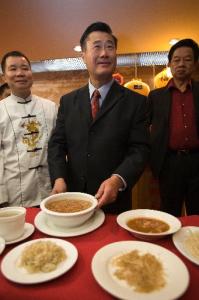
Shark fin soup is considered delicacy by many Chinese, particularly those live near the ocean and are wealthy, manifested by Cantonese speakers in the US. In order to curb the cruel shark finning in international waters, legislators in California proposed to outlaw the title ingredient in shark fin soup. Some Asian, particularly of Chinese descend, opposed it and calling it an assault on Chinese culture, such as San Francisco mayor hopeful Leland Yee, and mayor Ed Lee. Yet, the very same politician Leland Yee, the vocal opponent of shark fin ban, voted for foie gras ban in 2004. 

However, most Chinese-Americans, including me, support the ban. Associated Press reports that "a poll released Friday by the Monterey Bay Aquarium indicated strong support of a fin ban among Californians. More than three-quarters of the 600 registered voters surveyed said they support the bill. Of the 218 respondents who were Chinese-American, 70 percent said they support it."

Calling eating shark fin soup a Chinese tradition, as did Leland Yee and Ed Lee, is preposterous.

For example, let's cast eyes on an installation "Waste Not" in San Francisco's Yueba Buena Center for the Arts (YBCA) by Chinese artist Song Dong.

The installation features more than 10,000 household items ranging from pots and basins to blankets, bottle caps, toothpaste tubes, and stuffed animals, junk by most people's up-to-date standard, collected by Song's mother over half a century dating back to the Cultural Revolution, demonstrates the evolution of China within the 20th century and reveals the societal implications of modern China. They also express how he personally copes with his country's rapid development, while retaining a spiritual connection to the past.

YBCA described Song and his work as "especially powerful in expressing the effects of radical change and social transformation on members of his own family. It is this latter aspect of his work that has set him apart from the many extraordinary artists who have also been grappling with the rapid changes China is experiencing.

"Waste Not follows the Chinese concept of wu jin qi yong or 'waste not,' as a prerequisite for survival. A core theme of Waste Not is the idea that people, everyday objects and personal stories are not only spiritually rich in thematic material but recognizable evidence of the impact of politics and history on family life."

I wonder what Song's mother thinks of the shark fin soup, if she ever heard of it.

This so called cultural tradition has never linked to the masses and have nothing to do with people who struggle to put floor, rice, corn, or sorghum on their tables.

Some Chinese people, mostly Cantonese speakers who are well-known for their reckless taste for novelty, would sacrifice many other things to satisfy their desire, often pure vanity.

Like, shark fin soup, another quirky taste favored by Cantonese speakers is Nostoc flagelliforme, or Fat choy (Fa Cai in Mandarin) -- hair moss or hair weed, a terrestrial cyanobacterium (a type of photosynthetic bacteria) that is used as a vegetable in Chinese cuisine. When dried, the product has the appearance of black hair. For that reason, its name in Chinese means "hair vegetable." When soaked, this vegetable has a very soft texture which is like very fine vermicelli, and an appearance very similar to long, black, human hair.

The last two syllables of this name in Cantonese sound the same as another Cantonese saying meaning "struck it rich" (though the second syllable, coi, has a different tone) -- this is found, for example, in the Cantonese saying, "Gung1 hei2 faat3 coi4" (恭喜發財, meaning "wishing you prosperity"), which is often proclaimed during Chinese New Year. For that reason, this product is a popular ingredient in dishes used for the Chinese New Year. [source: wikipedia]

Collecting Fa Cai is very damaging to the vegetation. Since 1980s, with the dominance of commerce by and concentration of wealth in Cantonese speakers, what they like became fads in China and the results were rapid destroy of feeding pasture and the growth of desert.

Perhaps, Ed Lee and Leland Ye should visit those devastated places in northwest China in order to savor their "culture".

When I grew up in Mao's China, in my province, Liaoning Province, a residence was rationed to 7 oz. cooking oil per month. In a port city in Liaoning, Dalian, the mayor gained a nickname "Four Eggs" because then a resident had the ration of four eggs per month.

People also tend to link rice consumption to Chinese people. While, when I grew up, we didn’t have enough rice, though my home province grew best rice in the nation. Wheat flours, corn floors, millet and sorghum were necessary to fill the stomachs.

This continues today in some part of China.

Chinese Americans, particularly ABCs, mostly originated from a small corner of China and it is very presumptive for them to claim that their way of life represents Chinese culture. A small sector of it, yes; but never a whole.

Mr. Lee and Mr.Yee, do you have the heart to lecture them what Chinese culture is? What is Chinese culture?  It's not up to some isolated, rich Chinese American politicians to define.

It is highly disgusting when privileged people take their indulgences for granted and imply or insist on it is universally available, as Mr. Lee and Yee have done.


"Waste Not" by Song Dong
Editor's Choice Award for "The Song of Orpheus" - Artist Portfolio Magazine

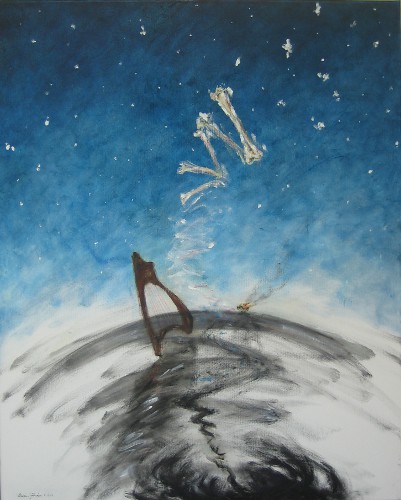
The Song of Orpheus / 奧菲厄斯的歌 / Das Lied des OrpheusThe Song of Orpheus
Oil on Canvas
30" x 24"
Completed in 2010

My painting "The Song of Orpheus" won Editor's Choice Award in the COVER II WINNERS competition, sponsored by MyArtContest.com - and will be featured in Artist Portfolio Magazine (Issue 2), which will be available online soon.  For reference, readers can view the first issue now. Below is the video presentation of this painting:


My Art Contest was created in Dec of 2007 as a way for artists to gain international exposure and to bridge the gap between artists, collectors and dealers around the world. Since then, My Art Contest has awarded thousands of dollars to support artist’s endeavors across the US and abroad. In recent years, the art world has seen a surge of online art contests. We are proud to be one of the original international juried online art contests. MyArtContest.com currently averages over 17,000 hits a day with over 500 unique visitors per day...

The entries have broad range of style and subject matters and the entries are mostly very accomplished and mature.  It is great be included in this selected group.


Related posts on Art · 文化 · Kunst:
- It's Official - Editors Choice Award Certificate- Editor's Award on Artist Portfolio Magazine, Published by My Art Contest
- "Diptych - Dawn" Won Another Award
- Another Award for a Drawing- One More Award from ArtSlant Showcase Competition- Honorable Mentioned in A Juried Competition

Lazy Cat

The cat who adopted me for almost a year is rather lazy sometimes. She only eats the food on the half plate near her and then stop, waiting for me to turn the plate for her.

That reminded me a funny story as a kid I heard in China.

There was a very lazy boy whose parents were planning a trip. The mother worried that the boy would starve to death so she made a gigantic pancake for her son. She believed that the boy would not even bother to fetch it when he became hungry so she made a hole of the pancake and hung it over his neck. However, when the parents came back from their trip, they found the son had indeed die of hunger - he only ate the part of the pancake immediately in front of his mouth. The rest still hung on his neck.

That is a champion. "My cat" has a long way to go.

Where is my pasta?
Where is my pasta?

Tuesday, May 10, 2011

Financial Troubles of Classical Music Institutions

In economic tough time, classical music institutions suffer greatly.  New Yorker tallied a partial list of such casualties:
The classical-music business lives in perpetual fear of the future. The last great shiver of foreboding swept over the city at the end of the nineteen-sixties, when it appeared that the new generation—the boomers—had no interest in classical music. The classical industry made a strong recovery, but the economic collapse of 2008 diminished both attendance and donations, and as a result several institutions are teetering or failing outright. What’s new about the current crisis is its sharply political edge, mirroring bigger battles that are taking place across the country. Managements and governing boards have often adopted an anti-union tone, charging that the costs of employing up to a hundred musicians year-round have become insupportable. That classical music could still draw a crowd was made clear in March, when YouTube Symphony drew an electronic public of thirty-three million people. Two orchestras that nearly went bankrupt in 2001—the St. Louis Symphony and the Toronto Symphony—are now thriving. The problem cases tend to show multiple symptoms of poor management: dubious real-estate moves, ham-fisted labor relations, klutzy P.R., and, above all, a lack of artistic focus. The classical business needs to start thinking of itself not as luxury but as an essential part of the average thinking person’s life. 

It went on to discuss recent productions by the financially troubled City Opera and gave a brief review of Wagner's "Die Walküre" at the Met, which cost enormous amount of money but brought little to the drama.

Last week, San Francisco Chronicle reported that San Francisco Opera's (SFO) general director, David Gockley
just renewed his contract for another five-year term as general director of the San Francisco Opera, but he's not taking any victory laps. Instead, he's using the occasion to sound an unusually urgent alarm about the company's financial future.

San Francisco Opera _8750
"I look at this company as teetering," he said during a recent interview in his office at the War Memorial Opera House. "The annual expenses are about $7 million more than we can reliably fund, and half of our annual gifts are made by just 11 individuals who are over 65 years old.

"That is sleep-depriving."

Among the perils besetting the company, Gockley says, are a $136 million endowment only half as large as it needs to be; dauntingly high fixed costs, particularly for health care; a punishingly compact performance schedule in a technologically antiquated facility; and a geographically scattered patchwork of office space, rehearsal venues and storage facilities.
Candid essays

Gockley began raising these issues last fall, in a startlingly candid series of essays that appeared in the company's program book. In those "Notes From the General Director," he described the Opera as standing at an economic "precipice."


The basic problem, as Gockley and Chief Financial Officer Michael Simpson lay it out, is stark enough. The company's annual budget runs to roughly $70 million, covered by ticket sales of $24 million (assuming ticket sales of 90 percent of capacity, which is as high as planners can rely on), contributions of $33 million, and a $6 million draw on the proceeds from the company's endowment. That leaves what Gockley calls "a $7 million hickey" that is not being covered up in any structural way.

Gockley is intent on building the endowment - and particularly on relieving the company's reliance on a small number of aging donors.

"People say not to worry about the graying of donors, because there are people in their 40s who are graying and they'll replace the grays," he said. "To a certain extent I embrace that idea, that people become more consistently wedded to attending an art form like symphony or opera when they get older.

"But it's hard to see the new generation of grays becoming our big contributors, given what I know of what the 40- and 50-year-olds are doing with their money. What we need to do is for each wealthy donor, to find 10 people who are interested in opera and get them to give one-tenth of what their parents gave."
Yes, indeed.  He needs to worry, despite the fact that SFO is still a strong and vibrant institution.  As a long time opera goer, and a cultural life observer, I would like to voice some thoughts of mine on how to improve the situation.
  1. Building relationships with business world and business schools.  Like it or not, money does concentrate in that sector and engage them is crucial for maintaining and enlarging the donor base.  I have worked in world-renown company and university they tend to give tickets to baseball games for their business partners and employees, but not art institutions.  Try it.  Give tickets to business schools and large companies.  SFO has wonderful theater and beautiful box seats can be very satisfying.
  2. SFO has done much to reach out, such as opera in the baseball park.  However, it does not translate into bring them into opera house.  What SFO can do is giving out door prizes and winners would be invited to experience opera in the theater.
  3. SFO cannot compete with the MET in cinemas.  What SFO can do is recording their performances and made DVDs to order and sell them to the audience after the performances.  People love souvenirs.
  4. Using social media to engage.  San Francisco Ballet has made some efforts worth trying - such as giving out free tickets to Facebook fans. 
  5. Engage young people - giving more CD/DVD/mp3/mp4 to school libraries.
  6. If Gockley's plan of enlarging office space takes place, make room for a year-round art gallery, feature theater-related art, or art work done by musicians, and exhibit scenery, costume, wig designs, production histories, etc.  When the theater is dark, maintain a light on SFO somewhere else.
  7. SFO tried to reach out to Chinese audience by producing opera based on Amy Tan's book.  Unfortunately the drama and music were sub-par. Chinese audience come to "Turandot" or Japanese audience come to "Madama Butterfly", not because these stories took place in China or Japan, but because of engaging drama and beautiful music.  Don't shortchange them.  If SFO is to try, Pulitzer winnder "Madame White Snake" by Zhou Long might be a good start.
  8. It's important to reach out to Chinese and other ethnic groups, because the tourists from China will grow fast.  Try to connect with Chinese tour groups - bring them to the house, let them see some recorded performances during the theater tour and sell them DVDs.
  9. Do some more edgy and acclaimed works, such as "Handmaid's Tale", "Tempest", "Minotaur", etc.  Some people do like the intellectualism of European conviction.  They don't need to be Euro-trash.  
  10. Find a small space for Baroque or chamber works. Hiring resident artists to sing parallel productions in the smaller space in English, or comparable works, such as Busoni's "Turandot" when the main stage present Puccini's.
  11. Better PR campaign.  For example, during Ring cycle period, SFO can show the amazing movie "Die Nibelungen" by Fritz Lang in the opera house, and invite people would might not come for the 16-hour saga.
I am sure, SFO have been trying hard to sustain the high artistic level and maintain healthy fiscal footing, and I wish this glorious institution will shine brighter.

San Francisco Opera House