Showing posts with label Monument. Show all posts

Saturday, October 1, 2016

My Favorite Calligraphy and Monument at Great Mosque of Xi'an, China


Great Mosque of Xi'an, China _ IMG_5300

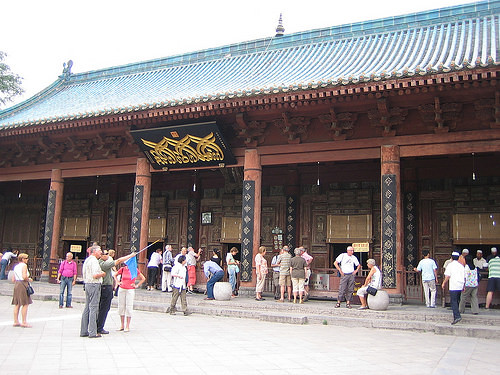
There is a Great Mosque in Xi'an, China, though the main buildings had distinctive flavor of Chinese architecture, amidst Arab characteristics.

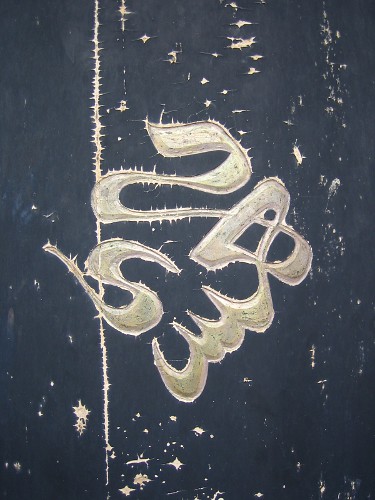
I loved a group of wooden scrolls hanging by the entrances to the main hall - gold-filled calligraphy carvings on blackened wood had a pleasing contrast and each character looked like a finely composed picture, perfectly balanced and centered, and full of flowing beauty.  Even the chipping of the black paints became well-integrated elements of the larger canvas.
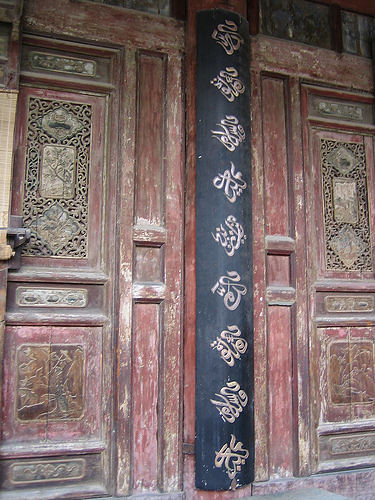
Great Mosque of Xi'an, China _ IMG_5312

Grand Mosque, Xi'an, China _5311

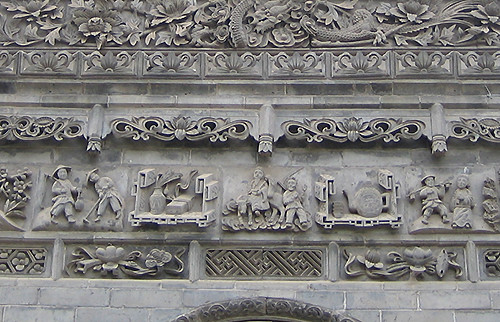
I also liked very much a pavilion protecting a stele. The basic structure of the pavilion was Chinese, but the decorative abstract motifs were Arab; yet there were figures in the relief, and they looked typical Chinese!
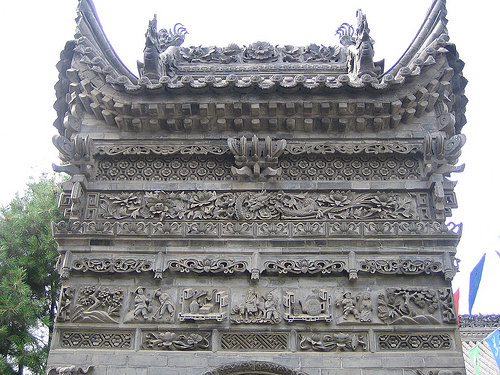
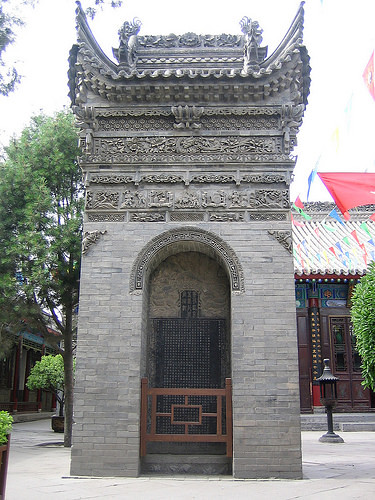
Grand Mosque, Xi'an, China _ IMG_5764

Grand Mosque, Xi'an, China _ IMG_5763

Detail of a Pavilion, Grand Mosque, Xi'an, China (detail) _ IMG_5764_m

My Favorite Museum Collection Series
>> My Favorite Museum Collection Series 137:  My Favorite Sculptures at Han Yangling (Han Dynasty Yang Tomb) in Xianyang, Shaanxi, China
<< My Favorite Museum Collection Series 135: My Favoritate Bronze Artifacts at Shaanxi History Museum, Xi'an, China

List of My Favorite Artworks in the Museums I've Visited

Other Related posts on Art · 文化 · Kunst:
- Last Chance to See Terracotta Warriors in San Francisco Asian Art Museum
- Ruins in Sanxingdui (Three-Star Mound) and Jinsha (Gold Sands), Sichuan, China
- Treasure in Liaoning Museum, Shenyang, China
- Art Gallery of Luxun Art Academy in Shenyang, China
- Visiting Four Universities in Austria and Italy
- Sunflower Seeds by Ai Weiwei at Tate Modern, London
- My Favorite Sculptures at Institut für Klassische Archäologie, Karl-Franzens-Universität Graz
- My Favorite Sculptures at Musei Civici degli Eremitani, Padova (Padua)

Monday, May 28, 2012

My Favorite Sculptures at Cimetière du Père-Lachaise, Paris

Named after Louis XIV's confessor, Cimetière du Père-Lachaise in Paris is reputed to be the world's most visited cemetery, attracting hundreds of thousands of visitors annually, to the graves of those who have made significant marks in history over the past 200 years.  Naturally, I couldn't resist such allure when in Paris.

The vast cemetery was incredibly beautiful, as comforting and pacifying as it should be for such a place - something in the Western culture I was truly grateful for, in opposite to what you might find, say in China, grim and gloomy.

There were many beautiful spots with incredibly monuments and sculptures marking the resting places of the famous and the nameless, solemn, comforting or sentimental.  I was particularly drawn to the resting spots of artists, dramatists, writers, musicians and performers.  The two most impressive ones I remembered well were those of Oscar Wilde and Eugène Delacroix.

The famous playwright and wit Oscar Wilde's tomb was a combination of a bit of a shrine and the living performing art.  His rather somber tomb, with a flying figure carrying huge amount of load, simple and attention seeking, often covered on its base with countless pink lip marks.  He was the personification of a certain love, perhaps, a love that dared not to speak its name:

Oscar Wilde, Cimetière du Père-Lachaise, Paris _ 8696

Like the one for Wilde, many sculptures, memorial and monuments there, from grandiose to humble, from flamboyant to serious, were often true works of art and commended attentions.  Yet, the other one truly gave me long lasting impress was very plain and simple, erected for the romantic French painter, Eugène Delacroix.

It was a solid black stone monument, in the shape of a simple sarcophagus, with polished but rich looking finish, sitting on top of plain granite base.  The painter's name was clearly inscribed onto the front of the black stone, filled with golden color, which contrasted with the black mass wonderfully.  More over, circling the spot, there were many tall trees with late fall colors, echoing the golden inscriptions and adding extra warmth to the site, and made this place magical and truly romantic: 

Eugène Delacroix, Cimetière du Père-Lachaise, Paris _ 8697


My Favorite Museum Collection Series

>> My Favorite Museum Collection Series 35: My Favoritate Sculptures on Karl's Bridge, Prague
<< My Favorite Museum Collection Series 33: My Favorite Paintings from Musée Picasso, Paris


List of My Favorite Artworks in the Museums I've Visited

Friday, August 26, 2011

Dr. Martin Luther King's New Statue in Washington D.C.


The unveiling of the new Dr. Martin Luther King's memorial designed and created by sculptor Lei Yixin was a major event in Washington D.C. and it had generated much discussions and even debates.  The debates took place largely when the project announced the chosen sculptor, largely due to his Chinese origin.  The the debut of the sculpture, the discussion now shifted to the representation of Dr. King, the merit of the sculpture as memorial and artistic achievement.  New York Times published a long article on this project and the highlights are as follow:

That figure is the Rev. Dr. Martin Luther King Jr., and this Sunday, when his four-acre, $120 million memorial on the edge of the Tidal Basin is to be officially dedicated, it will be adjacent to Franklin D. Roosevelt’s, across the water from Thomas Jefferson’s, and along an axis leading from that founding father directly to Abraham Lincoln’s. There are few figures in American history with similar credentials who would have even a remotely comparable claim for national remembrance on the Washington Mall.

Perhaps, though, it was the presence of such company that led to the kind of memorial that now exists. There is always an element of kitsch in monumental memorials, a built-in grandiosity that exaggerates the physical and spiritual statures of their human subjects.

So it should be no surprise that something similar happens to Dr. King. But his statue goes even further. Those of Jefferson and Lincoln are a mere 19 feet tall; Dr. King looms 30 feet up, staring over the Tidal Basin. And he isn’t decorously posed in a classical structure; he isn’t contained in an ordered space with Greek or Roman allusions. His form emerges halfway out of an enormous mound of granite so heavy that 50-foot piles had to be driven into the ground to provide support.

We don’t even see his feet. He is embedded in the rock like something not yet fully born, suited and stern, rising from its roughly chiseled surface. His face is uncompromising, determined, his eyes fixed in the distance, not far from where Jefferson stands across the water. But kitsch here strains at the limits of resemblance: Is this the Dr. King of the “I Have a Dream” speech? Or the writer of the 1964 Nobel Peace Prize acceptance speech?


But do these mounds of granite, which are given an almost artificial appearance with their sketchy, cartoonish contours — do they evoke anything at all like a “mountain of despair”? And the unattractive slice supposedly pushed into the center of the memorial: is that really a “stone of hope”? Certainly not, judging from the expression on Dr. King’s face.

The metaphor is not one of Dr. King’s best, anyway, but to center an entire memorial on it, and then to do so in a way that makes no real sense, is baffling. Moreover, the original context of the line from the speech is quite different. Dr. King, after the demonstration in Washington, was going back to the South, his faith intact.

And the mound’s isolation from any other tall objects, its enormity and Dr. King’s posture all conspire to make him seem an authoritarian figure, emerging full-grown from the rock’s chiseled surface, at one with the ancient forces of nature, seeming to claim their authority as his. You don’t come here to commune with him, let alone to attend to the ideas the memorial’s Web site insists are latent here: “democracy, justice, hope and love.” You come to tilt your head back and follow; he, clearly, has his mind elsewhere.

The still photo above gives us a close up of that face hoovering in the clouds which the video below from the official website give us some idea of what they want us to see. I think some shots at below moments are very representative: 2:24, 2:47 and 3:18:


Dr Martin Luther King by Lei Yixin - 2'24Dr Martin Luther King by Lei Yixin - 2'47Dr Martin Luther King by Lei Yixin - 3'18

Thus we can see much more vividly, almost in situ.  The unrealistically polished folds of his impeccably suit, his haughtily crossed arms, his stern facial expression all conspired to make him as authoritative and aloof as possible, rather than a fiery and compassionate man who has a deep connection to the time, the people and their sufferings.  To me, it invokes the unpalatable feelings of encountering those always-correct Communist leaders on high horses, such as the Stalin statue below:


I think to make the appropriate tribute to Dr. King, a statue in the style of Rodin's "The Burghers of Calais" would be much more proper:

The Burghers of Calais, Stanford University
The Burghers of Calais, Auguste Rodin, Stanford University

Or the Memorial in Berlin to all victims of war and violence by Käthe Kollwitz, which was just as stylized and sleek bu full of emotion and compassion:


This Dr. Martin Luther King's statue by Mr. Lei - with a startlingly similar facial features to the artist and a grandiose profile to that of an Egyptian deity - failed to measure up to the essence of Dr. King and what he represented for and is not a successful addition to the capital where he delivered his important speech, I Have a Dream, surrounded by people he had been fighting for:


The greatness of Dr. King is not to be judged by the size of his pedestal.