Showing posts with label MOMA. Show all posts

Saturday, October 8, 2016

My Favorite Paintings at New York Museum of Modern Art (MOMA)


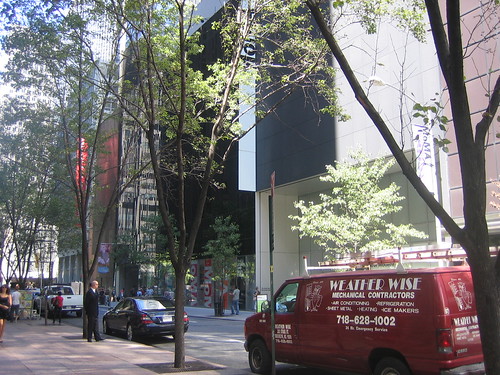
MOMA _7376

One of my favorite museums is the New York Museum of Modern Art (MOMA), of whose early 20th century European painting collections I am particularly partial.

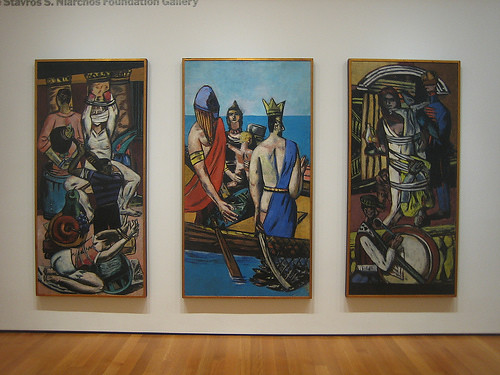
My most favorite was a triptych by the German painter Max Beckmann, the mystical and political Departure (1933-35). These beautifully rendered hallucinatory, menacing, foreboding, and just slightly hopeful and redemptive panels, aptly and sadly captured one of the most horrifying moments of human history. These paintings were the answers to the art's existential question.

Departure, 1933-35, Max Beckmann, NY MOMA _7495

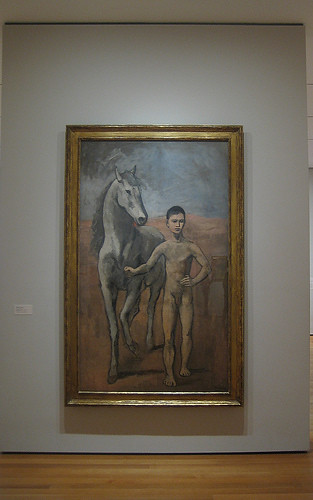
Less tense, yet no less disquieting, an early Picasso, Boy Leading a Horse (1905-06) from his Rose Period, also registered with me highly. Without any covering and protection, a slender youth and a lean and graceful horse, both economically outlined and modeled, wandered in an abstract landscape — a pale pink expanse of a barren field under a grave and leaden sky.  The high horizon enabled the pink boy fully merged with the pink field thus a harmony, and that also contributed to make the atmosphere less menacing; rather, a prevalent melancholy and a tinge of sadness permeated the canvas. The subtle and subdued beauty, the quietly riveting drama generated by the contrasting colors and moods, made one's heart ache.

Boy Leading a Horse, 1905-06, Pablo Picasso, NY MOMA _7443 (m)


My Favorite Museum Collection Series
>> My Favorite Museum Collection Series 139: My Favorite Paintings at The Frick Collection, New York City
<< My Favorite Museum Collection Series 137: My Favorite Sculptures at Han Yangling (Han Dynasty Yang Tomb) in Xianyang, Shaanxi, China

List of My Favorite Artworks in the Museums I've Visited

Other Related posts on Art · 文化 · Kunst:
- Museum of Modern Art (MOMA), New York City 
- Max Beckmann's Paintings in MOMA and MET
- Gustav Klimt and Egon Schiele in Wien (Vienna)
- Sunflower Seeds by Ai Weiwei at Tate Modern, London
- Last Trip to a Museum in 2012 - The William S. Paley Collection: A Taste for Modernism at De Young Museum in San Francisco
- "The Steins Collect" Exhibit in San Francisco Museum of Modern Art (SFMOMA)
- Art in Subway Station, New York City
- Neue Galerie New York - Austrian and German Art Gallery
- Barry McGee Mural, Soho, New York 2010
- Arslan: In the Midst of a Single Breath - Dillon Gallery, New York

Monday, December 31, 2012

Last Trip to a Museum in 2012 - The William S. Paley Collection: A Taste for Modernism at De Young Museum in San Francisco

My museum visits in this year (2012) have been greatly augmented by my trips to China, Austria and Italy in May and October, especially the one to Europe, which I have sporadically discussed in my previous blog entries

DSCN5626 _ De Young Museum, San Francisco, 30 December 2012Yesterday, 30 December 2012, I returned to De Young Museum in San Francisco for The William S. Paley Collection: A Taste for Modernism, on the very last day of the exhibit, of which The De Young Museum website informed us was "A selection of major works from the William S. Paley Collection at the Museum of Modern Art in New York.. A pioneering figure in the modern entertainment, communication and news industries, Mr. Paley (1901–1990) was a founder of the Columbia Broadcasting System (CBS), and a dedicated philanthropist and patron of the arts. The Paley Collection, which includes paintings, sculpture and drawings, ranges in date from the late 19th century through the early 1970s. Particularly strong in French Post-Impressionism and Modernism, the collection includes multiple works by Paul Cezanne, Henri Matisse and Pablo Picasso, as well as significant works by Edgar Degas, Henri Toulouse-Lautrec, Paul Gauguin, Andre Derain, Georges Rouault and artists of the Nabis School such as Pierre Bonnard and Edouard Vuillard."

It was an astonishingly rich collection and one highlight succeeded another.  Though I've seen most of them in New York's MOMA, it was wonderful to see them again, in our home museum.  Amongst those wonderful works, I particularly love these below:

DSCN5627 _ The Seed of the Areoi, 1892, Paul Gauguin, NY MOMA at De Young
The Seed of the Areoi, 1892, Paul Gauguin

DSCN5629 _ Strawberries, c 1905, Pierre-Auguste Renoir, NY MOMA at De Young
Strawberries, c 1905, Pierre-Auguste Renoir

DSCN5638 _ Milk Can and Apples (1879-80), Paul Cezanne, NY MOMA at De Young
Milk Can and Apples (1879-80), Paul Cezanne

DSCN5645 _ Reclining Nude, 1897, Pierre Bonnard, NY MOMA at De Young
Reclining Nude, 1897, Pierre Bonnard

DSCN5653 _ Two Dancers, 1905, Edgar Degas, NY MOMA at De Young
Two Dancers, 1905, Edgar Degas

DSCN5652 _ Mme Lili Grenier, 1888, Henri de Toulouse-Lautrec, NY MOMA at De Young
Mme Lili Grenier, 1888, Henri de Toulouse-Lautrec

DSCN5659 _ Woman with a Veil, c 1907, Henri Matisse, NY MOMA at De Young
Woman with a Veil, c 1907, Henri Matisse

DSCN5661 _ Seated Woman with a Vase of Amaryllis, 1941, Henri Matisse, NY MOMA at De Young
Seated Woman with a Vase of Amaryllis, 1941, Henri Matisse

DSCN5663 _ Odalisque with a Tambourine, Matisse, NY MOMA at De Young
Odalisque with a Tambourine, Henri Matisse

DSCN5676 _ Boy Leading a Horse, 1905-06, Pablo Picasso, NY MOMA at De Young - modified
Boy Leading a Horse, 1905-06, Pablo Picasso

DSCN5686 _ Still Life with Guitar, 1920, Pablo Picasso, NY MOMA at De Young
Still Life with Guitar, 1920, Pablo Picasso

DSCN5715 _ Portrait of Ambroise Vollard, 1925, Georges Rouault, NY MOMA at De Young
Portrait of Ambroise Vollard, 1925, Georges Rouault

DSCN5721 _ Oasis (Mirage), 1944, Georges Rouault, NY MOMA at De Young
Oasis (Mirage), 1944, Georges Rouault

I also stopped by to see another special exhibit: Rudolf Nureyev: A Life in Dance, which featured photos, video clips and costumes of the great dancer, overwhelming in its opulence and extravagance with a tint of vulgarity, redeemed by his unapologetic conviction.


Monday, October 4, 2010

Max Beckmann's Paintings in MOMA and MET

When I reported my visits to MOMA and the MET, excepting for reporting Matisse separately, and Doug + Mike Starn due to special exhibits, I also left out German born American painter Max Beckmann, whose influence on me was the greatest.  I particularly cherish his topical insight and brilliant sense of color and painterly technique.

I was very glad to encounter his great triptychs again, Departure, 1933-35, at MOMA and Beginning, 1949, at the MET. 

The MOMA's catalog states such about Departure:
In the right panel of Departure, Beckmann once said, "You can see yourself trying to find your way in the darkness, lighting the hall and staircase with a miserable lamp, dragging along tied to you, as part of yourself, the corpse of your memories." The triptych is full of personal meaning, and also of mysteries. The often-appearing fish, for example, are ancient symbols of redemption, but may also connote sexuality. Perhaps the woman under torture gazes prophetically into a crystal ball—but what she seems to see is the daily paper. Men's faces are hidden: averted in the side panels, masked in the center. Is it the same couple whose fate each image tracks?

Beckmann's accounts of Departure are fragmentary, and, in any case, he believed that "if people cannot understand it of their own accord, . . . there is no sense in showing it." But the work, however elusive in its details, is clear overall: painted at a dark time in Germany (that of Hitler's rise to power), it tells of harsh burdens and sadistic brutalities through which the human spirit, regally crowned, may somehow sail in serenity. Beckmann called the center panel "The Homecoming," and said of it, "The Queen carries the greatest treasure—Freedom—as her child in her lap. Freedom is the one thing that matters—it is the departure, the new start."

Departure, 1933-35, Max Beckmann _7495
Departure, 1933-35, Max Beckmann, MOMA

Departure (details), 1933-35, Max Beckmann _7502

Departure (details), 1933-35, Max Beckmann _7500

Departure (details), 1933-35, Max Beckmann _7501

Departure (details), 1933-35, Max Beckmann _7504

Departure (details), 1933-35, Max Beckmann _7498

Departure (details), 1933-35, Max Beckmann _7513

Departure (details), 1933-35, Max Beckmann _7503

It was very interesting to compare this, made in one of the darkest moments of human history, to that at the MET, made at the end of the nightmare and the beginning of the new growth, yet it was still hard to find hope.  Less than a nightmare, disturbing nonetheless.

Beginning, 1949, Max Beckmann _8358
Beginning, 1949, MET

MET's website says such about the above Beginning:
The theme that connects the three panels of "Beginning," the most autobiographical of Beckmann's ten triptychs, is a childhood dream. The central panel shows a playroom where a little boy in military costume brandishes a sword as he mightily rides a rocking horse. His Puss 'n Boots doll hangs upside down behind him, presumably slayed by his weapon. The noise he makes has alarmed his parents (seen at the left near the ladder), who have climbed up to inspect his attic kingdom. More prominently placed is the figure of a redheaded woman who reclines seductively, blowing blue bubbles from a pipe. Squeezed between the boy and his fantasy is an old grandmother reading a newspaper. To the left and right, on separate panels, Beckmann painted other memories from his childhood — a hurdy-gurdy grinder and a classroom with teacher and students.

At each museum, I also saw other pieces by Beckmann: The Descent from the Cross, 1917, at MOMA, and Vaudeville Act, 1934 and 1937, at the MET:

The Descent from the Cross, 1917, Max Beckmann _7522
The Descent from the Cross, 1917, Max Beckmann, MOMA

Vaudeville Act, 1934 and 1937, Max Beckmann _8363
Vaudeville Act, 1934 and 1937, MET

I was less smitten by his works in his early period, when his palette was pale and corpse like.  I truly love his color palettes from 1930s onwards.  Take Vaudeville Act for example, the wonderful contrast of yellow and red on the dress, the black scarf between the yellow dress and pale green screen/curtain, and the blue and red color patches of the audiences webbed a world both beautifully reassuring and unnaturally otherworldly.  On surface, this is rather a jovial work, but the creepy figure with white and black face lurched behind the instrument player told us more.  What a scary world he endured and what wonderful output he gave us.

>> New York City Report, September 2010, Part XIV: Neue Galerie New York - Austrian and German Art Gallary 
<< New York City Report, September 2010, Part XII: 19th and 20th Century Art at the MET 

Saturday, September 25, 2010

The Museum of Modern Art, New York City

MOMA _7376

My main purpose of visiting the Museum of Modern Art (MOMA) was to see Matisse: Radical Invention, 1913-1917, which was definitely the highlight of my recent trip to New York City.

That said, its permanent collections were no less satisfying. There are so many amazing things to behold and it did feel like a miracle that I was able to savor so many of them within a few short hours span. It is hard to pick what I like most but I will give it a try.

I really liked the mysterious image of Henri Rousseau, whose messages I only started to understand.

The Sleeping Gypsy, 1897, Henri Rousseau 
_7449
The Sleeping Gypsy, 1897, Henri Rousseau

Another painting I have been resisting till recently was Klimt. I didn't care much for Art Nouveau movement but it was by no means limited to overtly ornate images and designs. They were productions of periods for sure, but the humanity transcended its stylistic boundary. I particularly love this "Hope, II" due to the striking simplicity of the two background "panels" where an ornate woman figure sandwiched in between.

Hope, II, 1907-08, Gustav Klimt _7434
Hope, II, 1907-08, Gustav Klimt

My perennial favorites were represented by Picascso, Van Gogh, Cézanne and Redon. "Three Women at the Spring" by Picasso was striking for its bold monumentality.  They reminded me of marbles by Michelangelo.  In great contract to this, Picasso's earlier piece "Boy Leading a Horse" was pure delicate beauty, including the giant horse.  One can see the connection of these two pieces as well as the great contrast.  Knowing of where his final style was, I marveled at his development journey.

Three Women at the Spring, summer 1921, Pablo Picasso _7398
Three Women at the Spring, summer 1921, Pablo Picasso

Boy Leading a Horse, 1905-06, Pablo 
Picasso _7443 (m)
Boy Leading a Horse, 1905-06, Pablo Picasso

Boy Leading a Horse (details), 1905-06, Pablo Picasso _7447
Boy Leading a Horse (details), 1905-06, Pablo Picasso

Van Gogh's "The Starry Nigh" never lost its impact, even though the canvas was rather small and hardly believable that it could have contained such unbridled passion.  However, the unflattering frame did it much disservice.

The Starry Night, June 1889, Vincent van Gogh _7454
The Starry Night, June 1889, Vincent van Gogh

Still Life with Apples, 1895-98, Paul Cézanne _7455
Still Life with Apples, 1895-98, Paul Cézanne

Cézanne's "Still Life with Apples" above and Chagall's "I and the Village" below are an interesting pair (not displayed in the same hall).  Their styles and topics were very different for sure but they both sought to explore boundless planes and space and resulted in canvases deceptively simple in details but vast in their entireties.

I and the Village, 1911, Marc Chagall _7428
I and the Village, 1911, Marc Chagall

My favorite artist Redon's "Roger and Angelica" was not my favorite work of his but the vibrancy of his colors still made rapturous impression on me.

Roger and Angelica, c. 1910, Odilon Redon _7466
Roger and Angelica, c. 1910, Odilon Redon

In contract, Miró's "The Birth of the Wold" was beautiful despite or because of its subdued palettes.  So did "Nude with Violet Stockings and Black Hair" by Egon Schiele.

The Birth of the Wold, late summer-fall 1925, Joan Miró

Nude with Violet Stockings and Black Hair, 1912, Egon Schiele _7437
Nude with Violet Stockings and Black Hair, 1912, Egon Schiele

Schiele's images are often disturbing but James Ensor went much further with his "Masks Confronting Death".

Masks Confronting Death, 1888, James Ensor _7463
Masks Confronting Death, 1888, James Ensor

I have always been draw to German artists for their gravity. I was very happy to encounter my favorite artists Käthe Kollwitz and Max Beckmann in the same room. There was a series of prints by Kollwitz:

The Widow I (Die Witwe I) (plate 4) from War (Krieg), (1921-22, 
published 1923), Käthe Kollwitz _7510
The Widow I (Die Witwe I) (plate 4) from War (Krieg), (1921-22, published 1923), Käthe Kollwitz

There was a triptych by Backmann and another oil painting of his here. I will discuss them separately, together with another triptych of his I saw a couple days later at Metropolitan Museum.

After these disturbing images, I'm ready to discuss tranquility represented by the sedate beauty of Modigliani ("Anna Zborowska") and Monet's "Water Lilies".  Modigliani was somewhat an acquired taste.  Sometimes I didn't care much for his apparent mannerism but once I looked beyond it, I was again and again overcome by its innate luminosity. 

Anna Zborowska, 1917, Amedeo Modigliani _7469
Anna Zborowska, 1917, Amedeo Modigliani

Monet's large panels of "Water Lilies" were nothing short of miraculous.  They were deep and silent.  I was convinced that only an experience rich old man could have summarize life in a pond like this.  It contained universe.

Water Lilies, 1914-26, Claude Monet _7481
Water Lilies, 1914-26, Claude Monet

Water Lilies, 1914-26, Claude Monet _7476
Water Lilies, 1914-26, Claude Monet

Water Lilies (details), 1914-26, Claude Monet _7484
Water Lilies (details), 1914-26, Claude Monet

There weren't many sculptures in MOMA. One interesting sculpture was "Standing Youth" by Wilhelm Lehmbruck, which stood in the same room as Chagall's work.

Standing Youth, 1913, Wilhelm Lehmbruck _7425(m)
Standing Youth, 1913, Wilhelm Lehmbruck

The other one was "Monument to Balzac" by Rodin, casted in 1954, which stood by the entrance to MOMA's enchanting garden:

Monument to Balzac. 1898 (cast 
1954), Auguste Rodin _7567
Monument to Balzac. 1898 (cast 1954), Auguste Rodin

MOMA also collects many new works by active artists.  I liked several graphic pieces and some installations. I did not find any noticeable paintings by contemporary artists, unfortunately.

Study for Blue Water, Silver Moon, 1991, Kerry James Marshall _7542
Study for Blue Water, Silver Moon, 1991, Kerry James Marshall

Selections from Reconstructions, 2007 Huma Bhabha _7545
Selections from Reconstructions, 2007 Huma Bhabha

Selections from Reconstructions, 2007 Huma Bhabha _7548
Selections from Reconstructions, 2007 Huma Bhabha

Untitled (Stave), 1993, Marisa Merz _7552
Untitled (Stave), 1993, Marisa Merz

I also saw some interesting design display and conceptual work.  They were fascinating but I was too exhausted to investigate into the details.

MOMA _7537

MOMA _7529

MOMA _7532

MOMA _7569

MOMA _7534

Finally, the building itself was an understated marvel and I found many beautiful images from many angels.

MOMA _7533

MOMA _7382

MOMA _7394

MOMA _7541

MOMA _7571


PS: Only in an institution like this, Andrew Wyeth's "Christina's World" would be assigned casually a spot in the corridor.  In a minor institution, this piece might have been the crown jewel of its collections.

Christina's World, 1948, Andrew Wyeth _7389
Christina's World, 1948, Andrew Wyeth

>> New York City Report, September 2010, Part VII: Richard L. Feigen Collection and Yale University Art Gallery
<< New York City Report, September 2010, Part V: "Matisse: Radical Invention, 1913-1917" at New York MOMA