Showing posts with label Max Beckmann. Show all posts

Friday, December 9, 2016

My Favorite Paintings at Los Angeles County Museum of Art (LACMA)

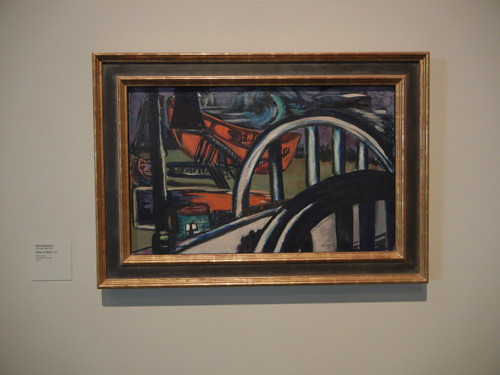
What I enjoyed most at Los Angeles County Museum of Art (LACMA) were paintings from modern German masters.  My favorite was Bridge and Wharf (1945) by Max Beckman. This was a typical mature Beckmann in his most probing mold. This landscape confronted us with a section of a massive industrial bridge, bold and strong chrome colored beams imprisoned by thick black outlines, chilly looking, partially blocking the view of a narrow wharf, in which haphazardly moored ships of various sizes, shapes and placements. Behind this chaotic yet impressive tableau, there was an almost angry leaden sky, whose pale purple color, together with muted earth brownish green over the static water in the central strip of the canvas, heightened the brightness of the colors in the wharf, predominantly rich red on the bodies of some ships, and on an edge of a boat a small patch of thalo green, which also lent its special chilling allure to some celestial elements in the sky.  All those bright colors were also boldly outlined, similar to those beams of the bridge, with massive black strokes, which bound together the diverse elements and colors with its inexhaustible reaches like slithering arms of a giant octopus. A beautiful rendition of a disrupted world.

DSCN7887 _ Bridge and Wharf, 1945, Max Beckmann (1884-1950)
Bridge and Wharf, 1945, Max Beckmann (1884-1950)

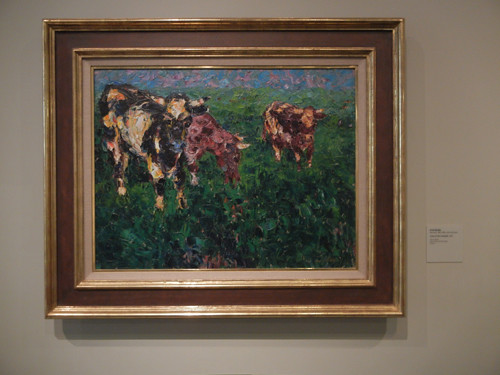
Cows in the Lowland (1909) by Emil Nolde was an apparently idyllic pastoral world, with several cows gazing in a lovely meadow; yet, nothing was as apparent as it was — dark grass, unnaturally colored noble beasts, scattered flowers, a wall of light pink and blue sky, all in heavy impasto and painted with determined palette knife, verging toward disintegration, and formed a world in the shadow of hallucination and madness. A prophetic work.

DSCN7885 _ Cows in the Lowland,1909, Emil Nolde (1867-1956), LACMA
Cows in the Lowland, 1909, Emil Nolde (1867-1956)

My Favorite Museum Collection Series
>> My Favorite Museum Collection Series 155: My Favorite Paintings at Museum of Contemporary Art (MOCA), Los Angeles
<< My Favorite Museum Collection Series 153: My Favorite Sculptures at J. Paul Getty Museum - Getty Villa, Los Angeles (Malibu)

List of My Favorite Artworks in the Museums I've Visited

Other Related posts on Art · 文化 · Kunst:
- LACMA - Los Angeles County Museum of Art
- Getty Villa in Los Angeles (Malibu)
- The Museum of Contemporary Art (MOCA) in Los Angeles
- Brand New Contemporary Art Museum - The Broad Museum in Los Angeles
- Urs Fischer Exhibit at MOCA, Los Angeles
- Revisiting Norton Simon Museum in Pasadena
- Anderson Collection at Stanford University
- Paintings at Cantor Arts Center, Stanford University
- Surprisingly Urbane Los Angeles

Saturday, October 8, 2016

My Favorite Paintings at New York Museum of Modern Art (MOMA)


MOMA _7376

One of my favorite museums is the New York Museum of Modern Art (MOMA), of whose early 20th century European painting collections I am particularly partial.

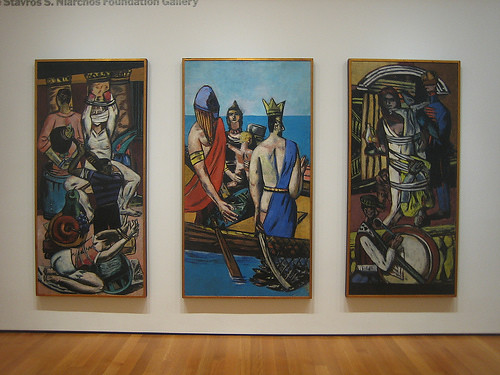
My most favorite was a triptych by the German painter Max Beckmann, the mystical and political Departure (1933-35). These beautifully rendered hallucinatory, menacing, foreboding, and just slightly hopeful and redemptive panels, aptly and sadly captured one of the most horrifying moments of human history. These paintings were the answers to the art's existential question.

Departure, 1933-35, Max Beckmann, NY MOMA _7495

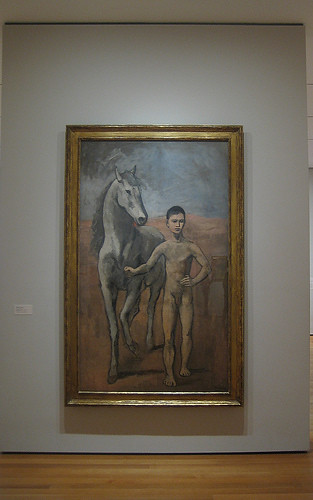
Less tense, yet no less disquieting, an early Picasso, Boy Leading a Horse (1905-06) from his Rose Period, also registered with me highly. Without any covering and protection, a slender youth and a lean and graceful horse, both economically outlined and modeled, wandered in an abstract landscape — a pale pink expanse of a barren field under a grave and leaden sky.  The high horizon enabled the pink boy fully merged with the pink field thus a harmony, and that also contributed to make the atmosphere less menacing; rather, a prevalent melancholy and a tinge of sadness permeated the canvas. The subtle and subdued beauty, the quietly riveting drama generated by the contrasting colors and moods, made one's heart ache.

Boy Leading a Horse, 1905-06, Pablo Picasso, NY MOMA _7443 (m)


My Favorite Museum Collection Series
>> My Favorite Museum Collection Series 139: My Favorite Paintings at The Frick Collection, New York City
<< My Favorite Museum Collection Series 137: My Favorite Sculptures at Han Yangling (Han Dynasty Yang Tomb) in Xianyang, Shaanxi, China

List of My Favorite Artworks in the Museums I've Visited

Other Related posts on Art · 文化 · Kunst:
- Museum of Modern Art (MOMA), New York City 
- Max Beckmann's Paintings in MOMA and MET
- Gustav Klimt and Egon Schiele in Wien (Vienna)
- Sunflower Seeds by Ai Weiwei at Tate Modern, London
- Last Trip to a Museum in 2012 - The William S. Paley Collection: A Taste for Modernism at De Young Museum in San Francisco
- "The Steins Collect" Exhibit in San Francisco Museum of Modern Art (SFMOMA)
- Art in Subway Station, New York City
- Neue Galerie New York - Austrian and German Art Gallery
- Barry McGee Mural, Soho, New York 2010
- Arslan: In the Midst of a Single Breath - Dillon Gallery, New York

Tuesday, June 10, 2014

My Favorite Paintings at Albertina Museum, Vienna

The renown Albertina Museum in Vienna, Austria was mostly valued for its graphic art collections, such as works by the incomparable Albrecht Dürer, whose ultra-realistic drawings and watercolors were so delicate that the museum only put reproductions on display, therefore, I refrain from citing his works as my favorite there.

Albertina Museum also had some really impressive oil paintings, amongst which, I was particularly enthralled by paintings by Max Beckmann and Paul Delvaux.

The Frau mit Katze (Woman with Cat) by German artist Max Beckmann was a stylish, understated yet highly erotically charged woman portrait, typical of his pre-Third-Reich oeuvre, without the unsettling sinister atmosphere permeated in his later works.

I was particularly enchanted by the sitters' self-satisfying langour, the marvelously subtle and bold interplays of orange, yellow, pale purple, green and black shades, and the sitter's slightly monumental bulk, which didn't take away any of her sensuality or her femininity.

DSCN9068 _ Frau mit Katze (Woman and Cat), 1942, Öl auf Leinwand, Max Beckmann, Albertina Museum, Wien, 2 October - 500
Frau mit Katze (Woman and Cat), Max Beckmann, 1942, Öl auf Leinwand (Oil on Canvas)

My second favorite works was Belgian painter Paul Delvaux's Landschaft mit Lanternen (Landscape with Lanterns) - a mysterious cityscape which extended to landscape under cool moonshine, almost symmetrical, with a noble-looking woman stood at the foreground, looking into the goings-on on the receding away from the viewers, including two small figures in white, carrying a stretcher with a person enshrouded in white sheet, against the gently lit hills dotted with unfinished architectures, or strange gate-shaped structures, corresponding to the seemingly unfinished city structures in the foreground.

DSCN9070 _ Landschaft mit Lanternen, 1958, Paul Delvaux (1897-1994), Albertina, - 500
Landschaft mit Lanternen (Landscape with Lanterns), 1958, Paul Delvaux (1897-1994)

The cool atmosphere and the classical symmetry recalled The Ideal City by Piero della Francesca (?) though the mood of Delvaux's painting was much darker and more mysterious, even quite sinister, and the story was much harder to decode, thus even more fatally attractive.

File:Piero della Francesca Ideal City.jpg
The Ideal City, Piero della Francesca, public domain work of art

During my visit, I shot the picture with a viewer looking inside the frames, and her presence added another layer to this haunting piece.


My Favorite Museum Collection Series
>> My Favorite Museum Collection Series 81: My Favorite Paintings at Österreichische Galerie Belvedere, Vienna
<< My Favorite Museum Collection Series 79: My Favorite Sculptures in Cathédrale Notre Dame de Paris

List of My Favorite Artworks in the Museums I've Visited


Other Related posts on Art · 文化 · Kunst:
- Magnificent Churches in Vienna
- Kaiser Maximilian I und die Kunst der Duerer-Zeit in Albertina Museum, Vienna
- My Favorite Paintings at Akademie der bildenden Künste Wien
- My Favorite Paintings at Kunsthistorisches Museum, Wien (Vienna)
- Gustav Klimt and Egon Schiele in Wien (Vienna)
- Visiting Four Universities in Austria and Italy

Sunday, May 13, 2012

My Favorite Art Works at Centre Pompidou, Paris

In Paris, the museum which collected the most modern works was Musee National d'Art Moderne, Centre Pompidou, of which I remembered more of the building itself than the collections within.  I remembered that the most contemporary works, particularly from Pop Art Movement onward, was not very engaging, while older works were much more satisfactory, such as the works produced between the Wars, and particularly those by the tortured German artists, with whom I seemed to have great affinity.

My first pick was a surrealism print by Max Ernst, dated 1929, with a French title as Reste donc celui qui spécule sur la vanité des morts, le fantôme de la repopulation, whose rough translation could be Remained one that speculates on the vanity of the dead the ghost of the re-population.

This prints depicted two figures, one bent and ancient, calmly consulted with a sitting ape-like character with an enormous belly and limping arms.  The convoluted title and the slightly domestic scene didn't diminish the strangeness and the grotesqueness.  Whatever the meaning the allegory was, it had an unforgettable imagery.


Reste donc celui qui spécule sur la vanité des morts, le fantôme de la repopulation (Remainsone thatspeculateson the vanityof the deadthe ghost of therepopulation., Max Ernst, 1929

The other favorite of mine was a painting by the great German artist, Max Beckmann, Der kleine Fisch (The Small Fish), a seemingly idyllic yet not without menace, with strong contrast between sun-bathed flat areas in pale and becalming yellow and blue hues, and the densely hatched patterns in domineering black strokes.

Three figures, in retro bathing gears, formed an up-side-down pyramid in the foreground on a seaside.  Two women were offered, by a suggestively smiling young man, a large, not small, fish, whose size, shape and position, had an unmistakable resemblance of a male sexual organ.

The women on the left, peeped at the fish not without curiosity, with her right arm poising to reach out to touch and feel the fish.  Her friend, shrank and hid behind her, face in shadow, was full of anxiety and anguish, yet her right index finger raised in the same way the fish's rising head, forming a mirror image and her finger could be seen either as a warning sign or a bargaining gesture.  Her left hand rested on the young man's arm holding the fish, her attempt to control the situation.  She looked into the young man's eyes, timidly and wearily, but the young man had eyes only for the other woman, who was obviously more receptive.

A quite innocent picture impregnated with amorous, even sinister innuendos.  A very economic and eloquent work.


Der kleine Fisch (Le petit poisson), Max Beckmann, 1933


My Favorite Museum Collection Series

>> My Favorite Museum Collection Series 32: My Favorite Sculptures at Musée Rodin, Paris
<< My Favorite Museum Collection Series 30: My Favorite Paintings from Musée d'Orsay, Paris

List of My Favorite Artworks in the Museums I've Visited

Sunday, January 29, 2012

My Favorite Paintings at Metropolitan Museum, New York

I'll be insanely rigid in following my formula to cite only two favorite works from the museums I've visited before, however big or small, even the Metropolitan Museum in New York or the Louvre in Paris.

Met, the most prestigious in the U.S., naturally has more collections I like than I can remember, put amongst its many glories, I pick the two paintings below.

The first one is a triptych - I hope this doesn't mean that I'm cheating - Beginning, 1949, by German painter Max Beckmann:


Beginning 
Max Beckmann (German, Leipzig 1884–1950 New York City) 
Date: 1949 Medium: Oil on canvas 
Dimensions: 69 x 125 1/2 in. (175.3 x 318.8 cm) 67 1/2 x 36 x 3 1/2 in. (171.5 x 91.4 x 8.9 cm) (Frame, 67.187.53a left panel) 71 1/2 x 61 1/2 x 3 1/2 in. (181.6 x 156.2 x 8.9 cm) (Frame, 67.187.53b center panel) 67 1/2 x 36 x 3 1/2 in. (171.5 x 91.4 x 8.9 cm) (Frame, 67.187.53c right panel) 

Beckmann is one of the very few artists I not only love, but draw inspiration greedily and incessantly.  I am very partial to the pessimistic and apocalyptic Germanic sensitivity.  I love Beckmann's insistence of staring down the deepest pit of human miseries and more importantly, the sources of them, while not dismiss a flicker of hope for the humanity.  More important, he was able to create paintings with real depth and gravity with incredible beauty and appropriate one.

A survivor of medical services during World War I, "he saw his world as a tragedy of man's inhumanity to man and saw life as a carnival of human folly. His work remained intense and allegorical throughout his life.
The theme that connects the three panels of "Beginning," the most autobiographical of Beckmann's ten triptychs, is a childhood dream. The central panel shows a playroom where a little boy in military costume brandishes a sword as he mightily rides a rocking horse. His Puss 'n Boots doll hangs upside down behind him, presumably slayed by his weapon. The noise he makes has alarmed his parents (seen at the left near the ladder), who have climbed up to inspect his attic kingdom. More prominently placed is the figure of a redheaded woman who reclines seductively, blowing blue bubbles from a pipe. Squeezed between the boy and his fantasy is an old grandmother reading a newspaper. To the left and right, on separate panels, Beckmann painted other memories from his childhood — a hurdy-gurdy grinder and a classroom with teacher and students." [metmuseum.org]

My second favorite, another painting, is a portrait of Erasmus of Rotterdam by Hans Holbein the Younger:


Erasmus of Rotterdam 
Hans Holbein the Younger (German, Augsburg 1497/98–1543 London) 
Date: 1528–32 Medium: Oil on linden panel 
Dimensions: 7 1/4 x 5 9/16 in. (18.4 x 14.2 cm); painted surface 6 15/16 x 5 1/2 in. (17.6 x 14 cm) 

I love this painting, first by the beautiful colors Holbein employed.  I'm always partial to the green-tinted blues.  His portrait of this great scholar and humanist, was somber, serious yet open.  The face of Erasmus was wise and like an opened-book, invited people to benefit from the light it emitted.  His features were sharp in the alerted sense, not in a preying mood.  His gaze knowing yet humble, and full of consternation and mediation.  A wise sage indeed.  The brilliantly painted fur trimmings offered the warm tones to balance the cool aqua tint of the background, without rendering his or the painting flamboyant which surely would have made this great scholar a simony hawk.

Though the brush works of Hans Holbein the Younger was not as celebrated as those by Da Vinci, Rubens or Rembrandt, his austere style here, almost a thrown-back to the icon paintings, left us a most memorable and beautiful portrait in the canon.  Met surly is proud to have this in its collection.


My Favorite Museum Collection Series

>> My Favorite Museum Collection Series 6: My Favorite Collections at The Cloisters, Metropolitan Museum of Art, New York  
<< My Favorite Museum Collection Series 4: My Favorite Paintings at Cincinnati Art Museum


List of My Favorite Artworks in the Museums I've Visited
 

Friday, January 13, 2012

My Favorite SFMOMA Collections

I have been to many museums, exulted or less glamorous, local or overseas.  I savor my memories of many visits to those museums and time to time relive the moments when I encountered a piece made the strongest impression on me.  I am going to write about those museums I have been to, with two pieces from each museum.  These works I pick don't have to be the "best" or the most renown, but they are to be truly my favorites.

Starting with the obvious museum - San Francisco Museum of Modern Arts (SFMOMA).  My favorite of mine at SFMOMA is Die Sechste Posaune (The Sixth Trumpet), Anselm Kiefer (Donaueschingen, Germany, 1945), 1996, painting: emulsion, acrylic, shellac, and sunflower seeds on canvas, 204 3/4 in. x 220 1/2 in. (520.07 cm x 560.07 cm)


I first saw this painting many years ago at SFMOMA and wad struck by the monumentality of this piece.  It is of biblical proportion, and its painful scream was quite overwhelming.  But, the pain was like those of madrigal from the earlier time, still orderly and restraint, like a Passion Oratorio by Bach.

Underneath the black specks, the deserted fields and hills were haunted spot, with eerie beauty, as if to tell us what we have lost, or what we did not deserve.

This is a beautiful but difficult piece to stare at.  It currently is not on display.  My guess is that if people see it too often, they might have lost all their wills to live.


My other favorite collection at SFMOMA is by Max Beckmann (Leipzig, Germany, 1884 - 1950, New York City, New York) - Frau bei der Toilette mit roten und weissen Lilien (Woman at Her Toilette with Red and White Lilies), 1938, Oil on Canvas.

Every time when I visited SFMOMA, I would spend some time with this enchanting Frau. I have always been partial with the German painter Beckmann.  I loved not only his stark vision but his bold yet exquisite execution. I particularly love the way he used the black color to outline object and give them monumental mass.  This Frau is both a typical and an atypical of Beckmann.  It has all the trademarks of his palette, his handling of paints in the bold outlines and thin layers.  However, this quietly melancholic piece is rather quite comforting, comparing to his more enigmatic and/or apocalyptic pieces.  This Frau needs not to be afraid but to be adored.

Frau bei der Toilette mit roten und weissen Lilien (Woman at Her Toilette with Red and White Lilies), Max Beckmann, 1938, Oil on Canvas, SFMOMA _ 9631

Frau bei der Toilette mit roten und weissen Lilien (Woman at Her Toilette with Red and White Lilies), Max Beckmann, 1938, Oil on Canvas, SFMOMA _ 9633

Frau bei der Toilette mit roten und weissen Lilien (Woman at Her Toilette with Red and White Lilies), Max Beckmann, 1938, Oil on Canvas, SFMOMA _ 9635

Frau bei der Toilette mit roten und weissen Lilien (Woman at Her Toilette with Red and White Lilies), Max Beckmann, 1938, Oil on Canvas, SFMOMA _ 9634

It is interesting that my favorite works were created by German masters haunted and pained by the ravages of war.  I am afraid that I do share such of their apocalyptic point of view.  But, by admitting my love for the Beckmann above, I think it is fair to say that I still have some hope and love for humanity.


My Favorite Museum Collection Series 

>> My Favorite Museum Collection Series 2: My Favorite De Young Museum Collections


List of My Favorite Artworks in the Museums I've Visited

Monday, October 4, 2010

Max Beckmann's Paintings in MOMA and MET

When I reported my visits to MOMA and the MET, excepting for reporting Matisse separately, and Doug + Mike Starn due to special exhibits, I also left out German born American painter Max Beckmann, whose influence on me was the greatest.  I particularly cherish his topical insight and brilliant sense of color and painterly technique.

I was very glad to encounter his great triptychs again, Departure, 1933-35, at MOMA and Beginning, 1949, at the MET. 

The MOMA's catalog states such about Departure:
In the right panel of Departure, Beckmann once said, "You can see yourself trying to find your way in the darkness, lighting the hall and staircase with a miserable lamp, dragging along tied to you, as part of yourself, the corpse of your memories." The triptych is full of personal meaning, and also of mysteries. The often-appearing fish, for example, are ancient symbols of redemption, but may also connote sexuality. Perhaps the woman under torture gazes prophetically into a crystal ball—but what she seems to see is the daily paper. Men's faces are hidden: averted in the side panels, masked in the center. Is it the same couple whose fate each image tracks?

Beckmann's accounts of Departure are fragmentary, and, in any case, he believed that "if people cannot understand it of their own accord, . . . there is no sense in showing it." But the work, however elusive in its details, is clear overall: painted at a dark time in Germany (that of Hitler's rise to power), it tells of harsh burdens and sadistic brutalities through which the human spirit, regally crowned, may somehow sail in serenity. Beckmann called the center panel "The Homecoming," and said of it, "The Queen carries the greatest treasure—Freedom—as her child in her lap. Freedom is the one thing that matters—it is the departure, the new start."

Departure, 1933-35, Max Beckmann _7495
Departure, 1933-35, Max Beckmann, MOMA

Departure (details), 1933-35, Max Beckmann _7502

Departure (details), 1933-35, Max Beckmann _7500

Departure (details), 1933-35, Max Beckmann _7501

Departure (details), 1933-35, Max Beckmann _7504

Departure (details), 1933-35, Max Beckmann _7498

Departure (details), 1933-35, Max Beckmann _7513

Departure (details), 1933-35, Max Beckmann _7503

It was very interesting to compare this, made in one of the darkest moments of human history, to that at the MET, made at the end of the nightmare and the beginning of the new growth, yet it was still hard to find hope.  Less than a nightmare, disturbing nonetheless.

Beginning, 1949, Max Beckmann _8358
Beginning, 1949, MET

MET's website says such about the above Beginning:
The theme that connects the three panels of "Beginning," the most autobiographical of Beckmann's ten triptychs, is a childhood dream. The central panel shows a playroom where a little boy in military costume brandishes a sword as he mightily rides a rocking horse. His Puss 'n Boots doll hangs upside down behind him, presumably slayed by his weapon. The noise he makes has alarmed his parents (seen at the left near the ladder), who have climbed up to inspect his attic kingdom. More prominently placed is the figure of a redheaded woman who reclines seductively, blowing blue bubbles from a pipe. Squeezed between the boy and his fantasy is an old grandmother reading a newspaper. To the left and right, on separate panels, Beckmann painted other memories from his childhood — a hurdy-gurdy grinder and a classroom with teacher and students.

At each museum, I also saw other pieces by Beckmann: The Descent from the Cross, 1917, at MOMA, and Vaudeville Act, 1934 and 1937, at the MET:

The Descent from the Cross, 1917, Max Beckmann _7522
The Descent from the Cross, 1917, Max Beckmann, MOMA

Vaudeville Act, 1934 and 1937, Max Beckmann _8363
Vaudeville Act, 1934 and 1937, MET

I was less smitten by his works in his early period, when his palette was pale and corpse like.  I truly love his color palettes from 1930s onwards.  Take Vaudeville Act for example, the wonderful contrast of yellow and red on the dress, the black scarf between the yellow dress and pale green screen/curtain, and the blue and red color patches of the audiences webbed a world both beautifully reassuring and unnaturally otherworldly.  On surface, this is rather a jovial work, but the creepy figure with white and black face lurched behind the instrument player told us more.  What a scary world he endured and what wonderful output he gave us.

>> New York City Report, September 2010, Part XIV: Neue Galerie New York - Austrian and German Art Gallary 
<< New York City Report, September 2010, Part XII: 19th and 20th Century Art at the MET