Showing posts with label Titian. Show all posts

Tuesday, June 16, 2015

My Favorite Artworks at Basilica di Santa Maria della Salute, Venezia

Basilica di Santa Maria della Salute in Venezia, though so-called a minor cathedral, due to its strategic location near the tip of Punta della Dogana, visible when entering the Piazza San Marco from the Grand Canal, was a natural stop for many visitors to the city. Its interior was relatively sparse, understated and unassuming, but that it didn't prevent Salute from accumulating some muted splendors.

Amongst several interesting and moving works, I cite these two as my favorites (below).

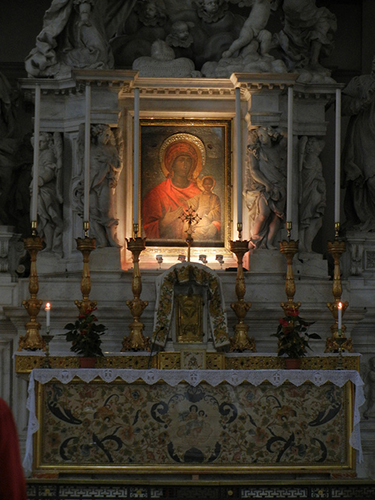
The one left me the strongest impression was an altar to Virgin Mary - centering on a brilliantly-painted ikon, a Byzantine Madonna and Child of the 12th or 13th century, known as Panagia Mesopantitissa in Greek ("Madonna the mediator" or "Madonna the negotiator"), framed by flowing baroque sculpture of the Queen of Heaven Expelling the Plague (1670), which was a theatrical Baroque masterpiece created by the Flemish sculptor Josse de Corte.  The colored painting and the bleached sculpture, the stiffness of the icon and the soft sensual line of the stone figures contrasted strongly and a sense of unexpected and fascinating surprise.

DSCN2781 _ Basilica di Santa Maria della Salute, Venezia, 15 October

DSCN2781 _ Basilica di Santa Maria della Salute, Venezia, 15 October

My second favorite was a painting by Titian, titled The Descent of the Holy Ghost. For modern eyes, his tableau might not be so ground-breaking; but at the time of its creation and aided with more vivid colors, the large altar piece must be breathtakingly impressive - the classical triangle composition, the seamless transition from the built columns to the painted arch, and finally the blindingly dizzying holy spirit crashing down from heaven, must be truly awe inspiring.

DSCN2771 _ Basilica di Santa Maria della Salute, Venezia, 15 October


My Favorite Museum Collection Series
>> My Favorite Museum Collection Series 101: My Favorite Sculpture at Punta della Dogana
<< My Favorite Museum Collection Series 99: My Favorite Artwork at Piazza di San Marco

List of My Favorite Artworks in the Museums I've Visited

Other Related posts on Art · 文化 · Kunst:
- My Favorite Paintings at Église Saint-Sulpice, Paris
- My Favorite Sculptures at Stephansdom (St. Stephen's Cathedral), Vienna
- My Favorite Sculptures in Basilique Saint-Denis (Paris)
- Basilica di San Petronio and San Domenico in Bologna
- My Favorite Art Works at Santa Maria Novella, Firenze

Saturday, January 24, 2015

My Favorite Artworks in Palazzo Ducale, Venezia (Doge Palace, Venice)


DSCN1604 _ view of Palazzo Ducale from Basilica di San Marco, 13 October

DSCN9982 _ Palazzo Ducale, Venezia, 11 October

DSCN0176 _ view of Ponte dei Sospiri from the prison of Palazzo Ducale, Venezia, 11 October

The vast compound of Palazzo Ducale, Venezia (Doge Palace, Venice) is a trove of architectural and art treasures scattered around within and without the highly decorated walls of the palace, therefore it took me some concentration to choose my two favorites.

My first choice was a painting by Titian, depicting the giant Saint Christopher carrying baby Jesus on his back, across a river before the child revealed himself as Christ.  The composition was powerfully dynamic, with the Saint startlingly sinewy and serious, a personification of reliability and steadfastness.  The Child, airy, playful and full of vitality, in the lighter moment of his eventful and tragic life.  The coloration was neither flashy nor rich - time might have robbed some of its tonal splendor but the muted palette gave gravitas to the painting and a sense of timelessness.

DSCN0091 _ San Christopher, Titian, Palazzo Ducale, Venezia, 11 October
San Christopher by Titian

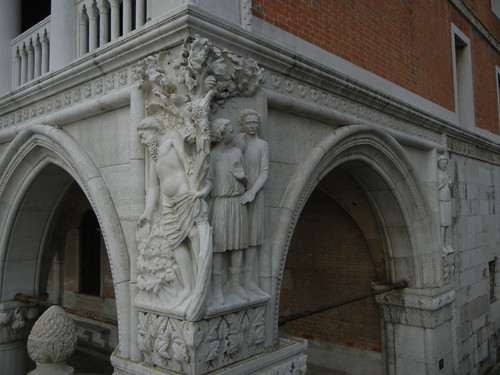
My second favorite artwork in the palace was a relief on the outer wall, titled "The Drunkenness of Noah".  This relief cleverly utilized the confined space about a portal, positioning Noah, barely covered of his nakedness with a cloth, on one side of the portal, turning corner from the main plane, upon which carved all his three sons, who were divided into two groups, separated by the pointed arch, with his "good sons" Shem and Japheth nearing Noah, holding the garment to cover him, while his bad son "Ham" stood far away from the rest, with a clear sense of the banishment of him, whose descendents were cursed by Noah for Ham's supposed insensitivity to his father's privacy.

A very strange story out of bible, rendered with great economy, clarify and pathos. 

DSCN1193 _ Details of Palazzo Ducale, Piazza di San Marco, 13 October
The Drunkenness of Noah on the 'Vine Angle' above the 1st Capital on Palazzo Ducale

My Favorite Museum Collection Series
>> My Favorite Museum Collection Series 99: My Favorite Artwork at Piazza di San Marco
<< My Favorite Museum Collection Series 97: My Favorite Reliefs in Franziskanerkirche, Graz

List of My Favorite Artworks in the Museums I've Visited

Other Related posts on Art · 文化 · Kunst:
- My Favorite Sculptures at Stephansdom (St. Stephen's Cathedral), Vienna
- Boy With Frog Sculpture and Punta della Dogana, Venice
- Angelic and Evil - Bunkerei and Palais Augarten in Augarten, Vienna
- My Favorite Works at Palazzo Medici Riccardi, Firenze, Italia
- My Favorite Paintings at Palatina Gallery, Palazzo Pitti, Firenze, Italia
- My Favorite Paintings at the National Gallery (Schwarzenberg Palace) in Prague
- Bridges in Venice, Italy
- Magical Piazza San Marco in Venice


Sunday, September 9, 2012

My Favorite Paintings in the Fitzwilliam Museum, Cambridge, UK

The Fitzwilliam Museum in Cambridge was the last major museum I visited in the United Kingdom in 2006.  It was founded in 1816 and is the art and antiquities museum of the University of Cambridge. Naturally, an institution as ancient as this would have amazing collections and my expectation was fully met.

Yet, amongst its endless arrays of antiquities from all corners of the world, and paintings by many great masters, I was most affected by a very small monochromatic painting, titled Agnes (below), painted by an artist named I didn't know - Catherine Blake.


Agnes, tempera on canvas, circa 1800, height: 14 cm, width: 15.3 cm
Catherine Blake, British, 1762-1831 

Online search yielded that Catherine Blake was indeed related to the more famous Blake, William.  Wikipedia informed us that "Catherine Blake (née Catherine Boucher) (1762–1831) was the wife of the poet, painter and engraver William Blake (1757–1827), and a vital presence and assistant throughout his life as an artist.

What moved me most by that painting was that it was incredibly sincere, touching, a bit scary and immensely beautiful, despite its obvious gloom.  It was done with tempera but looked more like an etching or a drawing; I have no argument with this fact, because my paintings are often monochromatic and I truly appreciate its dark psyche and the draftsmanship undisguised by display of colors.

To cure the melancholy this painting plunged me into, I turned to the colorist Venetian master Titian for a cure.  Well, it was a painting about a tragic affair, but it was so stylized and so beautiful to behold, that one ought to be forgiven to feel joyous in front of this enchanting painting, a painting with graceful figures, lovely nude, ravishing colors and wonderful composition. 


Tarquin and Lucretia, oil on canvas,  circa 1571, height: (canvas): 188.9 cm, width: (canvas): 145.1 cm
Tiziano Vecellio (Titian) (1488/1490-1576) 

The horror Lucretia suffered, actually, got heightened once viewers looked pass the surface beauty and dived deep into the situation the master depicted, and that made this painting, beyond its beauty, profound.


My Favorite Museum Collection Series

>> My Favorite Museum Collection Series 50: My Favorite Paintings at Rijksmuseum, Amsterdam
<< My Favorite Museum Collection Series 48: My Favorite Paintings at Tate Britain, London


List of My Favorite Artworks in the Museums I've Visited

Tuesday, July 31, 2012

My Favorite Paintings from Museum of Fine Arts (Budapest) (Szépművészeti Múzeum)

The cosmopolitan capital of Hungary had a wonderfully unique atmosphere and if I had not been there for a wedding, I surely would have enjoyed the lovely city more.  Even so, between rehearsals, pre-wedding reception and the ceremony itself, I managed to savor a little bit of the city, including the rich Museum of Fine Arts (Budapest) (Szépművészeti Múzeum).

As one of the former twin capitals of dual monarchy, the Austro-Hungarian Empire, Budapest had accumulated a huge heritage of world art.  The two most impressive works I saw there were masterpieces by Titian (Tiziano Vecellio) and Anthony van Dyck, two giants in the art history.

The portrait of the Venetian Doge Marcantonio Trevisani, showed a sharp looking old man in understated sumptuousness. His gaze, directly towards the viewer, was a bit sad, with tear in the eyes.  His lips drew back, as if holding back some secret or concern.  His right hand, clinching a silk handkerchief, reinforced the discomfort of his own thoughts or state of mind.  Despite the detailed depiction of his embroidered golden cape and funny-looking Doge's cap, and his rich maroon-colored velvet rope, we could hardly tear our eyes away from his penetrating and compassionate gaze. According to the museum's website, the original painting was destroyed in the fire of 1577. "The Budapest work is an autograph replica or variant after the burnt painting. As in all of his portraits, Titian fulfils the requirements of representation, while he equally concentrates on the accuracy and suggestivity of the characterisation. With a painting technique based on the combined effect of colour and light, the Venetian master is able to depict the living, breathing man."


Portrait of the Doge Marcantonio Trevisani, c. 1553, oil on canvas, 100 × 86.5 cm
Titian (Tiziano Vecellio), (c. 1489 - 1576)

Anthony Van Dyck, using the techniques and sharp observation not dissimilar to those of Titian, gave us a double portrait below with dizzying virtuosic forces - particularly the myriads shades of black and grey on the beautiful yet stern looking silky dresses of the sitters, and the silly yet undeniably delicate laces and cartwheel ruffs.


Portrait of a Married Couple, c. 1620, oil on canvas, 112 × 131 cm
Sir Anthony van Dyck, (1599 - 1641)

Again, despite all these external marvels, we found the two sitters very real.  Their show of wealth was honoring their rich married life together, in the most pious way.  Their hands holding together, symbolized their sanctified vow.  Their facial expressions were characterful - he was solicitous, while she anxious, almost in fear.  She sat in the armed chair stiffly, shrank a bit, with obvious discomfort, while he put left arm around her to provide some support, as if preventing her from falling into pieces.  Their posture demonstrated both their relationship on personal level and the accepted, rather strict social structure.  Yet, despite all the constrictions and the overt somberness, there was tranquility from the landscape on the left and warm from red curtain on the right of the canvas, behind the solid mass of the old couple, in the center of the canvas and fill it up almost completely.

And this concluded my journey to the old Austro-Hungary Empire in 2002.


My Favorite Museum Collection Series

>> My Favorite Museum Collection Series 42: My Favorite Paintings in the National Gallery, London
<< My Favorite Museum Collection Series 40: My Favorite "Sculptures" at the Imperial Crypt (Kapuzinergruft), Vienna


List of My Favorite Artworks in the Museums I've Visited

Saturday, February 18, 2012

My Favorite Artworks at Galleria Borghese, Rome

After the miracle of the Musei Vaticani (Vatican Museums), it might be tempting to say that I was saturated and couldn't take in any.  But my greediness knew no bound, therefore, my pilgrimage continued, in the eternal city itself.

The other major art museum in Rome, besides the Vatican and the Musei Capitolini, is Galleria Borghese - the Borghese Gallery, housed in the former Villa Borghese Pinciana. "The Galleria Borghese houses a substantial part of the Borghese collection of paintings, sculpture and antiquities, begun by Cardinal Scipione Borghese, the nephew of Pope Paul V (reign 1605–1621)." [Wikipedia]

I remembered that during my visit to Roma, in late September, it was very still quite hot and I was very grateful to be inside the cool villa after long trek in the endless garden ground.  The museum's arrangement was like that in someone's own home - a supremely rich person's home.  I saw the art collections as the residents or guests would have seen, only need to remind myself that they ought not to be touched.

The scale of the villa, though big, was not as big as a palace, therefore deeply deceptive.  I was constantly amazed at how many treasures it had held.  It had a hugely important sculpture collections and some very important paintings.  Flipping through the materials I collected and browse online, I zoom in for these two my favorites:


Apollo and Daphne Carrara's marble cm. 243 | Gian Lorenzo Bernini

This tall marble sculpture by the great sculpture Gian Lorenzo Bernini, was a marvel, vividly captured the moment Daphne, fleeing from the passion of Apollo, transformed into a laurel tree.  Look at how the barks started to encase her lithe body and how her flowing hair and the tips of her hands were turning into leafy branches, therefore the obvious characteristics of Baroque epoch. 

The official website of the Galleria provided further details on this masterpiece: "This life-size marble sculpture, begun by Bernini at the age of twenty-four and executed between 1622 and 1625, has always been housed in the same villa, but originally stood on a lower and narrower base set against the wall near the stairs. Consequently anyone entering the room first saw Apollo from behind, then the fleeing nymph appeared in the process of metamorphosis: bark covers most of her body, but according to Ovid's lines, Apollo's hand can still feel her heart beating beneath it. In 1785, when Marcantonio IV Borghese decided to place the work in the centre of the room, Vincenzo Pacetti designed the present base by using the original pieces, adding plaster to the plinth and another cartouche bearing the Borghese eagle, sculpted by Lorenzo Cardelli."

The second piece of my favorite in this Gelleria is an enigmatic painting by the great Titian (Tiziano), Sacred and Profane Love:


Sacred and Profane Love (1514 ca.) oil on canvas cm. 118x279 | Titian

This painting, made when Titian was about twenty-five to celebrate the marriage of the Venetian Nicolò Aurelio (coat of arms on the sarcophagus) and Laura Bagarotto in 1514, was actually a celebration of beauty of perfection and the chaste and stern woman in white was the bride herself, accompanied by Cupid and Venus, in her most alluring pose and attire. The strong contrast of these two evocative and provocative figures, the wonderful Arcadian landscape, and the playful putto, constituted an enchanting lyrical poetry.

According to the Galleria's description, the current allegorical title "is the result of a late 18th-century interpretation of the painting, which gives a moralistic reading of the nude figure, whereas the artist intended this to be an exaltation of both earthly and heavenly love. Titian's Sacred and Profane Love has virtually become the symbol of the Borghese Gallery itself."


My Favorite Museum Collection Series

>> My Favorite Museum Collection Series 12: My Favorite Sculptures at Museo Nazionale Romano, Roma
<< My Favorite Museum Collection Series 10: My Favorite Art Collections at Musei Vaticani (Vatican Museums)


List of My Favorite Artworks in the Museums I've Visited

Saturday, February 11, 2012

My Favorite Paintings at National Gallery of Art, Washington DC

National Gallery of Art in Washington DC is the second major art museum I've visited, after the Metropolitan Museum in New York City.

It was long time ago and I had to admit that the museum didn't leave much an impression on me.  Yet, dig into my memory and the official website from the Gallery, it was not hard to remember those two paintings made the most impressions on me.

My first pick is an oil painting, Ranuccio Farnese, by the incomparable master, Tiziano, or Titian.


Titian, Italian, c. 1490 - 1576
Ranuccio Farnese
, 1542
oil on canvas
overall: 89.7 x 73.6 cm (35 5/16 x 29 in.) framed: 124.8 x 126.4 x 9.5 cm (49 1/8 x 49 3/4 x 3 3/4 in.)

This portrait of the delicate youth captured the first bloom of him wonderfully. The complexity of the expression on this precocious boy's face is beyond his age and one pains for him.  Titian, a true master of Venetian school, excelled in his handling of the oil paints and his colors, particularly those on the doublet of the boy, simmered, and one wants to feel the silky surface of the fabric, revealing the master's signature technique of applying numerous layers of translucent oil glazes.

National Gallery stated that the painting was "commissioned as a gift for the boy's mother, this portrait of twelve-year-old Ranuccio was painted in Venice just after he had been made prior, or religious director, of San Giovanni dei Forlani, an important property belonging to the Knights of Malta. The grandson of Pope Paul III, Ranuccio was the youngest member of one of the wealthiest and most powerful families in Italy. He became cardinal of Santa Lucia in Sicily at the age of fifteen, and he was granted several bishoprics before his untimely death at the age of thirty-five."

My second favorite work there was another portrait, in the same melancholic vein.  This portrait, by the Dutch painter Rogier van der Weyden, of the ethereal young lady was as delicate and beautiful as those by the more renown Botticelli.  The artist created wonderful linear contours of the woman - her high-cheek-boned face, her gauzy headdress, her swan-like thin, long neck, her small waist and her delicate facial features, all contributed to the otherworldliness of this young lady.

More over, the colors Van der Weyden employed were sparse, austere, yet exceptionally beautiful.  The large central area was in pale skin tone and creamy colors of the headdress, framed by rich black robe and deep greenish-blue flat background.  Echoing a pale golden hair band on the top of the panel, a richly-accented red belt broke the dark areas of the robe and the background, and added some weight to the bottom of the panel, therefore gave the figure and the work more balance.


Rogier van der Weyden
, Netherlandish, 1399/1400 - 1464
Portrait of a Lady
, c. 1460 oil on panel
painted surface: 34 x 25.5 cm (13 3/8 x 10 1/16 in.) overall (panel): 37 x 27 cm (14 9/16 x 10 5/8 in.) framed: 60.9 x 53.3 x 11.4 cm (24 x 21 x 4 1/2 in.)

The National Gallery informs us that Rogier was among the greatest painters of northern Europe. His inventiveness and emotional intensity had great and lasting influence.

It also pointed out that the painting has "a severe balance of pattern and form -- notice the interlocking triangles in her veil and neckline -- creates a brittle, abstract elegance that is typical of Rogier's portraits. Details are reduced to geometric clarity, and the face is painted in a restrained, linear manner."


My Favorite Museum Collection Series

>> My Favorite Museum Collection Series 10: My Favorite Art Collections at Musei Vaticani (Vatican Museums)
<< My Favorite Museum Collection Series 8: My Favorite Collections at Musei Capitolini, Roma


List of My Favorite Artworks in the Museums I've Visited

Wednesday, January 25, 2012

My Favorite Paintings at Cincinnati Art Museum

The first American city I lived after graduation from an American university was Cincinnati and its art museum, Cincinnati Art Museum, became my first home museum I have explored multiple times.  This happened after I'd visited some wonderful museums in the US, including Metropolitan Museum in New York City, and National Gallery in Washington, D.C., but a home museum is a home museum and the easy access made it special.

The Cincinnati Art Museum features an unparalleled art collection of more than 60,000 works spanning 6,000 years and boasts of works by Andrea Mantegna, Sandro Botticelli, Lucas Cranach the Elder, Thomas Gainsborough, Jean Auguste Dominique Ingres, Childe Hassam, William Merritt Chase and Paul Cezanne, etc. Amongst works by these renowned masters and other worthy artists, I chose two paintings as my favorites from that museum.

The first choice is a painting by Tiziano Vecellio (Titian) - Portrait of Philip II.  It is a quite disturbing painting.  We see the king of Spain sat uneasily in his armchair, in wonderful slashed gown and chain of knight order, and a crown on head.  But he was hardly regal.  His weasel like feature and his furtive side glance made one wince and cowed.  This is a sickly monarch tormented by some inner conflict.  Only after some mental adjustment, one could move away from gazing into his penetrating eyes and wander about to see the surroundings of this king, and realized the wonderful touches Titian had.  This painting is the manifestation of wonders of those venetian masterpieces - buoyant color palette and lively brushstroke, etc.  It also had the hallmark of the psychological insight of Titian.  It is a marvelous piece.


Portrait Of Philip II, Tiziano Vecellio (Titian) (Italian, b.Circa 1488-Circa 1490, d.1576), Circa 1550-Circa 1551
42 3/16 x 36 1/2 in. (107.2 x 92.7 cm), framed 60 1/4 x 54 1/4 x 5 1/4 in. (153 x 137.8 x 13.3 cm), oil on canvas

The second favorite of mine is a unfinished piece by the French painter Honoré Daumier - the equivalent of a social-realist writers like Émile Zola or Theodore Dreiser.  Even in the unfinished stage, this painting had great beauty to recommend it.  The delicate profile of the character on the forefront, the flowing lines and the moody atmosphere gave me an impression that any extra paint would be unnecessary.  For a painter, it is often hard to judge when to stop.  Sometimes, the inability to complete did result in a wonderfully complete piece as this.  It also revealed, at least partially, the process of Daumier and that always holds special interest for me, therefore, I chose this my second favorite, despite many other more polished pieces.

 
Orchestra Stalls, Honoré Daumier (French, b.1808, d.1879), Circa 1865
23 1/2 x 33 1/4 in. (59.8 x 84.3 cm), oil on canvas


My Favorite Museum Collection Series

>> My Favorite Museum Collection Series 5: My Favorite Paintings at Metropolitan Museum, New York
<< My Favorite Museum Collection Series 3: My Favorite Paintings at Museum of Legion of Honor, San Francisco


List of My Favorite Artworks in the Museums I've Visited

Wednesday, January 11, 2012

Venetian Masterpieces from Vienna at De Young Museum


Last December, I visited the Masters of Venice: Renaissance Painters of Passion and Power from the Kunsthistorisches Museum, Vienna at De Young Museum in San Francisco.

I have visited the Kunsthistorisches Museum in Vienna many years ago but the biggest impressions I gained from that visit were made more by the collections from Dutch, Flemish and German masters such as Albrecht Dürer, Lucas Cranach, Pieter Bruegel the Elder, Jan van Eyck, Rogier van der Weyden, Vermeer, Rembrandt, etc. and the salt cellar, Saliera, by Benvenuto Cellini, which was stolen on May 11, 2003and was covered on January 21, 2006, according to Wikipedia.  That of course, did not mean that I wasn't moved or impressed by 16th-century Venetian paintings (Titian, Veronese, Tintoretto), or 17th-century Flemish painting (Peter Paul Rubens, Anthony Van Dyck).  If my chief impression was on those northern masters, it was due to the incredible richness of the collection that museum boasted.

I was deeply grateful that I had an unhurried experience of viewing their collections of Venetian Masters.  There are too many wonderful paintings at De Young but if I attempt, I would name Titian, Giorgione, Tintoretto and Veronese as my favorites, naturally, all those usual suspects.

De Young Museum provided a nice online preview of the exhibit.  Since some images they lists are my favorites, I'll cite them below:


Tiziano Vecellio, called Titian. Danaë, ca. 1560. Oil on canvas


Titian. Portrait of Isabella d'Este, Marchioness of Mantua, ca. 1534-1536. Oil on canvas


Titian, Portrait of Johann Frederich, Elector of Saxony, 1548-1551. Oil on canvas


Paolo Caliari, called Veronese, Lucretia, ca. 1580–1583. Oil on canvas


Paolo Caliari, called Veronese. Judith with the Head of Holofernes, ca. 1580. Oil on canvas


Jacopo Robusti, called Tintoretto, Susanna and the Elders, ca. 1555-1556. Oil on canvas

 
Giorgio da Castelfranco, called Giorgione. Youth with an Arrow, ca. 1508–1510. Oil on panel

True to their reputations, the sense of colors and the freedom of their painterly brushes were exhilarating and ravishing to behold.  

A few more thoughts: 

1) I love Veronese's Lucretia but Titian outdid him.  Veronese's was too calm and demur while Titian's were absolutely wounded and grieving, which was also included in this exhibit:


 2) I made a day-trip to Venice from Florence in 2000, especially to see Giorgione's The Tempest (c. 1507-1508, 82 x 73 cm, Oil on Canvas), in the Gallerie dell'Accademia, Venice, which was as enigmatic as it was beautiful:


[Wikipedia image, in US public domain]

3) I have seen so many Titian paintings and I cannot remember where I saw which wonderful pieces.  For Veronese, I will always associate him with "The Feast in the House of Levi", which also locates in the Gallerie dell'Accademia:


The Feast in the House of Levi (1573), 555 cm x 1280 cm (219 in x 500 in), Oil on canvas
[Wikipedia image, in US public domain]

This special exhibit will end on 12 February 2012 and I strongly recommend it.  It's an unforgettable exhibit.